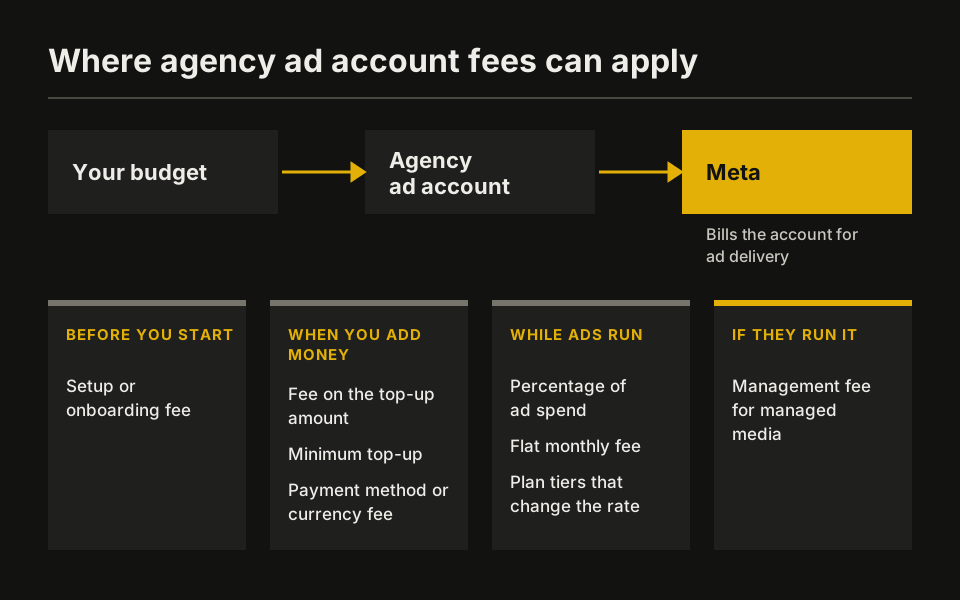
An agency ad account price depends on the provider’s fee model, not on Meta. Meta bills the ad account for ad delivery. The provider charges on top: usually a share of ad spend, sometimes a share of each top-up, a flat monthly fee, or a management fee for managed media. Setup fees, top-up minimums and payment fees add to it.
We built our Meta agency accounts in GLP-1 telehealth, one of Meta’s most heavily reviewed niches, and we rent them and run them for advertisers in other niches too. This guide explains each fee model in plain words so you can compare offers on the same basis. It names no providers and quotes no rates. The models come from the public rate cards we reviewed on November 5, 2026, and the Meta billing facts from Meta’s help center on the same day.
What you pay Meta and what you pay the provider
On an agency ad account, two parties charge you. Meta charges for the ads. Meta says “Usually, you’re charged based on the number of impressions your ad receives unless specified otherwise during ad creation.” The provider charges for access to its account, for running it, or both.
Meta’s own billing rules still apply inside an agency account:
- Automatic billing. Meta charges when costs reach a payment threshold, which starts “to a small amount” ($25 in Meta’s example) and may rise as payments go through.
- Available funds (prepaid). Money is added to the account first, and Meta deducts from it “up to once a day.” Meta sets a “daily top up limit” and a “stored balance limit” on how much can be added.
- Separate accounts per advertiser. Meta’s Advertising Standards expect each advertiser or client to run through its own ad account, and Meta’s Self-Serve Ad Terms cover placing ads “on someone else’s behalf.”
The provider’s fee sits on top of what Meta bills. When you compare offers, ask how the provider’s fee relates to the Meta charges: is it calculated on what Meta billed, or on what you sent in?
The fee models agency ad account providers use
Five models came up again and again in the public rate cards we reviewed. Most offers combine two or more.
| Fee model | What it’s charged on | What to check |
|---|---|---|
| Percentage of ad spend | What Meta actually billed the account | Whether the rate changes with daily spend |
| Percentage of top-up | The amount you add, before it is spent | What happens to money you add but don’t spend |
| Flat monthly fee or plan tier | A fixed amount per month, sometimes lowering the percentage | Caps on accounts or spend inside each plan |
| Setup or onboarding fee | Once, at the start | Whether it is refundable |
| Management fee (managed media) | The work of running campaigns | What the team does each week and how it reports |
Percentage of ad spend
The most common model: the provider takes a share of what the account spends. The cost grows with spend, and you pay nothing on money that never ran. Ask whether “spend” means Meta’s billed amount, and whether the rate steps down at higher daily spend.
Percentage of top-up
Some providers charge on the amount you add to the account, before Meta spends it. On paper the rate can look the same as a share of spend. The difference shows up when you add more than you spend in a period. Ask what happens to unspent funds and whether the fee is charged again when they roll over.
Flat monthly fee or plan tiers
A fixed monthly price, either alone or as a plan that lowers the percentage on spend. Flat fees suit teams with steady, high spend. Plans can also carry their own caps on the number of accounts or the spend allowed, so read the plan terms as well as the price.
Setup fees, top-up minimums and payment fees
These smaller items move the real cost. Some offers charge a one-time setup or onboarding fee. Many set a minimum amount per top-up. Some add a fee that depends on how you pay, or on currency conversion. Add all of them to the headline rate before you compare.
Management fee for managed media
When the provider’s team plans, builds and runs the campaigns, you pay for that work as well as for the account. Managed offers price higher than rental access because they include the media team’s time. Compare them with what an in-house buyer or a separate agency would cost you.
Rent or managed: what the fee covers
Renting an agency ad account and buying managed media are priced differently because you buy different things.
- Renting. Your own team runs an ad account dedicated to your business on the provider’s agency accounts. The fee pays for access to the account and the support around it.
- Managed media. The provider’s team runs the campaigns. The fee covers the account and the team’s work: structure, creative, launches, scaling and reporting.
A business with a strong in-house media buyer usually compares rental offers. A business without one compares managed offers against hiring. If you’re unsure which you need, our guide to agency ad accounts explains what an agency account changes and what it doesn’t.
How to compare two agency ad account offers
Put both offers into the same terms before you look at the rate:
- Write down every fee: setup, the percentage or flat fee, top-up minimums, payment fees and any management fee.
- Note what each percentage is charged on: billed spend or money added.
- Estimate one month at your real daily spend under each offer, including the fixed fees.
- Ask what happens to unspent funds if you stop or move.
- Get the terms in writing, including which niches the provider accepts under Meta’s rules.
Be wary of offers that promise what no Meta page supports, such as accounts that can’t be restricted or limits that never apply. Meta sets daily spending limits on most accounts from their history; our guide to the Facebook ad account spending limit explains how they work.
FAQ
Does Meta charge for an agency ad account? Meta bills the ad account for the ads it delivers. The fee for using an agency account comes from the provider, not from Meta.
Is a percentage fee better than a flat fee? It depends on your spend. A percentage costs less while spend is low and grows with it. A flat fee costs the same each month, so it suits steady, high spend.
Why do some providers charge on top-ups instead of spend? It is a different basis for the same kind of fee. It matters when you add more money than you spend, so ask how unspent funds are handled.
What does GLP1.partners charge? We price by niche and daily spend, and there is no setup fee. Tell us both and we come back with terms.
Sources
- Meta Business Help Center, How Meta charges for ads (charged mostly by impressions; automatic billing vs available funds; limits on adding funds) · accessed
- Meta Business Help Center, How budgets, spending limits, prepaid balance limits and your payment threshold differ (daily top up limit; stored balance limit; threshold does not pause ads) · accessed
- Meta Business Help Center, About payment thresholds for Meta ads (small starting threshold, $25 example) · accessed
- Meta Transparency Center, Introduction to the Advertising Standards (each advertiser or client managed through separate ad accounts) · accessed
- Meta, Self-Serve Ad Terms (Effective Date: August 22, 2025; placing ads on someone else's behalf) · accessed