The best CPA offers are the ones your traffic can convert on and the advertiser will approve. Judge every offer on three things: the payout, the conversion event that triggers it, and the share of conversions that survive review. US GLP-1 telehealth offers score high on payout per sale, and they suit content, comparison and influencer traffic best.
Most “best CPA offers” lists rank offers by headline payout or by network. That tells you little about what an offer will pay on your traffic. This guide gives you a test that works on any CPA offer, in any vertical, and runs it on GLP-1 telehealth offers from published US brand terms (checked November 2, 2026).
What makes a CPA offer the best one for you
A CPA offer is worth what it earns per click on your traffic, and that number has three parts: payout, conversion rate on the payout event, and approval share. Earnings per click (EPC) is the product of the three. A high payout with a hard event or heavy reversals can earn less than a modest payout that fires early and sticks.
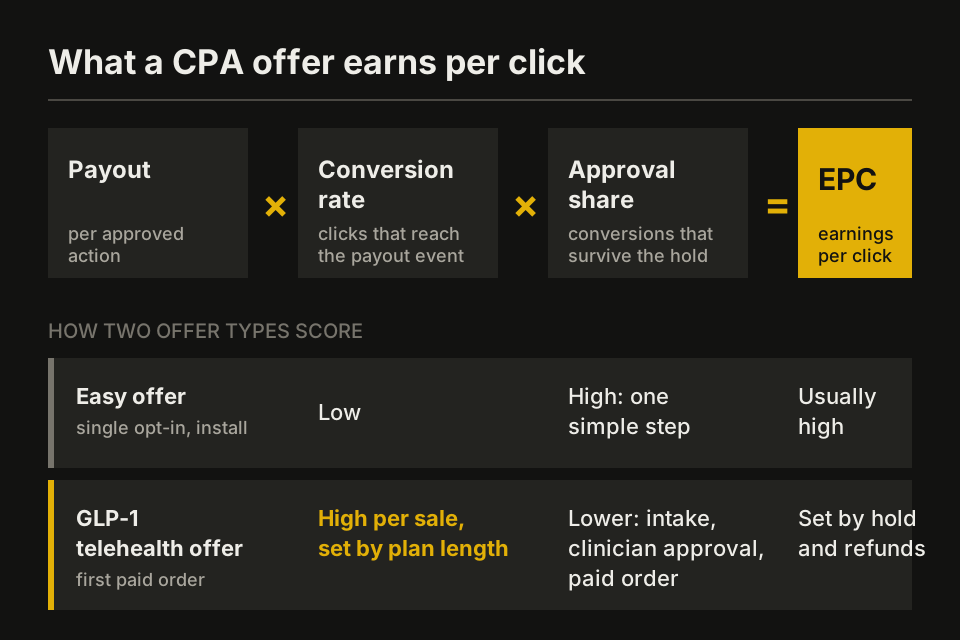
The three levers in practice:
- Payout. The amount per approved action. Check which orders it applies to, because rate cards often pay different amounts by plan, product or order type.
- Conversion event. What the visitor has to do: an email submit, a lead form, a free trial with a card, a sale. The harder the event, the fewer clicks reach it.
- Approval share. How many conversions survive the advertiser’s review, the hold period and refunds. A conversion that’s reversed in the hold pays nothing.
Network EPC figures help, but they come from other affiliates’ traffic. Your own EPC on a test budget is the number that counts.
CPA offer types by conversion event
CPA offers fall into types by the action that triggers the payout, and the type decides which traffic can work it. Low-friction events convert cold traffic. High-friction events need visitors who already want the product.
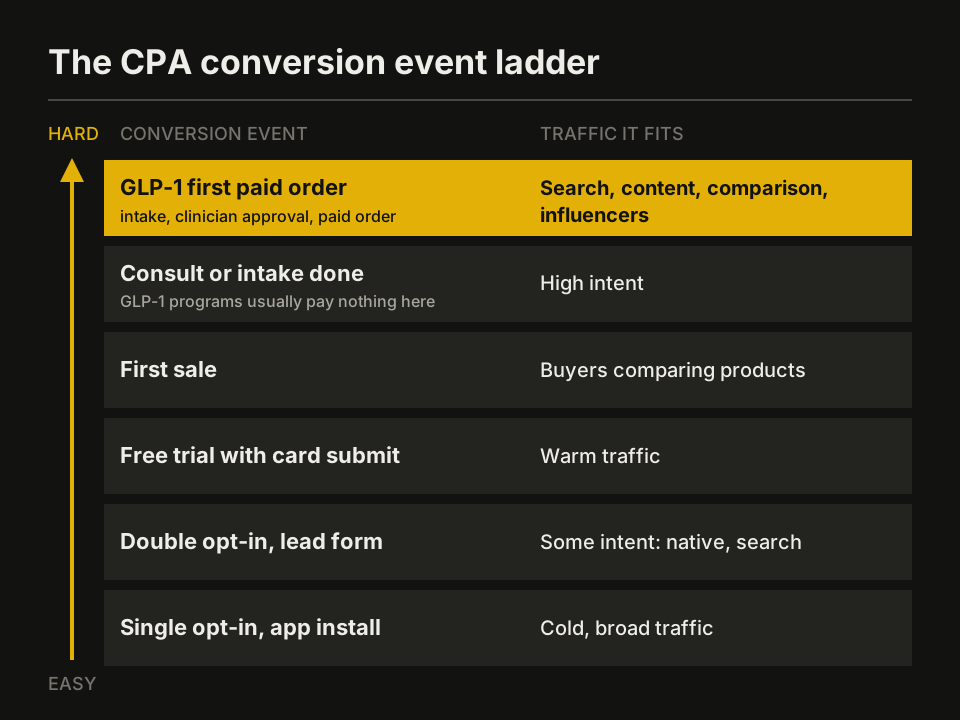
| Offer type | Conversion event | Traffic it usually fits | What to check |
|---|---|---|---|
| Single opt-in (SOI) | Email or phone submit | Broad, cold traffic | Lead quality rules, duplicate rejection |
| Double opt-in (DOI) | Submit plus confirmation | Some intent | Confirmation rate |
| App install or engagement | Install, or an in-app action | Mobile traffic | Device and OS limits, fraud checks |
| Lead (CPL) | Qualified form or call | Search, native, content | What “qualified” means, consent rules |
| Trial or card submit | Card entered for a trial | Warm traffic | Chargebacks, rebill rules |
| Sale (CPS) | A paid order | Buyers comparing products | Hold, refunds, excluded orders |
| Telehealth first paid order | Intake, clinician approval, paid order | Search, content, comparison, influencers | Payout event wording, hold, lock trigger |
How telehealth CPA listings on networks define their conversion event, step by step, is covered in telehealth CPA offers.
Why US GLP-1 telehealth offers rank high among CPA offers
US GLP-1 telehealth offers rank high on payout per action because they pay on a sale of a prescription program, often a multi-month plan. Demand is large. KFF’s poll published November 14, 2025 found that 18% of US adults had ever taken a GLP-1 drug and 12% were taking one, “an increase of 6 percentage points from May 2024.” Among adults who had taken one, 17% got it “from an online provider or website,” the channel telehealth brands sell through.
Published rate cards show the size and the spread. HealthRX’s card (checked November 2, 2026) pays a flat CPA on a new customer’s first order, set per product and per plan length. On a 12-month plan it lists $540 for tirzepatide and $325 for semaglutide. On a 3-month plan the same products pay $165 and $115. The card adds: “Monthly plans do not commission.”
That’s the first lesson for picking a GLP-1 CPA offer. The headline rate applies to some orders only, and plan mix decides the average payout you’ll see. The full set of public rate cards is in GLP-1 affiliate commissions, and how GLP-1 compares with finance, iGaming and nutra is in highest-paying affiliate niches.
GLP-1 offers come in a few shapes:
- Subscription plans billed monthly or prepaid for 3, 6 or 12 months. Longer plans pay more on tiered cards.
- Consult-first offers, where the payout fires only if an order follows the clinician’s review.
- Branded or compounded programs. Compounded offers carry more claim risk, covered below.
Reading a GLP-1 CPA offer: the terms that change its value
A GLP-1 CPA offer’s value sits in its terms: the exact payout event, the attribution window, the lock trigger and what claws a payout back. Good Girl Rx’s public page (checked November 2, 2026) is a clear example of each:
| Term | What Good Girl Rx says | What it does to the offer’s value |
|---|---|---|
| Payout event | “a first paid, doctor-approved order placed by a new customer through your unique link” | Only paid, approved orders count |
| Excluded events | “never on quiz starts, sign-ups, or approvals alone” | Lead-stage activity earns nothing |
| Attribution | “Your unique link tracks clicks for 14 days” and orders from paid ads “are attributed to those ads, not the link” | Slow deciders past day 14 are lost |
| Lock | “after the customer’s first refill ships or 45 days, whichever comes first” | Cash comes later than the sale |
| Clawback | “Refunds or cancellations in that window claw back” | Approval share drops with refunds |
| Payment | “paid monthly after the month closes, net-30, with a $50 minimum that rolls forward” | Float you carry before you’re paid |
The same page pays a lower flat rate on tirzepatide referrals ($75) than its standard per-referral rate ($150). Two GLP-1 offers with similar headlines can pay very differently once plan, product and lock rules apply. The click-to-payout stages are walked through in how GLP-1 affiliate programs work.
How CPA payouts work across the industry, in general:
- Flat CPA: a fixed amount per defined event. Most GLP-1 cards use it, often tiered by plan length.
- Tiered CPA: the rate rises with volume. Good Girl Rx lists Silver at 10+ referrals a quarter and Gold at 25+.
- CPL: pays on a qualified lead. Rare on GLP-1 cards.
- Revenue share: a percentage of customer spend. Uncommon on GLP-1 cards.
- Hold and clawback: the payout sits in a review window before it locks.
Which traffic fits GLP-1 CPA offers
GLP-1 CPA offers fit traffic from people already researching providers: SEO and comparison content, creator and influencer posts, and email to your own list where the program allows it. Paid social and search are limited, partly because the platform certification belongs to the brand. Meta’s policy says: “Meta requires online pharmacies and telehealth providers to be actively certified with LegitScript.”
| Traffic source | GLP-1 CPA offers | Reason |
|---|---|---|
| SEO, content, comparison pages | Allowed | Visitors are comparing providers |
| Influencer and creator posts | Allowed with conditions | Disclosure next to the link, brand-approved claims; Good Girl Rx asks partners to “Send drafts to us for a quick review” |
| Email to your own list | Ask first | Get the program’s email rules in writing |
| Coupon and deal sites | Varies by program | Some programs accept them and some ban them; get the rule in writing |
| Paid Meta or Google from your own account | Not allowed at HealthRX; ask each program | HealthRX: “Never on Google or Meta for prescription products from your own ad accounts, and never as TikTok branded content.” |
| Brand and drug-name bidding | Not allowed | HealthRX: “No bidding on HealthRX.com brand terms, no lookalike domains, no brand-plus-coupon keywords. Ever.” |
| Push and pop | Poor fit | Cold traffic rarely completes an intake and a clinician review |
If your traffic is push, pop or cold mobile, an SOI or install offer is the better CPA offer for you. If it’s search or content intent from US readers, GLP-1 is where the payout per sale is highest.
Rules that come with GLP-1 CPA offers
GLP-1 CPA offers come with claim and disclosure rules on top of the brand’s traffic rules, because the product is a prescription program. The rules most programs expect:
- Disclose next to the link. The FTC says “‘Paid link’ right next to an affiliate link should be an adequate disclosure,” and warns that “Consumers might not understand that ‘affiliate link’ means” the poster gets paid.
- No sameness claims on compounded drugs. FDA warned 30 telehealth companies on March 3, 2026 over “claims implying sameness with FDA-approved products.”
- No outcome promises. Keep weight-loss result claims and before-and-after images out of your creative.
- Brand-approved creative. Send drafts for review where the program asks.
- No self-referrals. HealthRX: “Orders placed through your own links are not commissionable.”
An offer whose rules your traffic can’t follow isn’t the best offer for you, whatever it pays. Breaking a traffic rule is a common reason for reversed conversions.
A checklist before you run any CPA offer
Run these 8 checks on every CPA offer before you send paid traffic. They work for SOI offers and GLP-1 offers alike.
- Write down the payout event in the advertiser’s own words.
- List the excluded orders or leads (plans, products, coupon orders, duplicates).
- Confirm your traffic source is allowed, in writing.
- Note the attribution window and whether the advertiser’s own ads override your link.
- Note the hold, the lock trigger and what reverses a conversion.
- Note the payment cycle, net terms and minimum.
- Check the geo, including which US states a telehealth brand serves.
- Test with a small budget and track your own EPC and approval share before you scale.
When you’re comparing two GLP-1 offers, ask each one for the same eight answers. Then compare your own EPC after approvals. If you already run a GLP-1 offer, send us your current GLP-1 payout and we’ll beat it.
FAQ
What are CPA offers?
CPA offers pay an affiliate a fixed amount when a visitor completes a defined action, such as an email submit, a lead form, a trial or a sale. The advertiser sets the action, the payout and the traffic rules. GLP-1 telehealth CPA offers usually pay on a new customer’s first paid order.
Should I promote high-payout or high-volume offers?
Promote the offer with the higher EPC on your own traffic after approvals. High-payout offers such as GLP-1 telehealth suit high-intent US traffic. High-volume, low-friction offers suit cold traffic. Test both on a small budget if your traffic sits in between.
Do I need the advertiser’s permission for my traffic source?
Yes. Most programs list allowed and banned sources, and GLP-1 programs add rules on paid social, brand bidding and coupons. Using a banned source can get conversions reversed. Get your traffic sources approved in writing before you spend.
Are GLP-1 CPA offers good for beginners?
GLP-1 CPA offers suit beginners who have US content, comparison or influencer traffic and can follow claim rules. They’re a poor fit for beginners planning cold push or pop traffic, or paid social from their own ad account on a program that bans it.
Sources
- HealthRX, Affiliates (published rate card, payout event, traffic rules) · accessed
- Good Girl Rx, Affiliate Program (payout event, 14-day link, lock and clawback, payment terms) · accessed
- KFF Health Tracking Poll: Prescription Drug Costs, Views on Trump Administration Actions, and GLP-1 Use (November 14, 2025; fielded October 27 to November 2, 2025) · accessed
- Meta Transparency Center, Drugs and pharmaceuticals · accessed
- FTC, FTC's Endorsement Guides: What People Are Asking · accessed
- FDA, FDA warns 30 telehealth companies against illegal marketing of compounded GLP-1s (March 3, 2026) · accessed