Telehealth CPA offers pay a fixed amount when a visitor you send reaches one event the listing defines: a lead submit, a completed consult or a paid purchase. Many of them are GLP-1 weight-loss offers. Before you compare payouts, check three lines on the listing: the conversion event, what gets reversed, and which traffic is allowed.
This guide works from CPA network listings, the way a media buyer sees them, rather than from brand program pages. We read six GLP-1 and telehealth offers on November 2, 2026. Four stated their conversion event in words (one only in a network blog post), and two left it blank. One of the four carried a label in its name that its own pixel rule contradicts. For how brand-run GLP-1 programs set their terms, see how GLP-1 affiliate programs work.
What a telehealth CPA offer pays on
A telehealth CPA offer pays on one step of the brand’s funnel, and that step can sit anywhere from the intake form to the first paid order. The step decides how many of your visitors count, so it matters more than the payout line.
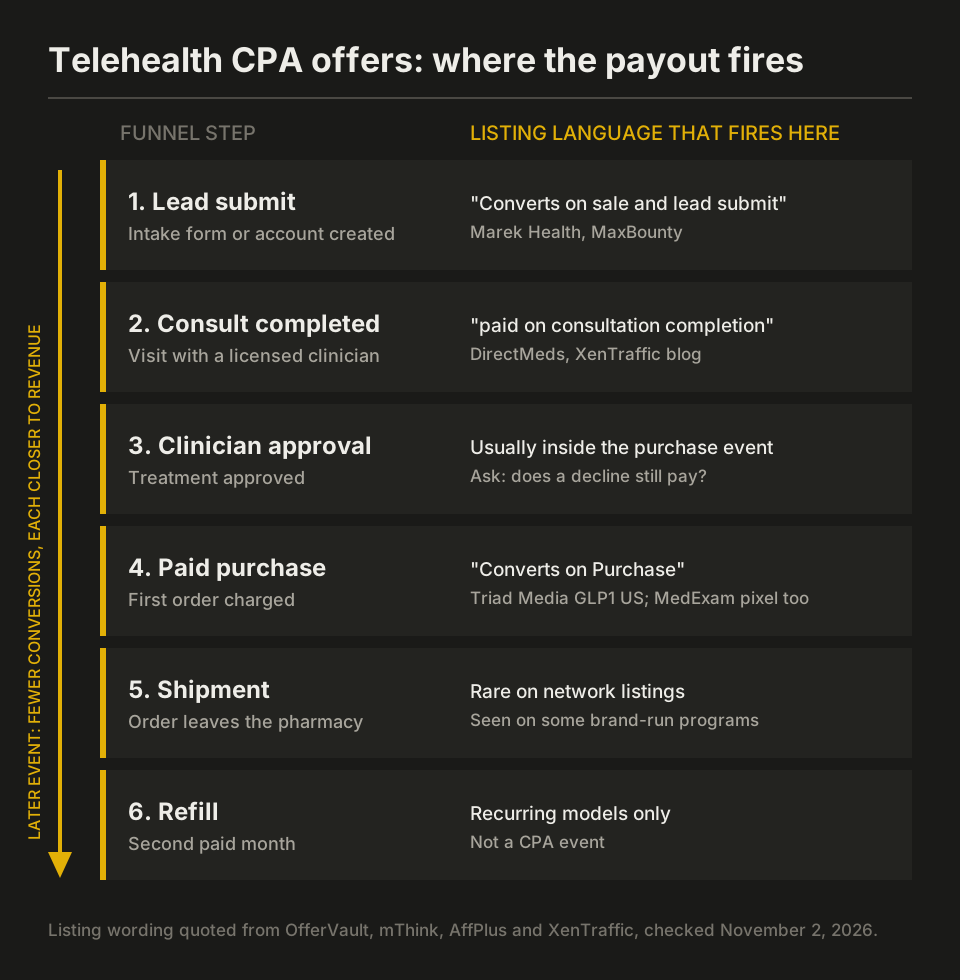
Here is what each listing says, in its own words:
| Listing (network) | Vertical | Conversion event, as written | Our note |
|---|---|---|---|
| GLP1 - US (Triad Media) | GLP-1 weight loss | “Converts on Purchase” | The clearest event of the six |
| Marek Health, Premier Telehealth - CPA (MaxBounty) | GLP-1 and TRT | “Converts on sale and lead submit.” | Ask which of the two events pays, and whether both can fire |
| DirectMeds GLP-1 (XenTraffic blog) | GLP-1 weight loss | “paid on consultation completion” | Stated in a network blog post, not on a listing |
| DirectMeds GLP1 SS - US (No PPC) (SmashLoud) | GLP-1 weight loss | Not stated | Same brand as the row above; get the event from this network in writing |
| Sesame Care, Telehealth for UTI - CPL (MaxBounty) | Urgent care | Not stated; “CPL” in the name only | A per-lead offer outside weight loss |
| Prescription Weight Loss - MedExam (US) (CPL) (AdsMain) | Weight loss Rx | “Pixel will fire when customer purchases the product” | Named CPL, pays on purchase; listing now expired |
The MedExam row is the lesson. The offer name said “CPL”, while the tracking rule said purchase. When the two disagree, the pixel rule is what you get paid on.
A lead or consult event fires early, so more of your traffic counts, and brands set a lower payout for it. A purchase event fires after the clinician has approved treatment and the card was charged, so fewer visitors reach it. Your test budget should match the event: a purchase-event GLP-1 offer needs more spend before the data tells you anything.
How to read a telehealth CPA offer listing
A telehealth CPA offer listing has five lines that decide whether you can run it: the event, the geo, the traffic list, the restrictions and the approval type. Read them in that order and write down anything the listing leaves blank.
| Listing line | What to look for | Real example (checked November 2, 2026) |
|---|---|---|
| Event | The exact action that fires the pixel | “Converts on Purchase” (Triad Media) |
| Geo | US, and any excluded states | XenTraffic notes that “some exclude high-regulation states (Mississippi, Louisiana)” |
| Allowed traffic | Each source spelled out | Triad Media allows Email, Display, SMS, Social, Native |
| Restrictions | Banned sources and banned creative | SmashLoud’s DirectMeds listing: “No PPC, No Incent, No Survey, No Celebrity Pages” |
| Approval | Open, by application or personal approval | MedExam was listed as “Personal Approval” |
Blank lines are common. The Sesame Care listing showed no conversion definition and no traffic rules, and the SmashLoud DirectMeds listing listed only what is banned. A blank line means you ask the affiliate manager and keep the answer in writing before you spend.
Telehealth CPA offer types: GLP-1, other Rx and weight loss supplements
Telehealth CPA offers fall into three groups, and the group changes the event, the creative rules and who buys the product. Weight loss CPA offers in particular mix prescription telehealth with supplements that borrow the GLP-1 name.
- GLP-1 telehealth offers. A US visitor signs up, sees a licensed clinician, and pays for a prescription plan if approved. These carry the strictest creative rules. The SmashLoud DirectMeds listing bans “ANY branded drug names (Ozempic, Wegovy, Mounjaro, Zepbound, etc.)” and any “portrayal or reference to doctors, nurses, or medical professionals.”
- Other telehealth Rx verticals. TRT, urgent care, hair loss and sexual health run on the same funnel. Marek Health’s listing covers GLP-1s and TRT in one offer. Sesame Care’s UTI offer pays per lead.
- Weight loss supplements. Nutra products sold without a prescription, often with “GLP-1” in the product name. They are a different product with a different buyer. Some GLP-1 telehealth offers forbid mixing the two: the SmashLoud DirectMeds listing says “Do NOT promote supplements (no longer offered).” For the full comparison, see nutra vs telehealth affiliate offers.
Demand for the telehealth group keeps growing on the brand side. LegitScript reported on September 22, 2026 “a 59% increase in certification applications overall” over the past year “and a 101% increase in telemedicine applications specifically.”
Why telehealth CPA conversions get scrubbed
A scrub is a conversion the network or brand reverses after it fired, so it never gets paid. In telehealth CPA offers, scrubs come from traffic quality, banned sources, state rules and refunds.
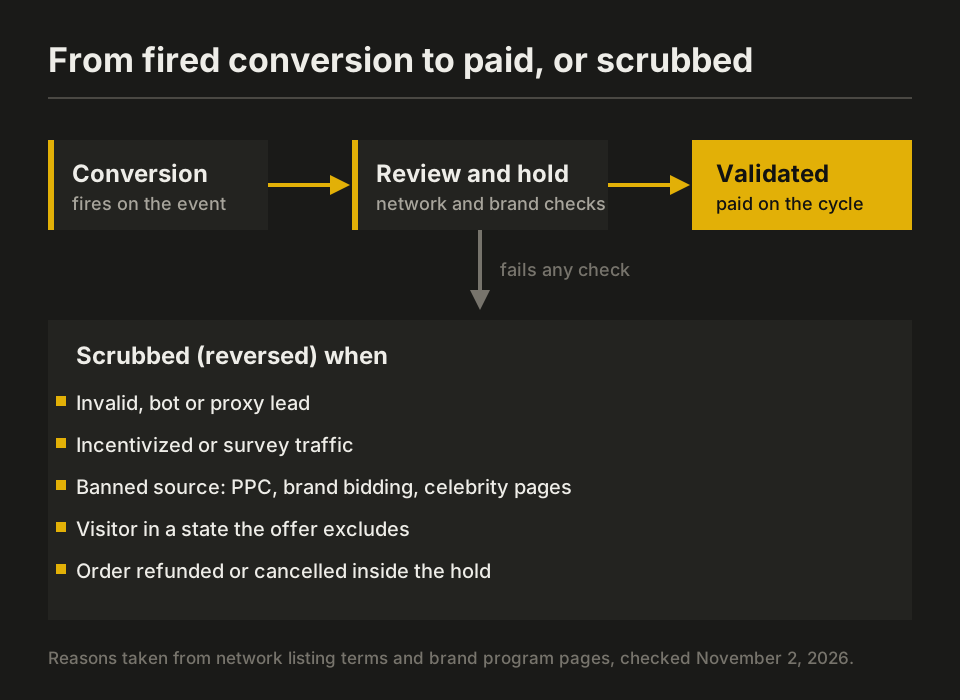
| Scrub reason | Where it is written | How to prevent it |
|---|---|---|
| Invalid, bot or proxy leads | Triad Media: “All invalid/bot/proxy leads will be reversed.” | Filter bots and proxies before the click reaches the lander |
| Incentivized or survey traffic | “No Incent” (Triad Media); “No Incent, No Survey” (SmashLoud) | Keep rewards and survey walls out of the path |
| Banned sources | “No PPC” (SmashLoud); “No incentive traffic or Brand Bidding is permitted.” (Marek Health) | Run only sources listed as allowed |
| Excluded states | XenTraffic on GLP-1 offers that exclude Mississippi and Louisiana | Geo-target to allowed states only |
| Refund or cancellation in the hold | Brand program terms; see GLP-1 affiliate commissions | Avoid creative that oversells; the SmashLoud listing also bans “money-back guarantee” language |
Purchase-event offers add one more drop-off before the pixel fires. A visitor who finishes the consult but isn’t prescribed never reaches the purchase, so the conversion never exists. Count that as part of your funnel, separate from scrubs.
Which traffic telehealth CPA offers allow
Telehealth CPA offers allow content, email, native and social traffic with conditions, and they mostly ban incentivized traffic, surveys and brand bidding. Paid search is offer by offer. The table below combines the listings above with the platform rules.
| Traffic type | Status | Why |
|---|---|---|
| SEO and comparison content | Allowed | Low risk when claims match the brand’s approved copy |
| Email to your own list | Allowed with conditions | Triad Media lists Email; MedExam lists Email |
| Native (advertorial landers) | Allowed with conditions | Triad Media lists Native; the creative bans still apply |
| Social and display | Allowed with conditions | Triad Media lists Social and Display; Meta’s rules for Rx ads apply to the advertiser |
| SMS | Allowed with conditions | Listed by Triad Media; needs consent you can prove |
| Paid search, generic terms | Varies | Banned outright on SmashLoud’s DirectMeds listing (“No PPC”) |
| Brand or drug-name bidding | Not allowed | Marek Health bans brand bidding; SmashLoud bans branded drug names |
| Incentivized, survey, offerwall | Not allowed | “No Incent” on both GLP-1 listings above |
| Coupon and deal sites | Varies by offer | Rules per program: coupon and deal sites in GLP-1 programs |
Paid social has an extra layer for telehealth. Meta says: “Meta requires online pharmacies and telehealth providers to be actively certified with LegitScript.” That certification belongs to the brand, so get written approval before you run any Rx ad from your own ad account.
Compliance rules for GLP-1 CPA traffic
GLP-1 CPA traffic has to follow three layers of rules: the FTC’s disclosure rules, the ad platform’s policy, and the creative bans on the listing. Breaking any one of them can scrub the conversion or get you removed from the offer.
- Disclose the paid link. The FTC says “‘Paid link’ right next to an affiliate link should be an adequate disclosure of the nature of the link.”
- Expect the brand to watch you. Per the FTC, “Advertisers need to have reasonable programs in place to train and monitor members of their network.”
- Use only approved claims. No promised weight loss, no promise of a prescription, no “same as” a branded drug. SmashLoud’s DirectMeds listing bans “ANY claim that our product is ‘the same as’ a branded drug.”
- Keep creative clean. No branded pens or packaging, no dramatic before and after images, no fake doctors.
- Tell the truth on lead forms. On August 7, 2025, the FTC described a health insurance lead generation case in which “MediaAlpha will pay $45 million,” and drew the lesson: “Lead generators should tell the truth when they collect consumers’ information.” The same applies to any CPL telehealth offer.
How CPA payouts work in telehealth
In the telehealth industry, a CPA offer pays one fixed amount per conversion, set by the event and sometimes by plan length or product. A CPL is the same model with a lead as the event. Rev-share and recurring models pay on order value or active months instead. Any of them can be scrubbed during the hold.
Compare two telehealth CPA offers on expected value per click, never on the headline payout. A higher payout on a purchase event can earn less than a lower payout on a consult event if your traffic rarely reaches the purchase. Run a small test on each, wait out the hold, and compare what was validated.
In the GLP1.partners program, a conversion is a sale, and payments run weekly or monthly depending on the deal. Our offers are GLP-1, mainly weight loss. See the GLP1.partners affiliate program.
FAQ
What is a CPA offer in telehealth?
A telehealth CPA offer is an affiliate offer that pays a fixed amount when a visitor you send completes a defined action with a telehealth brand, such as a lead submit, a completed consult or a first paid order. Many of them today are GLP-1 weight-loss offers.
Are GLP-1 CPA offers the same as weight loss CPA offers?
Not always. “Weight loss CPA offers” covers both prescription telehealth offers and supplements sold without a prescription. A supplement with “GLP-1” in its name is not a GLP-1 medication, and some GLP-1 listings ban affiliates from promoting supplements alongside them.
Why was my telehealth CPA conversion reversed?
The usual reasons are invalid or bot traffic, incentivized or survey traffic, a banned source such as PPC or brand bidding, a visitor in an excluded state, or a refund inside the hold. Ask the network for the reversal reason in writing, then fix that source.
Sources
- OfferVault, Triad Media: GLP1 - US (listing updated Nov 01, 2026) · accessed
- OfferVault, SmashLoud: DirectMeds GLP1 SS - US (No PPC) (listing updated Nov 01, 2026) · accessed
- OfferVault, MaxBounty: Sesame Care - Telehealth for UTI - CPL (US) (listing updated Nov 01, 2026) · accessed
- mThink, MaxBounty: Marek Health - Guided Optimization and Premier Telehealth - CPA (US) · accessed
- AffPlus, AdsMain: Prescription Weight Loss - MedExam (US) (CPL) (Personal Approval) (expired; created 2024/02/02) · accessed
- XenTraffic, Best GLP-1 Affiliate Offers in 2026 (DirectMeds conversion event, state exclusions) · accessed
- LegitScript, Certification Applications Rise 59%, Led by 101% Growth in Telemedicine (September 22, 2026) · accessed
- Meta Transparency Center, Drugs and pharmaceuticals · accessed
- FTC, FTC's Endorsement Guides: What People Are Asking · accessed
- FTC Business Blog, If you're deceiving consumers, the FTC means business: exploring the recent settlement with MediaAlpha (August 7, 2025) · accessed