High ticket health affiliate programs sell something the customer pays a lot for, either at once or over months. In health that means three shapes: one large order (hearing aids, fitness equipment), a prepaid multi-month plan, or a monthly refill. GLP-1 telehealth weight loss offers combine the last two, which is why they sit near the top on customer value.
We read the top results for this search on November 2, 2026. Most of them list supplements, CBD, skincare and fitness brands. This page sorts health offers by what the customer pays and how long they keep paying, with prices from the sellers’ own pages.
What makes a health affiliate offer high ticket
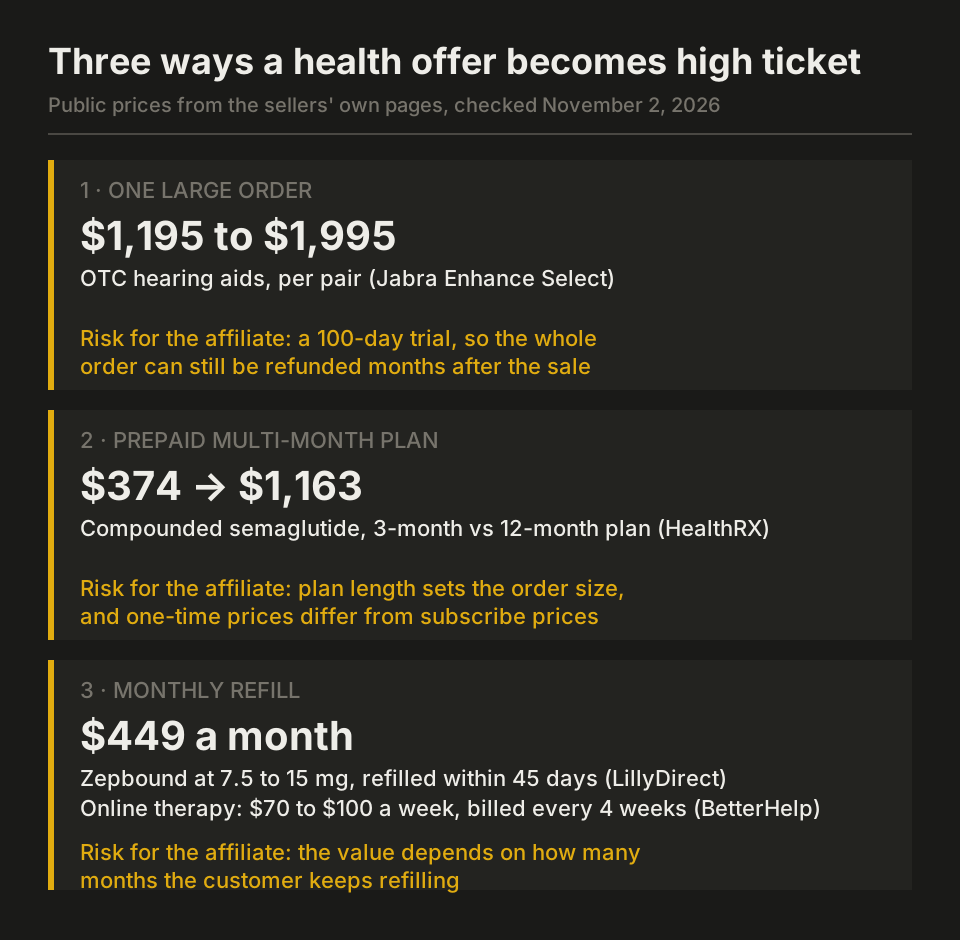
A health affiliate offer is high ticket when the customer’s total spend with the brand is large, because a bigger customer spend leaves the brand more room to pay for each sale. The spend can come from one big purchase or from many smaller ones, and the shape changes what can go wrong after the sale.
| Ticket shape | Public example (checked November 2, 2026) | What it means for the affiliate |
|---|---|---|
| One large order | Jabra Enhance Select OTC hearing aids: $1,195, $1,695 or $1,995 a pair. Peloton Bike: $1,445 | The value is known at checkout. Jabra’s 100-day trial refunds the whole order, so a sale can reverse months later |
| Prepaid multi-month plan | HealthRX compounded semaglutide: $165 monthly, $374 for 3 months, $1,163 for 12 months (Subscribe & Save) | The plan the visitor picks sets the order size. Longer plans mean bigger first orders |
| Monthly refill | Zepbound on LillyDirect from $449 a month at 7.5 to 15 mg. BetterHelp: “$70 to $100 per week,” billed every four weeks | Each month is small next to a device. The total depends on how many months the customer stays |
Hearing aids are a clean example of the first shape. FDA says “Adults 18 years of age and older can buy hearing aids for themselves OTC,” with no prescription or audiologist fitting needed for perceived mild to moderate hearing loss. Online therapy is the clearest monthly subscription outside prescription care.
How GLP1.partners works with affiliates on high ticket GLP-1 offers
GLP1.partners runs US GLP-1 telehealth weight loss offers from the brands we work with, and pays affiliates on those offers. The terms below are the ones we publish:
- The conversion is a sale. If the offer you run today pays on a different event, such as a sign-up or a booked consult, tell us when you send it.
- Payment is weekly or monthly, depending on the deal you agree with your manager.
- Send us your current GLP-1 payout. We’ll beat it. Your manager puts your offer next to a comparable US GLP-1 offer from one of our brands and comes back with a higher payout. How the match works is on our payout match page.
- Traffic we take includes paid social on Meta with brand-approved creative, generic search, native, opt-in email and coupon sites. We don’t accept push or pop traffic.
- Your manager agrees the payout, schedule and rules with you in writing, one deal at a time, before you send traffic.
High ticket health offers by category, with public prices
The high ticket health categories with public prices are GLP-1 telehealth, online therapy, OTC hearing aids and fitness equipment. Every price below is from the seller’s own page.
| Category | Seller (public page) | Price as listed | Ticket shape |
|---|---|---|---|
| GLP-1 telehealth, branded self-pay | LillyDirect (Zepbound) | From $449 a month at 7.5 to 15 mg when refilled within 45 days | Monthly refill |
| GLP-1 telehealth, branded self-pay | NovoCare (Wegovy pen) | $199 for each of the first 2 fills for new patients through December 31, 2026, “then $349 per month” | Monthly refill |
| GLP-1 telehealth, branded self-pay | NovoCare (Wegovy pill) | $149 a month for 1.5 mg, $199 for 4 mg, $299 for 9 mg and 25 mg | Monthly refill |
| GLP-1 telehealth, compounded | HealthRX (semaglutide) | $1,163 for 12 months on Subscribe & Save, $1,188 one-time | Prepaid plan |
| GLP-1 telehealth, compounded | HealthRX (tirzepatide) | $2,123 for 12 months on Subscribe & Save | Prepaid plan |
| Online therapy | BetterHelp | $70 to $100 a week, billed every four weeks | Monthly refill |
| OTC hearing aids | Jabra Enhance Select | $1,195 to $1,995 a pair | One large order |
| Fitness equipment | Peloton Bike | $1,445 | One large order |
Public telehealth companies report what a subscriber is worth each month. Hims & Hers reported on August 10, 2026 that it had nearly 2.9 million subscribers at the end of Q2 2026, with monthly revenue per average subscriber of $92, up 21% from $76 a year earlier. That figure covers all of its categories, not only weight loss.
Why refills make GLP-1 telehealth a high ticket health offer
GLP-1 telehealth is a high ticket health offer because the customer pays every month for as long as treatment continues, on top of a first order that is often a multi-month plan. Manufacturers price for refills too. Lilly’s LillyDirect page says: “Regular prices will apply if prescription is not refilled within 45 days ($499 for 7.5mg, $699 for 10mg, $699 for 12.5mg, and $699 for 15mg).”
The demand behind those refills is large, and many users pay out of pocket:
- 12% of US adults said they were currently taking a GLP-1 drug in KFF’s poll published November 14, 2025, and 18% had ever taken one.
- 17% of users got the drug “from an online provider or website,” the channel telehealth affiliates send traffic to.
- 56% of users said the drugs were difficult to afford, and 27% had insurance but paid the full cost themselves.
How long customers stay decides what each one is worth. Prime Therapeutics, a pharmacy solutions company, reported on June 25, 2025 that among commercially insured adults with obesity and without diabetes, 33% of people who started a GLP-1 in 2021 were still on it after one year. For people who started in the first quarter of 2024, that rose to 63%. Over three years, “Only 8% of individuals (or 1 in 12)” stayed on treatment.
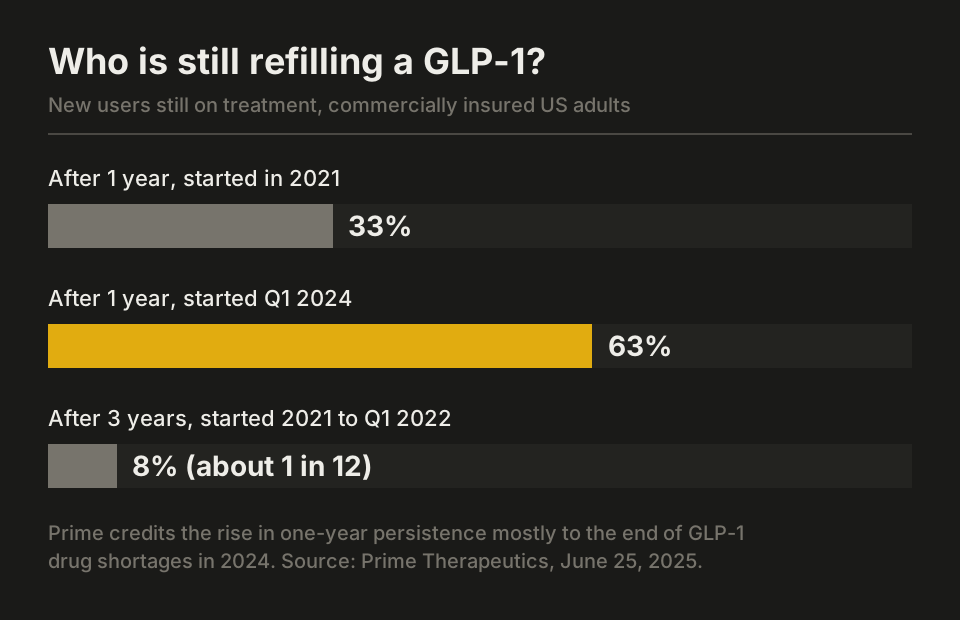
Prime’s data covers commercially insured patients, so it shows the general curve, not a telehealth brand’s own retention. For an affiliate, much of a GLP-1 customer’s value comes from the refills after the first order, so traffic that brings customers who keep refilling is worth more to the brand.
The GLP1.partners media team puts it this way: “The affiliates whose customers keep refilling are the ones who give customers all the information they need and make them want to stay with the brand.”
GLP-1 offer types affiliates can promote
GLP-1 telehealth offers come in a few types, and the type sets the order size and what you can say in your ads. No payout numbers here: published GLP-1 rates, brand by brand, are on our GLP-1 affiliate commissions page.
- Compounded GLP-1 subscription. A telehealth plan with compounded semaglutide or tirzepatide, sold monthly or as a prepaid 3, 6 or 12-month plan. The biggest first orders come from the long plans.
- Branded GLP-1 through telehealth. The brand’s clinicians prescribe Wegovy or Zepbound, and the patient fills it through a pharmacy or the manufacturer’s self-pay program. Some brands charge a membership on top.
- Consult or membership only. The brand sells the visit and ongoing care, and the medication is billed separately. The first order is smaller.
- Pill versions. NovoCare lists the Wegovy pill from $149 a month, so pill offers usually start at a lower monthly ticket than injections.
Weight loss offers outside prescription care (supplements, meal plans, coaching) are compared on our weight loss affiliate programs page.
How payouts work on high ticket health offers
High ticket health programs pay in one of four common ways. The model decides whether you get paid on the first order only or share in the refills.
| Payout model | How it works | Where you see it in health |
|---|---|---|
| Flat CPA per sale | One fixed amount when the first order is paid | Prescription telehealth, online therapy |
| Tiered CPA by plan | A higher amount for a longer prepaid plan | Compounded GLP-1 plans with 3, 6 and 12-month options |
| Revenue share | A percentage of the order | Devices, equipment, supplements |
| Recurring share | A percentage of each renewal | Some subscription and app programs |
Two terms matter more on high ticket offers than the headline rate:
- The hold. Some programs hold a commission until a refund window closes or a first refill ships. On a device with a 100-day trial, a sale can reverse months after checkout.
- The qualifying event. In prescription telehealth, a visitor fills an intake, a clinician decides, and only then is an order paid. Ask which of those steps triggers your payout.
Traffic that high ticket GLP-1 offers accept
High ticket GLP-1 offers accept most performance traffic, with conditions set by the platforms and the brand. Rules checked November 2, 2026.
| Traffic source | Status | Reason |
|---|---|---|
| Meta paid social | Allowed with conditions | Meta requires “telehealth providers to be actively certified with LegitScript,” ads to “Only target people 18 years or older” in the US, Canada or New Zealand, and brand-approved creative |
| Search (Google, Microsoft), generic terms | Allowed with conditions | Bidding on the brand’s name or “brand + coupon” needs the brand’s written OK |
| Native with a pre-lander | Allowed with conditions | The pre-lander has to use the brand’s approved claims |
| Email to your own opt-in list | Allowed | The list must be one you built, not bought or rented |
| Coupon and deal sites | Allowed | Use only the codes the brand gives you |
| Instagram influencer posts | Allowed with conditions | FTC disclosure in the post itself, and Meta’s branded content rules for health posts |
| TikTok creator branded content | Not allowed | TikTok’s Branded Content Policy prohibits “weight loss clinics” and “telehealth providers” |
| Incentivized, cashback, push or pop | Not accepted on GLP1.partners offers | They risk the brand’s offer and its ad accounts |
If you run coupon traffic, our guide to coupon sites on GLP-1 offers covers code rules and attribution.
Compliance rules for promoting high ticket health offers
Compliance rules on high ticket GLP-1 offers come from the FTC, FDA enforcement and the brand, because the product is a prescription service. These apply to every affiliate on a GLP-1 offer:
- Disclose the payment. The FTC tells affiliates: “You should disclose your relationship to the retailer clearly and conspicuously on your site.” It suggests wording such as “I get commissions for purchases made through links in this post.”
- Use the brand’s claims only. Weight loss results, drug comparisons and prices come from the brand’s approved copy.
- No before-and-after photos and no promised results.
- No drug-equivalence lines. “Same as Ozempic,” “generic Wegovy” or “FDA approved” for a compounded product repeat what FDA has cited in letters, listed in our guide to compounded GLP-1 claims the FDA flags.
- Describe visitors as people comparing providers, never as patients who qualify. A licensed clinician decides who gets a prescription.
- Keep health data out of tracking. Sub-IDs and URLs label traffic sources, never names, emails or health details.
Questions to ask before moving traffic to a high ticket health program
Ask these before you move volume, and get the answers in writing:
- What event triggers my payout: the intake, the clinician’s approval, or the first paid order?
- Does a longer prepaid plan pay more than a monthly plan?
- How long is the hold, and what reverses a commission (refund, chargeback, cancelled refill)?
- Do I earn anything on refills or renewals?
- Which states can the brand serve, and does traffic from other states pay?
- Which traffic sources are allowed, and what are the brand-bidding rules?
- When and how am I paid?
FAQ
What is a high ticket health affiliate program?
A high ticket health affiliate program promotes a health product or service with a large total customer spend, such as OTC hearing aids at $1,195 to $1,995 a pair or a 12-month GLP-1 telehealth plan at $1,163 (prices checked November 2, 2026). The spend can come from one order or from monthly refills.
What are the best high ticket health affiliate programs?
The best one is the program whose ticket shape and terms fit your traffic. On public prices, GLP-1 telehealth plans, online therapy subscriptions, OTC hearing aids and fitness equipment all carry large customer spend. GLP-1 adds refills on top of a large first order.
Do high ticket health affiliate programs pay recurring commissions?
Some do. Device and equipment programs usually pay once on the order. Subscription programs vary, and many prescription telehealth programs pay once per new customer, with longer plans paying more. Check each program’s terms.
Sources
- Lilly, LillyDirect: Zepbound (self-pay prices; refill within 45 days; regular prices if not refilled) · accessed
- Novo Nordisk, NovoCare Wegovy Savings Offer (pen $199 for 2 fills through December 31, 2026, then $349; pill $149 to $299) · accessed
- HealthRX, Pricing (prices current as of October 15, 2026) · accessed
- Hims & Hers Health, Form 8-K, Second Quarter 2026 Financial Results (August 10, 2026) · accessed
- Prime Therapeutics, Only 1 in 12 remain on a GLP-1 drug for obesity at three years (PR Newswire, June 25, 2025) · accessed
- KFF Health Tracking Poll: Prescription Drug Costs, Views on Trump Administration Actions, and GLP-1 Use (November 14, 2025) · accessed
- BetterHelp, How much does BetterHelp cost (updated October 22, 2026) · accessed
- Jabra Enhance, homepage (Enhance Select prices per pair, 100-day trial) · accessed
- FDA, How to Get Hearing Aids (OTC for adults 18 and older) · accessed
- Peloton, Peloton Bike (price) · accessed
- Meta Transparency Center, Drugs and pharmaceuticals · accessed
- TikTok, Branded Content Policy (effective October 30, 2026) · accessed
- FTC, FTC's Endorsement Guides: What People Are Asking · accessed