Health affiliate programs fall into five categories: GLP-1 and other prescription telehealth, non-prescription telehealth such as online therapy, supplements and health retail, fitness subscriptions, and devices. Telehealth programs pay a flat amount per new paying customer. Retail and supplement programs pay a percentage of each sale. Each category has its own ad and claim rules.
Most “best health affiliate programs” lists rank brands. This guide compares categories, because the category decides what you get paid on, how long you wait for it and which rules apply to your ads. Every rate below is quoted from the brand’s or network’s own page, checked on November 2, 2026 unless another date is given.
Health affiliate programs compared by category
Health affiliate programs differ by category on four things: the payout event, the payout model, who must hold a certification and the ad rule you hit first. The table uses published terms only; where a brand keeps its rates private, it says so.
| Category | You’re paid on | Published example (November 2, 2026) | Certification | First ad rule you hit |
|---|---|---|---|---|
| GLP-1 and prescription telehealth | A new customer’s first paid order after a clinician approves it | Good Girl Rx: $150 standard, $175 and $200 at volume tiers; HeliMeds: $70 to $100 by tier; OrderlyMeds: $75 one-time | The brand. Meta: “Meta requires online pharmacies and telehealth providers to be actively certified with LegitScript.” | No targeting under 18 for prescription drugs (Meta) |
| Non-prescription telehealth (online therapy) | A new member who joins | Online-Therapy.com: “Compensation starts at $150 per conversion,” 90-day cookie | Per platform and brand rules | Per platform health policy |
| Supplements and health retail | A percentage of the sale | Amazon Associates: 1.00% on Health & Personal Care; Supergut: “a minimum 10% commission” (checked October 30, 2026) | None for the affiliate or brand at the ad platform | Dietary and health supplements can’t target under 18 (Meta) |
| Fitness and wellness subscriptions | A qualifying subscription or sale | WeightWatchers: “a base commission of $10 for every qualifying subscription”; Amazon Associates: 3.00% on Sports | None | Weight loss offers target 18+ only (Meta) |
| Devices and wearables | A hardware sale, at a rate set inside the network | WHOOP on Sovrn Commerce: average commission “Varies,” full rate card after sign-up and approval | None | The platform’s rules for the product type |
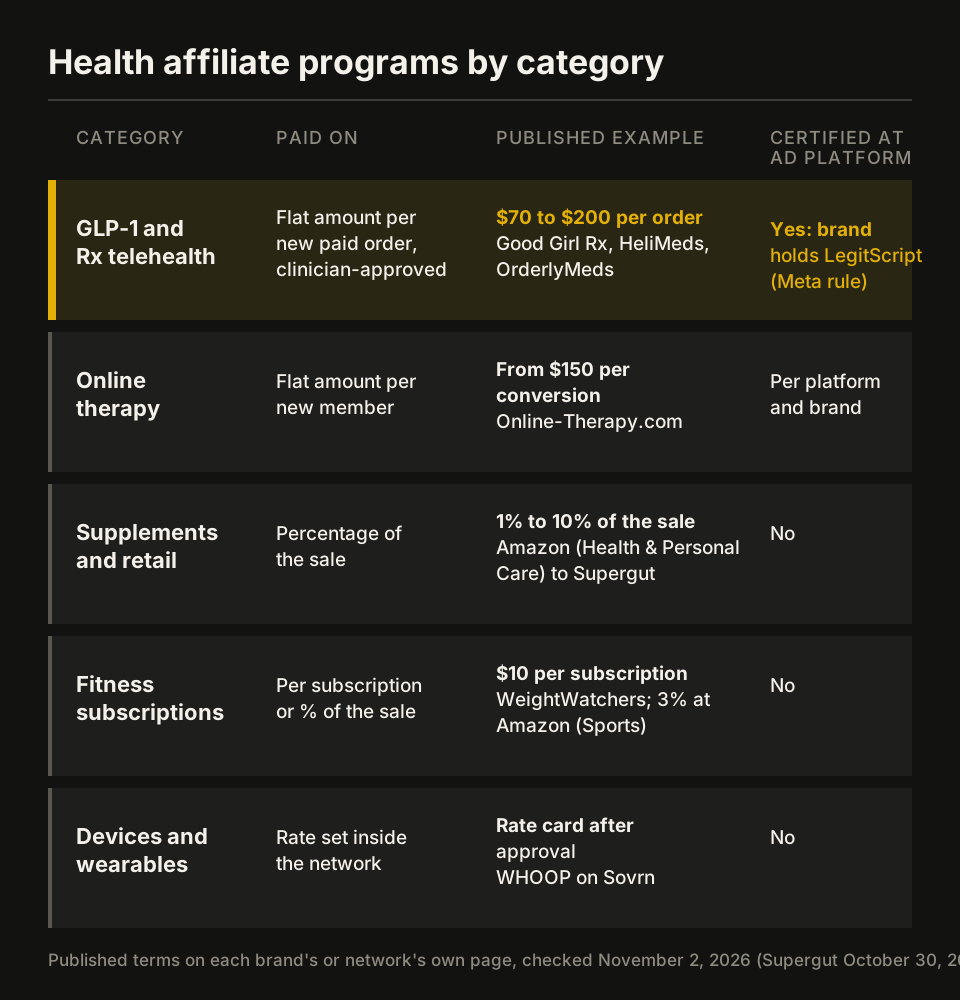
We read the top 5 Google results for “health affiliate programs” on November 2, 2026. None of the 5 mentioned GLP-1, LegitScript or FTC disclosure rules, and none compared categories on the payout event.
How health affiliate programs pay: flat CPA, revenue share and subscription bounties
Health affiliate programs use three payout models, and the category mostly decides which one you get. A flat CPA pays a fixed amount per new customer. Revenue share pays a percentage of each order. A subscription bounty pays a fixed amount when a subscription starts.
- Flat CPA per new customer. Used by GLP-1 telehealth and online therapy. Good Girl Rx describes a “single flat payout per new customer” and says it is “never a recurring percentage.” OrderlyMeds pays “a one-time payment of $75.”
- Revenue share. Used by retail and supplement brands. Amazon Associates pays 1.00% in Health & Personal Care and 3.00% in Sports. Supergut pays a minimum of 10%.
- Subscription bounty. Used by fitness and diet apps. WeightWatchers pays $10 per qualifying subscription through Impact, and its page doesn’t define which subscriptions qualify.
The gap per customer is easy to work out. A $150 flat CPA equals a 10% commission on a $1,500 order, or a 1% commission on a $15,000 order. HeliMeds’ own page lists tirzepatide at “$597 for your first 3-month order,” so the first order alone is large before any refill.
For the full click-to-payout cycle on a GLP-1 order, see how GLP-1 affiliate programs work.
GLP-1 and prescription telehealth affiliate programs
GLP-1 telehealth affiliate programs pay a flat amount per new customer whose first order is paid and approved by a clinician. The brand carries the medical and certification side; the affiliate sends traffic to the brand’s intake. These are the published terms we found on November 2, 2026, in alphabetical order (not a ranking):
- Good Girl Rx. $150 per “first paid, doctor-approved order placed by a new customer through your unique link,” rising to $175 at 10 or more a quarter and $200 at 25 or more. “Tirzepatide referrals are paid at a flat $75.” The link “tracks clicks for 14 days,” and the program takes “US-based partners only.”
- HeliMeds. A flat amount per new customer in four tiers: $70 for 1 to 5 referrals, $80, $90, and $100 for 26 or more, paid once a month.
- OrderlyMeds. “A one-time payment of $75” per new customer, paid “by the 15th each month for prior activity,” with “no minimums.” Commissions are “subject to review, approval, and ongoing program eligibility requirements.”
Demand for GLP-1 care online is large. KFF’s poll published November 14, 2025 found that 18% of US adults had ever used a GLP-1 drug and 12% were using one. Among those who had used one, 17% said they got it “from an online provider or website,” which is the channel telehealth affiliate offers sell through.
For other prescription telehealth verticals (testosterone, ED, hair loss), telehealth affiliate programs by vertical covers the payout terms, and GLP-1 affiliate commissions puts more published GLP-1 rate cards side by side.
Supplement, fitness and device affiliate programs
Supplement, fitness and device affiliate programs pay on a completed purchase, with no clinician step and no certification requirement at the ad platform. In the published examples they pay less per sale than telehealth.
- Supplements and health retail. Rates run from 1.00% (Amazon Associates, Health & Personal Care) to a published 10% minimum (Supergut). Supergut also tells affiliates: “You must disclose your affiliate relationships to your followers.” Its “GLP-1 Daily Support” product is a supplement with GLP-1 in the name, not a prescription drug, so supplement rules apply to it.
- Fitness and diet subscriptions. WeightWatchers pays $10 per qualifying subscription. Trifecta Nutrition says “Earn commission on all qualifying sales” and doesn’t publish a rate.
- Devices and wearables. Some device brands keep rates inside a network. WHOOP’s Sovrn Commerce listing shows the cookie window as “See terms” and says “Sign up free to see WHOOP’s full rate card,” with approval required before you get links.
If you already run supplement traffic, switching from nutra to GLP-1 offers covers what changes in the funnel and the creative. Weight loss supplements and meal plans are compared in detail on our weight loss affiliate programs page.
What has to happen before a health affiliate gets paid
The payout event in a health affiliate program sets how much of your traffic turns into commission and how long the money is at risk. In a supplement program, a purchase through your link is the event. In a GLP-1 telehealth program, the visitor has to finish an intake, a clinician has to approve, and the first order has to be paid.
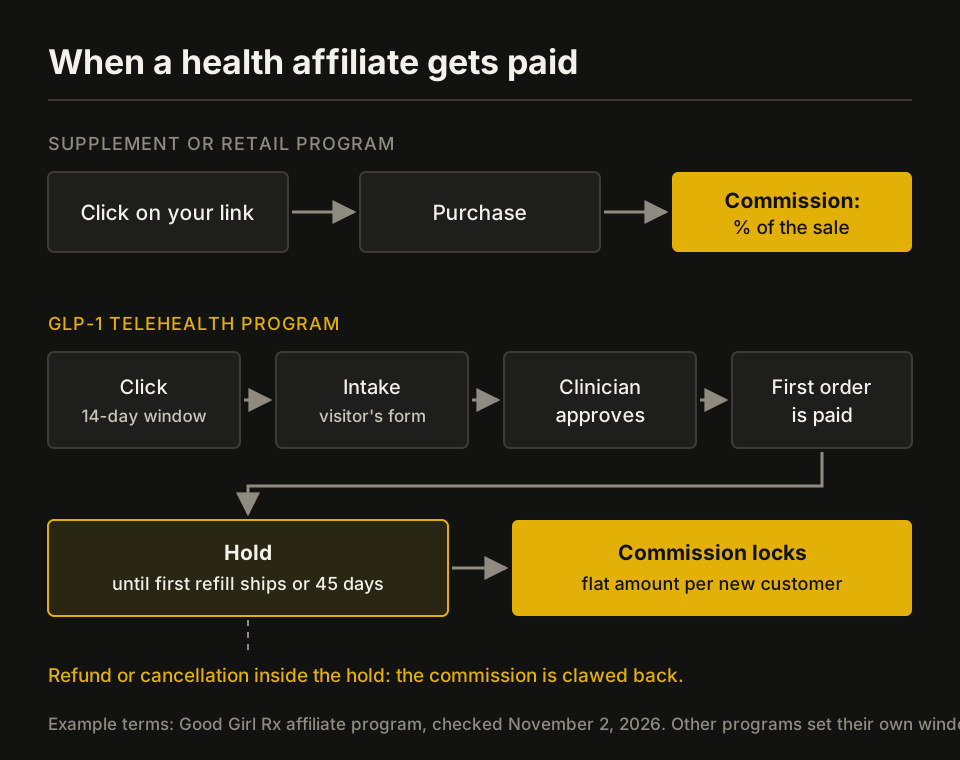
Good Girl Rx spells out each step. It pays “on real orders only, never on quiz starts, sign-ups, or approvals alone.” A commission “locks after the customer’s first refill ships or 45 days, whichever comes first,” and “Refunds or cancellations in that window claw back.” It also states that “orders that came through paid ads are attributed to those ads, not the link.” Ask every telehealth program for the same four terms in writing: the payout event, the window, the hold and the clawback.
Traffic rules by health affiliate category
Accepted traffic in health affiliate programs is set brand by brand, so “per brand terms” means the public pages we read don’t settle it. The firm lines come from the ad platforms. Policy checked on November 2, 2026.
| Traffic source | GLP-1 and prescription telehealth | Supplements and retail | Fitness and devices |
|---|---|---|---|
| SEO and comparison sites | Per brand terms | Per brand terms | Per brand terms |
| Instagram and influencer posts | Per brand terms; FTC disclosure applies | Allowed with disclosure (Supergut names Instagram and TikTok) | Per brand terms; FTC disclosure applies |
| Paid social on Meta | Brand must be LegitScript certified; no under-18 targeting | No under-18 targeting for supplements | 18+ for weight loss products and services |
| Brand-name bidding | Per brand terms; get it in writing | Per brand terms | Per brand terms |
| Coupon and deal sites | Accepted on GLP-1 offers we run; other brands vary | Per brand terms | Per brand terms |
| Push and pop | Not accepted on GLP-1 offers we run | Per brand terms | Per brand terms |
The paid social row matters most. Meta’s drugs and pharmaceuticals policy also says “Meta doesn’t allow targeting for over-the-counter medicine to people under the age of 18,” and its health and wellness policy names “Dietary weight loss or weight gain products and services such as supplements or pills.”
Claim and disclosure rules for health affiliates
Health affiliates are responsible for their own claims and disclosures, in every category. The FTC’s Health Products Compliance Guidance requires “competent and reliable scientific evidence” for health claims and says: “Anyone participating in deceptive marketing is potentially liable under FTC law.”
- Disclose the link. The FTC’s Endorsement Guides FAQ says “‘Paid link’ right next to an affiliate link should be an adequate disclosure,” while “‘Commissionable link’ is probably not a clear disclosure.” On video: “You should disclose the affiliate relationship both in the videos and in the description near the links.”
- Use the brand’s claims, not your own. Supplement and device claims need the brand’s substantiation. For prescription offers, results and drug claims come from the brand’s approved copy only.
- Keep compounded and branded drugs apart. On March 3, 2026 the FDA announced “30 warning letters” to telehealth companies over compounded GLP-1 marketing, naming “claims implying sameness with FDA-approved products.” An affiliate landing page that calls a compounded drug the same as a branded one repeats that claim.
How GLP1.partners runs GLP-1 offers for affiliates
GLP1.partners runs GLP-1 telehealth offers for affiliates on these rules:
- A conversion is a sale. You’re paid on a sale, never on a click or a quiz start.
- Weekly or monthly payments, depending on the deal.
- Coupon and deal sites are accepted. Push and pop traffic are not.
- Brand-approved claims only, with no before-and-after images and no weight-loss result claims.
Traffic rules, the review steps and how to apply are on the publishers page.
FAQ
What are the best health affiliate programs?
The best health affiliate program depends on your traffic and how long you can wait to be paid. Retail and supplement programs pay on the purchase, at 1% to 10% of the sale in the examples above. GLP-1 telehealth programs pay more per customer, $70 to $200 per new paid order in the terms we checked on November 2, 2026, after a clinician approval and a hold.
Do health affiliate programs pay recurring commissions?
Some supplement and subscription programs do; check each brand’s terms. The GLP-1 telehealth programs that state their model pay once per new customer. Good Girl Rx calls its payout “never a recurring percentage,” and OrderlyMeds calls its $75 “one-time.”
Can affiliates promote prescription health products?
Yes, through the telehealth brand’s program. The brand holds the prescription, the clinicians and the certification, and Meta requires telehealth providers to be “actively certified with LegitScript.” The affiliate sends traffic, discloses the link and uses the brand’s approved claims.
Sources
- Amazon Associates, Standard Commission Income Statement (Fixed Standard Commission Income Rates) · accessed
- WeightWatchers, Affiliate Program · accessed
- Online-Therapy.com, Affiliates · accessed
- Good Girl Rx, Affiliate Program · accessed
- HeliMeds, Affiliate Program · accessed
- OrderlyMeds, Affiliate Program: Get Started · accessed
- Supergut, Affiliate Program · accessed
- Trifecta Nutrition, Affiliate Partners · accessed
- Sovrn Commerce, WHOOP merchant listing · accessed
- Meta Transparency Center, Drugs and pharmaceuticals · accessed
- Meta Transparency Center, Health and wellness · accessed
- FTC, Health Products Compliance Guidance · accessed
- FTC, FTC's Endorsement Guides: What People Are Asking · accessed
- FDA, FDA warns 30 telehealth companies against illegal marketing of compounded GLP-1s (March 3, 2026) · accessed
- KFF Health Tracking Poll: Prescription Drug Costs, Views on Trump Administration Actions, and GLP-1 Use (November 14, 2025) · accessed