GLP-1 affiliate compliance comes down to a routine. You give partners written claim rules, check what they run on each channel, and act on what you find. Under the FTC Endorsement Guides, an advertiser should guide its endorsers, monitor them and fix non-compliance. Each platform shows US brands a different slice of what affiliates run.
Facts checked on October 30, 2026.
Why a GLP-1 brand answers for its affiliates’ ads
A GLP-1 brand can be held responsible for what affiliates say about it, even when the brand never saw the ad. The FTC’s Endorsement Guides state it directly in 16 CFR 255.1(d):
“An advertiser may be liable for a deceptive endorsement even when the endorser is not liable.”
The same paragraph lists what advertisers should do, including “Monitor their endorsers’ compliance” and “Take action sufficient to remedy non-compliance and prevent future non-compliance.” It adds that this is “not a safe harbor,” but it should “reduce an advertiser’s odds of facing a Commission enforcement action.”
Three more rules point the same way for a GLP-1 program:
| Rule | What it says about third parties | Source |
|---|---|---|
| FTC guidance on networks | “Delegating part of your promotional program to an outside company doesn’t relieve you of responsibility under the FTC Act.” | FTC Q&A |
| CAN-SPAM | “Both the company whose product is promoted in the message and the company that actually sends the message may be held legally responsible.” Penalties run “up to $53,088” per email. | FTC CAN-SPAM guide |
| FDA, compounded drugs | “a compounded drug is misbranded if its advertising or promotion is false or misleading in any particular” | FDA letter to MEDVi, LLC |
That FDA letter, dated February 20, 2026, was addressed to MEDVi, LLC and cited claims on medvi.io, including “Same active ingredient as Wegovy® and Ozempic®.” Business Insider reported on April 6, 2026 that the founder said medvi.io was run by an affiliate marketer who used the company name without permission. The letter still went to the brand. The full timeline is in what the Medvi story means for GLP-1 affiliate marketing.
Where to see affiliate ads, channel by channel
Each channel gives a GLP-1 brand a different view of its affiliates’ ads, and some give almost none for US campaigns. The table maps where to look and what the public tool can’t show you.
| Channel | Where to look | What you can see | What you can’t | Fill the gap with |
|---|---|---|---|---|
| Meta (Facebook, Instagram) | Meta Ad Library: search your brand name, your domains and the drug names you sell, country United States, active ads | Active ads on Facebook and Instagram; Meta says people “can search for all active ads running across products from Meta” (Meta Transparency Center) | Who the affiliate is behind a Page; ads that link through a redirect without your name | Require affiliates to list every Page and ad account they use for your offer |
| Google search | Search your brand terms yourself; Google’s Ads Transparency Center lets you “search for verified advertisers and their campaigns” across Search, Display and YouTube (TechCrunch, 2023) | Brand-term ads and the advertiser name | Ads shown only in certain places or hours | Check from several US locations and times, or use a brand-bidding monitor |
| TikTok | TikTok’s Commercial Content Library and API cover ads shown in the EU, the rest of the EEA, the UK and Switzerland; the United States is not on TikTok’s list of supported countries | Nothing for US-only campaigns | All of it | Pre-approval of every TikTok creative, plus ad IDs and screen recordings from the affiliate |
| Native and advertorials (for example Outbrain) | The live landing page behind each ad | The advertorial copy and the claims on it | Older versions after edits | Approve advertorials before launch; save dated captures |
| Email and SMS | Seed inboxes and numbers subscribed through each affiliate’s forms | Subject lines, sender domains, claims | Lists you are not on | Require the sending domains and the opt-in source for every list |
| Coupon and deal sites | The deal pages that list your brand | The codes, discounts and claims shown | Codes that leaked from another channel | Give each coupon partner its own code and ask which codes it lists |
| Comparison and review sites | The ranking page and the review of your brand | Rankings, claims, disclosure of the paid link | How the ranking was decided | Ask for the ranking method in writing |
| Lookalike domains | New domains with your brand name in them | Who registered and when, where WHOIS allows | Private registrations | A program rule that no affiliate domain may contain your brand name |
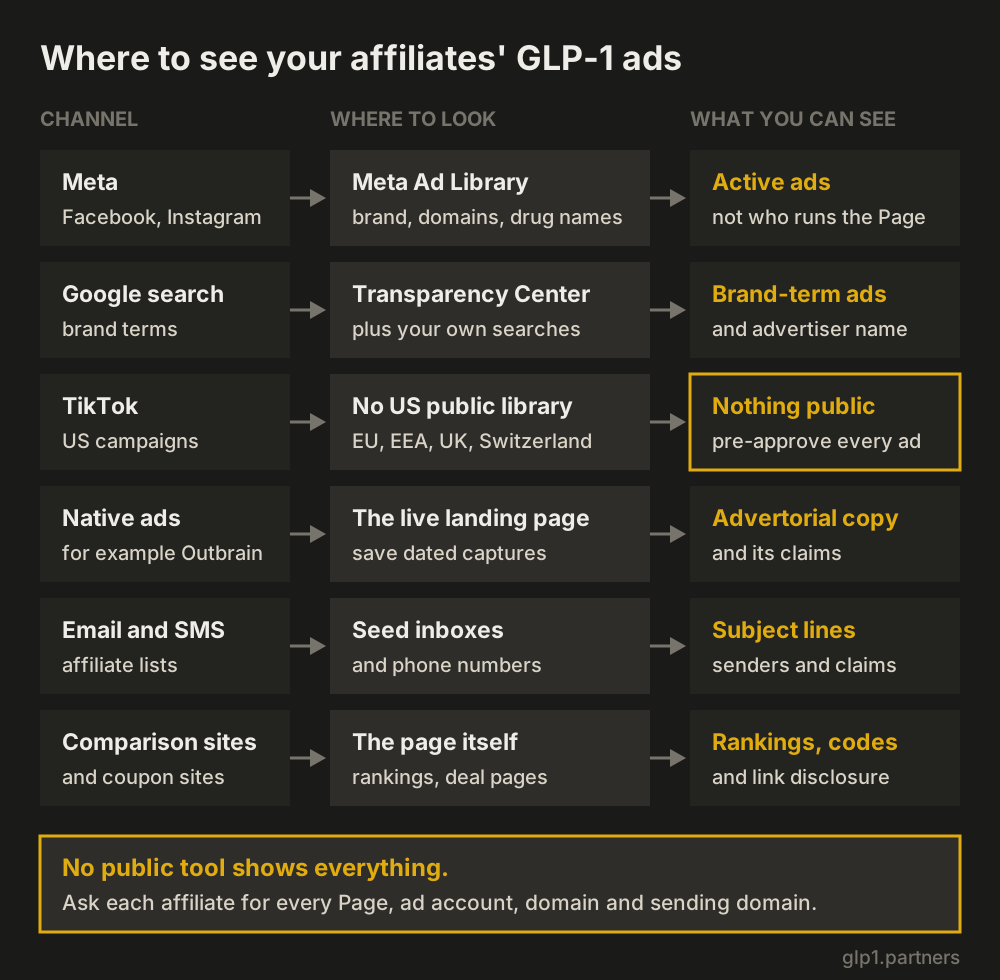
The Search Monitor’s affiliate compliance guide names the evasion tactics that hide brand-term ads from a single manual check, among them “Reverse Geo-Targeting” and “Day-Parting.” A single search from your office misses ads run that way.
Public counts move fast. Business Insider found “more than 5,000 active ad campaigns that mentioned or linked to Medvi” and, after it raised the issue with the company, the number “fell to roughly 2,800.” A brand that checks the Ad Library once a quarter would miss most of that movement.
GLP-1 claims to scan for
The same few GLP-1 claims show up again and again in regulator letters and research, so a short scan list is a practical first filter. A JAMA Health Forum study of 79 websites selling compounded GLP-1s, reported by TCTMD on January 20, 2025, found that 37.6% stated or implied the product was FDA-approved and 9% falsely called it generic.
| Flag in the ad or lander | Why it matters | Where the rule is |
|---|---|---|
| “FDA-approved” next to a compounded product | Compounded drugs are not FDA-approved | FDA claims guide |
| “Same active ingredient as Wegovy” or a brand-name comparison | Cited word for word in FDA’s February 2026 letter | FDA letter to MEDVi, LLC |
| “Generic semaglutide” or “generic Ozempic” | 9% of sites in the JAMA study used a false generic claim | TCTMD / JAMA Health Forum |
| A “Dr.” Page, white coat or AI avatar presenting as a clinician | Expert endorsement rules and Meta’s identity rules | AI doctor ads |
| Before-and-after photos of people who aren’t your customers, or a result promised in a set time | The FTC alleged on July 14, 2025 that NextMed “used deceptive before and after photos of people who were not their customers”; Meta’s Health and Wellness standard bans “promises of specific outcomes within a set timeframe without disclaimers or qualifiers” | FTC on NextMed; weight-loss ads policy |
| No disclosure that the site earns from the link | FTC disclosure of material connections | FTC Q&A |
| Your brand name inside the affiliate’s domain | Readers and regulators read it as your site | Your program terms |
| Prices or offers you don’t sell | Misleading in any particular | Your program terms |
How often to check affiliate ads
The FTC sets no fixed schedule. Its staff answer reads:
“There’s no one-size-fits-all standard. If regular monitoring is too much for you, you should probably switch to pre-approval of posts.”
For short-lived formats the FTC goes further and says you “should require that paid posts aren’t made without you approving them in advance.” A risk-based starting point for a GLP-1 program:
| What | When |
|---|---|
| New creative, advertorials, TikTok and Stories-type formats | Pre-approval before launch |
| Meta Ad Library sweep for brand, domains and drug names | Weekly, and daily in the first weeks of a new partner |
| Brand-term search checks | Weekly from more than one US location |
| Seed inbox and SMS review | As messages arrive |
| Lookalike domain check | Monthly |
| Comparison-site rankings and reviews | Monthly, and after any change to your offer |
The FTC also says monitoring “doesn’t have to go on forever” after a campaign ends, but it should be “reasonable.”
Program terms that make monitoring enforceable
Monitoring only works when the terms let you act on what you find. Put these in the affiliate agreement before the first link goes live:
- A claim library: the approved claims, the banned phrases from the table above, and the required disclosure.
- Pre-approval for every new creative and lander, with a named reviewer on your side.
- Disclosure of every Page, ad account, domain and sending domain used for your offer.
- A brand-bidding rule, stated as allowed, limited or banned.
- No brand name in affiliate domains, Page names or handles.
- A takedown window for flagged ads, and what happens to the conversions from a flagged ad.
- The right to pause links and end the agreement for repeat violations.
Where the program runs through a network, the same terms have to reach every sub-affiliate. How GLP-1 affiliate programs work covers the commercial terms that sit next to these.
When you find a violation
Treat each violation as a record first and a takedown second.
- Capture the ad, the lander and the date, with the Ad Library ID or URL.
- Notify the affiliate in writing, cite the rule, and set the takedown window.
- Pause the tracking link if the ad stays live past the window.
- Review conversions from that source under the terms.
- Log the case and the fix. Repeat cases end the partnership.
The FTC’s list of steps for advertisers ends with “Take appropriate action if you find questionable practices.” A written log of each case and fix is how you show later that you did.
Where GLP1.partners fits in a GLP-1 affiliate program
GLP1.partners sends GLP-1 brands traffic through an affiliate network we manage, with 410 affiliates earning with us, and through our own comparison sites. We also run brand media on Meta, on established agency accounts built for GLP-1 scale with a dedicated Meta agency contact; on Outbrain, on established accounts with a dedicated GLP-1 setup; on TikTok; and through Instagram influencers. Offers in the network come direct from brands. Coupon and deal sites are accepted as affiliate traffic; push and pop traffic is not. We have scaled 27 GLP-1 brands. Whichever partners send the traffic, the FTC duty to monitor sits with the advertiser, so the routine on this page stays with the brand.
A 30-day setup for affiliate monitoring
- Days 1 to 3: write the claim library and banned-phrase list, and add the seven terms above to the agreement.
- Days 4 to 7: collect every Page, ad account, domain and sending domain from each active affiliate.
- Week 2: run the first Meta Ad Library sweep and brand-term checks; save captures as the baseline.
- Week 2: subscribe seed inboxes and numbers to each affiliate’s forms.
- Week 3: switch TikTok and short-lived formats to pre-approval only.
- Week 4: review the log, pause repeat offenders, and set the weekly cadence on the calendar.
FAQ
Is a GLP-1 brand responsible for an affiliate’s ad it never approved? It can be. Under 16 CFR 255.1(d), an advertiser “may be liable for a deceptive endorsement even when the endorser is not liable,” and FTC staff say delegating promotion doesn’t remove responsibility.
Can I see my affiliates’ TikTok ads in a public library? Not for US-only campaigns. TikTok’s library covers ads shown in the EEA, Switzerland and the UK, so US monitoring depends on pre-approval and the affiliate’s own records.
Do I need an affiliate monitoring tool? For brand bidding, a tool helps because ads can be limited by location and hour. For Meta, the Ad Library is free; the work is the weekly search and the log.
Run your GLP-1 affiliate channel with us
Tell us how your affiliate program runs today and where you want more volume, and we’ll show you how our affiliate network would fit. Book a call.
Changelog
October 27, 2026: page drafted.
October 27, 2026: editor pass (TikTok library source replaced, Meta policy source added, GLP1.partners block limited to network facts).
October 30, 2026: sources rechecked, Meta Ad Library source updated, coupon-site row, channel diagram and current channel list added.
Sources
- 16 CFR 255.1, General considerations (Endorsement Guides), Cornell LII · accessed
- FTC, FTC's Endorsement Guides: What People Are Asking · accessed
- FTC, CAN-SPAM Act: A Compliance Guide for Business · accessed
- FDA, Warning letter to MEDVi, LLC dba MEDVi, MARCS-CMS 721455 (Feb 20, 2026) · accessed
- Business Insider, Jack Newsham, Medvi, the AI-powered telehealth company, is fueled by ads from doctors who don't appear to exist (Apr 6, 2026; read via AOL syndication) · accessed
- TCTMD, Misleading statements common in online ads for compounded GLP-1s (Jan 20, 2025), on Chetty et al., JAMA Health Forum 2025;6(1):e245018 · accessed
- TikTok for Developers, Commercial Content API: supported countries and regions · accessed
- TechCrunch, Google's new Ads Transparency Center (Mar 29, 2023) · accessed
- Meta Transparency Center, Ad Library tools · accessed
- Meta Transparency Center, Advertising Standards: Health and Wellness · accessed
- FTC, FTC Takes Action Against Telemedicine Firm NextMed (Jul 14, 2025) · accessed
- The Search Monitor, A Compliance Guide for Affiliate Managers · accessed