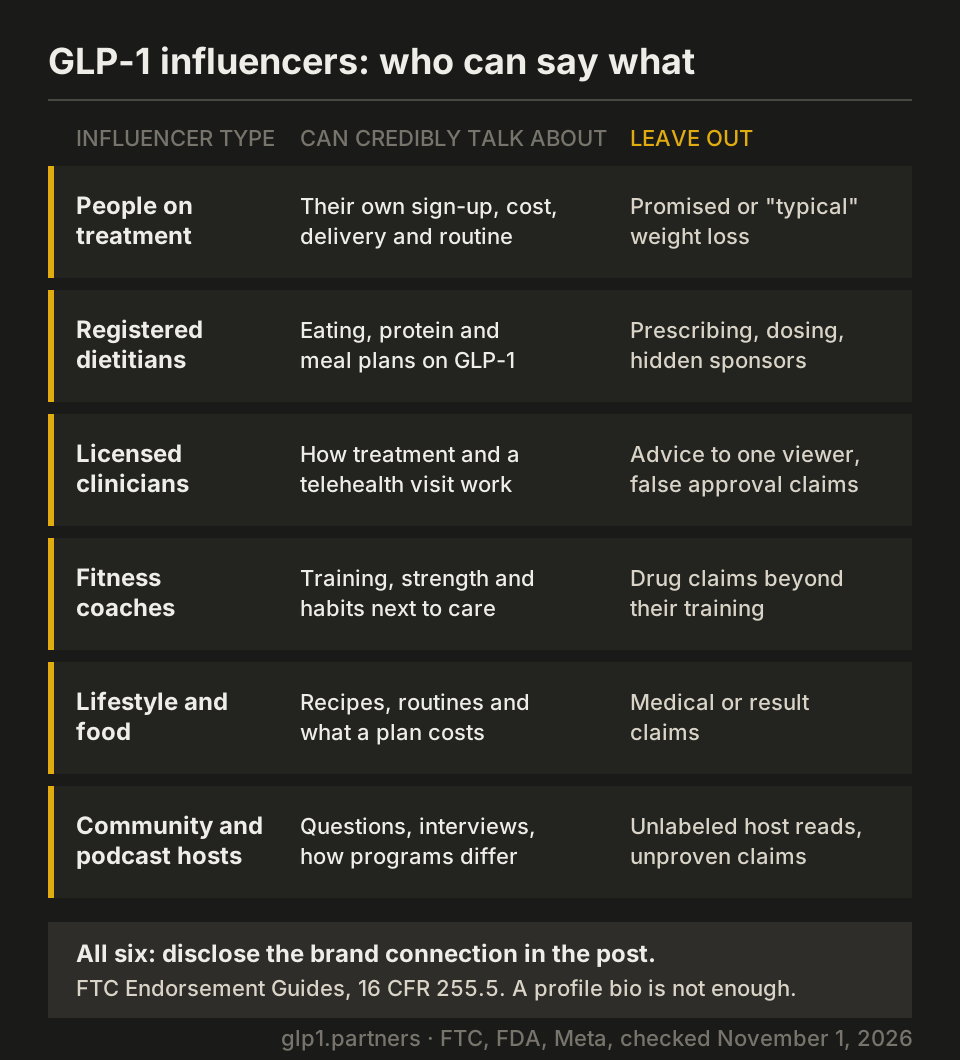
GLP-1 influencers fall into six types: people on treatment sharing their own experience, registered dietitians, licensed clinicians, fitness coaches, lifestyle and food influencers, and community or podcast hosts. Each type can credibly speak to a different part of a telehealth brand’s offer, and each has claims it should leave out under FTC, FDA and Meta rules.
Why telehealth brands look at GLP-1 influencers
GLP-1 influencers reach a large group of people who already use or consider the drugs. KFF’s poll published November 14, 2025 found that 18% of US adults had taken a GLP-1 drug and 12% were currently taking one, “an increase of 6 percentage points from May 2024.” Among adults who had taken one, 17% got it from an online provider or website, the channel telehealth brands sell through.
One public directory, GLP1 Tribe, listed 32 GLP-1 social accounts on November 1, 2026 in three groups: Expert, Healthcare Pro and Patient. A brand needs a finer split than that, because a dietitian and a person documenting their own treatment can’t make the same claims.
For telehealth brands, the work sits on Instagram. TikTok’s Branded Content Policy (effective October 30, 2026) lists weight loss services and telehealth providers as prohibited for branded content. Meta allows it with conditions, covered below.
How GLP1.partners runs GLP-1 influencer campaigns
GLP1.partners runs an Instagram influencer network for US GLP-1 telehealth brands. This is how we run GLP-1 influencer marketing for a brand:
- One target. Influencer traffic reports against the same target as the brand’s other channels, such as cost per started patient.
- Matched to the offer. Influencers with US followers and a topic that fits: weight loss, fitness, health or everyday life.
- Brand-approved talking points. Price, plan details and claims come from what the brand has approved, and nobody posts for the brand without its OK.
- Their own voice, their own link. Each influencer posts in their own words and sends followers through their own link or code.
- What stays out. Promised weight loss, before-and-after photos, and any claim that a program is the same as a branded drug.
- Weekly reporting. Influencer results sit in the same weekly report as the brand’s other channels with us: Meta on our established agency accounts, Outbrain, TikTok, comparison sites and affiliates.
The six types of GLP-1 influencers and what each can say
The six types of GLP-1 influencers differ in what their audience trusts them on. The FTC’s Endorsement Guides (16 CFR Part 255) set the line: an endorsement “may not convey any express or implied representation that would be deceptive if made directly by the advertiser.”
| Influencer type | Audience trusts them on | Can credibly talk about | Leave out |
|---|---|---|---|
| People on treatment | Their own experience | How sign-up, the consult and delivery worked, what they pay, their routine | Promised results, results framed as typical, before-and-after photos |
| Registered dietitians | Food and nutrition | Eating, protein and meal planning while on a GLP-1 program | Prescribing or dosing, posts that hide the sponsor |
| Licensed clinicians | Medicine | How GLP-1 treatment works in general and what a telehealth visit involves | Advice to one viewer, calling a compounded drug FDA approved |
| Fitness coaches | Training | Strength training and habits next to medical care | Claims about the drug beyond their training |
| Lifestyle and food influencers | Daily life | Recipes, routines, what a program costs and includes | Medical or weight-loss result claims |
| Community and podcast hosts | Conversation | Audience questions, interviews, how programs differ | Host reads with no ad label, unsupported claims |
People on treatment
People documenting their own GLP-1 treatment are consumer endorsers under the FTC Guides. Section 255.2 says a consumer endorsement on a key attribute “will likely be interpreted as representing that the endorser’s experience is representative.” If the brand can’t show that a result is what people generally get, the ad should “clearly and conspicuously disclose the generally expected performance.” This type works best on the steps every customer goes through: sign-up, consult, price, delivery.
Before-and-after photos carry extra risk. On July 14, 2025 the FTC alleged that NextMed, a GLP-1 telemedicine firm, “used deceptive before and after photos of people who were not their customers.” Meta’s position on these photos is in our Meta weight loss ads policy guide.
Registered dietitians
Registered dietitians are expert endorsers on nutrition under section 255.3: an expert’s “qualifications must in fact give the endorser the expertise that the endorser is represented as possessing.” Nutrition on a GLP-1 program is inside that expertise. Prescribing decisions are not.
Dietitians have been caught on disclosure before. On November 15, 2023 the FTC warned two trade associations and 12 influencers, including registered dietitians, over Instagram and TikTok posts that didn’t clearly disclose who paid for them. Samuel Levine, then Director of the FTC’s Bureau of Consumer Protection, said it was “irresponsible for any trade group to hire influencers to tout its members’ products” and “fail to ensure that the influencers come clean about that relationship.”
Licensed clinicians
Physicians, nurse practitioners and physician assistants can explain how GLP-1 treatment works and what a telehealth visit looks like. A medical title makes viewers trust the claim more, so the claims rules bite hardest here. A clinician who calls a compounded drug “generic,” “the same as” a branded drug, or FDA approved repeats lines FDA has cited in letters to telehealth companies, listed in our guide to compounded GLP-1 claims the FDA flags. If the clinician also prescribes for the brand, that is a material connection under section 255.5 and has to be disclosed.
Fitness coaches, lifestyle influencers and hosts
Fitness coaches, lifestyle and food influencers, and community or podcast hosts each fit one part of the offer:
- Fitness coaches talk about training, keeping strength and habits next to medical care. Section 255.0(e) defines an expert by knowledge “superior to what ordinary individuals generally acquire,” so a coach is an expert on training and an ordinary consumer on the drug.
- Lifestyle and food influencers fit through recipes, grocery lists and routines. The program’s price, what’s included and how ordering works suit them. Result claims don’t.
- Community and podcast hosts bring a brand into a conversation: audience questions, a provider interview, how programs differ. A host read is still an ad. The FTC’s Disclosures 101 guide says a video disclosure belongs in the video itself and should be repeated during live streams.
Rules that apply to every GLP-1 influencer
Three rule sets apply to every GLP-1 influencer a telehealth brand pays. The full detail will sit in our GLP-1 influencer rules guide. Rules checked on November 1, 2026:
| Rule set | What it requires | Who it binds |
|---|---|---|
| FTC Endorsement Guides, 16 CFR 255.5 | A material connection the audience wouldn’t expect, such as payment or free product, “must be disclosed clearly and conspicuously” | The influencer and the brand |
| FTC Endorsement Guides, 16 CFR 255.1(a) and 255.2(a) | No claim the brand couldn’t make directly; the brand needs proof for claims made through endorsers | The brand |
| Meta Branded Content Policies | The business partner “must apply to Facebook to promote prescription drugs”; telehealth providers are eligible to apply; posts restricted to 18+ in the US, New Zealand or Canada; weight loss branded content 18+ | Brand and influencer on Instagram and Facebook |
| FDA drug advertising enforcement | FDA named “undisclosed paid influencer promotion” as a concern on September 9, 2025 | The brand and anyone promoting for it |
FDA’s September 9, 2025 announcement cited a 2024 review: “100% of pharmaceutical social media posts highlight drug benefits, only 33% mention potential harms.”
The FTC’s Disclosures 101 guide adds two placement points. A disclosure that sits only in a profile bio is “likely to be missed,” and influencers shouldn’t “assume that a platform’s disclosure tool is good enough.”
How brands find GLP-1 influencers
Telehealth brands find GLP-1 influencers through Meta’s tools, public directories and Instagram search:
- Meta Creator Marketing Hub. Meta’s Help Center describes it as a tool in Meta Business Suite or Ads Manager that “helps brands discover and evaluate creators to partner with on branded content and partnership ads.” It also manages partnership ad permissions and checks Instagram content eligibility.
- Search and filters. When Meta expanded its Instagram creator marketplace on February 21, 2024, it said “Brands can also search for creators, filtering for creator and audience attributes,” and can contact them directly.
- Partnership ads. The same post says partnership ads “allow advertisers to amplify content with a creator or other partner’s handle.”
- Public directories. Sites such as GLP1 Tribe list GLP-1 accounts by category. Treat them as a starting list and check each account.
Audience fit and red flags in GLP-1 influencer accounts
Audience fit for a GLP-1 influencer comes down to where the followers are, what the account is known for, how its past paid posts were labeled and how followers reacted to past GLP-1 posts. Meta limits prescription drug branded content to the US, New Zealand and Canada, and a brand’s offer only fits followers in the states it serves.
Red flags in an influencer’s existing posts:
- Undisclosed paid posts. Brand mentions with no “ad,” “sponsored” or paid partnership label, or vague tags such as “collab” or “spon,” which the FTC guide calls out.
- Result claims. Pounds lost “in X weeks,” promised outcomes, or one result shown as normal.
- Before-and-after content used to sell a program.
- Drug-equivalence language. “Generic Wegovy,” “same as Ozempic,” or “FDA approved” for a compounded product.
- Advice to individual followers. Answering “should I take it” or dosing questions in comments or DMs.
- Many competing GLP-1 sponsors in a short period.
Once posts are live, section 255.1(d) lists “Monitor their endorsers’ compliance” among the steps advertisers should take. Our guide on how GLP-1 brands monitor affiliate ads shows a working routine.
Backlash against GLP-1 influencer posts
Backlash against GLP-1 influencer posts comes mostly from body positive and anti-diet communities. NBC News reported on February 24, 2024 that “Some in the body positivity community are concerned weight loss drugs are setting the movement back,” and that influencers who started GLP-1 treatment faced criticism from their own followers.
For a telehealth brand:
- Match the account to the message. An influencer followed for body acceptance loses trust, and the brand shares the criticism, if the post turns into a weight-loss pitch.
- Sell the service. Posts about access to a licensed provider, price and how the program works draw less backlash than posts about pounds lost.
- Keep health details private. Don’t ask an influencer to share weight or treatment history they haven’t already made public.
A step-by-step plan to start with GLP-1 influencers
- Write the claims sheet first: price, what’s included, states served, and the claims your brand can prove. Everything an influencer says comes from it.
- Pick the influencer types that match your offer, using the table above. A program with nutrition support suits dietitians; one sold on price suits lifestyle influencers.
- If posts will mention prescription drugs on Instagram or Facebook, apply to Meta for branded content permission and set the 18+ and country limits.
- Shortlist accounts from Meta Creator Marketing Hub, directories and Instagram search, then run the audience-fit checks above.
- Brief each influencer in writing: the claims sheet, the leave-out list, the disclosure wording and Meta’s paid partnership label.
- Give each influencer a unique link or code so results show up in your order data.
- Review posts before they go live and check them again after. Remove or correct posts that drift.
- Judge influencers on the same target as every other channel, and keep the ones that hit it.
FAQ
Sources
- eCFR, 16 CFR Part 255, Guides Concerning the Use of Endorsements and Testimonials in Advertising (255.0(e) expert; 255.1(a); 255.2(a)-(b) consumer endorsements and generally expected performance; 255.3 expert endorsements; 255.5 material connections) · accessed
- FTC, Disclosures 101 for Social Media Influencers · accessed
- FTC, FTC Warns Two Trade Associations and a Dozen Influencers About Social Media Posts Promoting Consumption of Aspartame or Sugar (November 15, 2023) · accessed
- FTC, NextMed GLP-1 telemedicine case: deceptive before and after photos (July 14, 2025) · accessed
- FDA, FDA Launches Crackdown on Deceptive Drug Advertising (September 9, 2025) · accessed
- Meta Business Help Center, Branded Content Policies (prescription drugs: business partner must apply; telehealth providers eligible; 18+; US, NZ, CA; weight loss 18+) · accessed
- Instagram Help Center, About Meta Creator Marketing Hub · accessed
- Meta Newsroom, Making it Easier for Brands and Creators to Collaborate on Instagram (February 21, 2024) · accessed
- TikTok, Branded Content Policy (effective October 30, 2026; prohibited: weight loss products or services, telehealth providers) · accessed
- KFF Health Tracking Poll: Prescription Drug Costs, Views on Trump Administration Actions, and GLP-1 Use (November 14, 2025; fielded October 27 to November 2, 2025; 18% ever, 12% current, +6 points from May 2024; 17% of users got it from an online provider or website) · accessed
- GLP1 Tribe, GLP-1 influencers directory (32 listed; categories Expert, Healthcare Pro, Patient) · accessed
- NBC News, Curvy influencers post a lot about body positivity. But what happens when they use Ozempic? (February 24, 2024) · accessed