Healthcare advertising agencies plan, build and buy ads for health businesses. For a telehealth or GLP-1 brand, the useful kind is a paid-media agency that knows each platform’s prescription drug rules. It works from the brand’s LegitScript certification, helps with platform approvals, writes claims the brand can prove, sets up ad accounts and reports against one target.
Three kinds of healthcare advertising agencies
Healthcare advertising agencies fall into three groups, and each is built for a different buyer. Most “best agencies” lists mix all three, which is why a telehealth founder can read one and still not know who to call.
| Kind of agency | Built for | Typical work | Fit for a telehealth brand |
|---|---|---|---|
| Pharma brand networks | Drug manufacturers launching a branded drug | TV and print campaigns, doctor-facing communications, launch planning under FDA drug ad rules | Low: built around a manufacturer’s approved drug, not a prescribing service |
| Provider and hospital agencies | Clinics, hospital systems, local practices | Local search, websites, reputation, call tracking | Partial: good at local demand, rarely runs national Rx campaigns |
| Telehealth paid-media agencies | Online prescribing brands selling direct to consumers | Meta, Google, TikTok and native ads, creative testing, account setup, platform approvals, reporting on cost per patient | High: this is the work a GLP-1 or telehealth brand buys |
Pharma brand agencies work under FDA’s prescription drug advertising rules. FDA’s Office of Prescription Drug Promotion provides “written comments to pharmaceutical sponsors on proposed promotional communications,” a process built for drug makers. A telehealth brand faces a different first gate: the ad platforms.
What a paid-media healthcare ad agency does for an Rx telehealth brand
A paid-media healthcare ad agency turns a telehealth brand’s offer into ads that platforms approve and that bring new patients at a cost the brand can afford. For an Rx brand, such as one selling a GLP-1 weight-loss program, the work covers six things:
- Eligibility. Check what each platform needs from the brand before any ad is built, starting with LegitScript.
- Approvals. Prepare the brand’s applications for Meta, Google and TikTok and keep the paperwork current.
- Accounts. Set up the ad accounts the campaigns run on and the access each side has.
- Claims and creative. Write ads and landing pages inside platform and FDA limits, and get the brand’s sign-off on every one.
- Buying. Test angles on small budgets, then move spend to what hits the target.
- Reporting. One target, such as cost per started patient, reported by channel every week.
How GLP1.partners runs it
We run GLP-1 and telehealth traffic at scale with platform approvals on every network we buy. Meta runs on established agency accounts built for GLP-1 scale, with a dedicated Meta agency contact. Outbrain runs on established accounts with a dedicated setup for GLP-1, and TikTok creative is made for the format and its ad rules. The brand brings its LegitScript certification, approves every ad and sets the target. GLP-1 telehealth is our main category, and we help brands scale in other verticals too. The channel mix is on our paid media for telehealth brands page.
Platform approvals a healthcare ad agency works inside
Platform approvals decide whether a telehealth brand can advertise prescription treatment at all, and every healthcare ad agency works inside them. Policy wording below was checked on November 2, 2026.
| Platform | What the policy says | What the brand brings |
|---|---|---|
| Meta (Facebook, Instagram) | “Meta requires online pharmacies and telehealth providers to be actively certified with LegitScript.” Then “they must request authorization from Meta.” Rx targeting only in the US, Canada or New Zealand, never under 18 | LegitScript certification, then Meta authorization |
| Google Ads (US) | “Google allows telemedicine providers if they’re accredited by LegitScript’s Healthcare Merchant Certification Program.” Also: “Advertisers must also be certified with Google.” | LegitScript, then Google’s healthcare certification form (it lists “Prescription drug services provider (online pharmacy, telemedicine)”) |
| TikTok (US) | Prescription medicine “May be allowed” if advertisers “Provide proof of approval and certification from appropriate local regional regulating authorities” and “Restrict the ads to audiences aged 18 years or older.” Last updated September 2026 | Regulator proof; LegitScript or NABP for online pharmacies |
Meta also lists ads that “Promote telehealth services generally” among those that don’t need written authorization, so a brand ad that names no drug follows a lighter route than a GLP-1 treatment ad. Outbrain, Taboola, AppLovin and Microsoft each set their own process; our guide to LegitScript and ad platform rules covers seven platforms line by line.
LegitScript: the brand’s certificate, the agency’s first check
LegitScript certification belongs to the telehealth brand, never to the agency, and a good healthcare ad agency asks for it on the first call. Without it, Meta and Google won’t let a telehealth provider promote prescription drugs.
Demand for it is rising. LegitScript reported on September 22, 2026 “a 59% increase in certification applications overall” and “a 101% increase in telemedicine applications specifically,” and said it had passed 10,000 certified websites. Scott Roth, LegitScript’s CEO, said: “We’re seeing companies think about certification earlier than they used to.”
Certification starts the approval process but doesn’t finish it. LegitScript’s webinar summary of May 13, 2026 says: “Each platform has its own policies layered on top of LegitScript Certification requirements.” The agency’s job is to handle those layers so the certificate turns into running ads.
Creative and claims review in healthcare advertising
Creative and claims review is where most telehealth ads fail, and a healthcare advertising agency should treat every ad as something a regulator and a platform reviewer will read. Two federal actions set the tone for GLP-1 brands:
- September 9, 2025. FDA said it was sending “approximately 100 cease-and-desist letters to companies with deceptive ads” and “thousands of letters” asking drug companies to remove misleading ads.
- March 3, 2026. FDA warned 30 telehealth companies over compounded GLP-1 marketing, citing claims “implying sameness with FDA-approved products.” FDA Commissioner Marty Makary said: “It’s a new era. We are paying close attention to misleading claims being made by telehealth and pharma companies.”
On the platform side, LegitScript’s webinar summary names the usual triggers: unsupported claims, missing disclosures, restricted drug names and before-and-after images. Its advice on the last one: “in most cases, avoid before-and-afters in the ads themselves.” Automated systems also flag compliant ads by keyword, and those are often reversed after a human review, so the agency should be ready to dispute fast. Our guide on GLP-1 ads rejected by Meta walks through fixes.
A working claims process has four parts:
- A claims sheet from the brand: price, what’s included, states served, and every claim it can prove.
- Ads and landing pages written only from that sheet.
- Brand sign-off on every ad before launch.
- A record of each rejection and fix, so the same mistake doesn’t repeat across channels.
Ad accounts: brand-owned, partner access or agency accounts
Healthcare advertising agencies run campaigns on one of three account setups, and the choice affects control, history and how fast a telehealth brand can scale.
| Setup | How it works | When it fits |
|---|---|---|
| Brand-owned accounts | The brand owns the ad accounts and gives the agency access | Brands with healthy accounts and their own approvals in place |
| Partner access | The agency works inside the brand’s business assets through partner permissions | Brands that want to keep ownership but hand over day-to-day buying |
| Agency ad accounts | Campaigns run on accounts the agency holds, with its own platform relationship | Brands that need established accounts and support to grow spend |
Whichever setup a brand picks, the platform approvals from the step above have to cover the accounts the ads run on before launch. The detail is in our guide to Meta agency ad accounts for telehealth.
What onboarding with a healthcare ad agency looks like
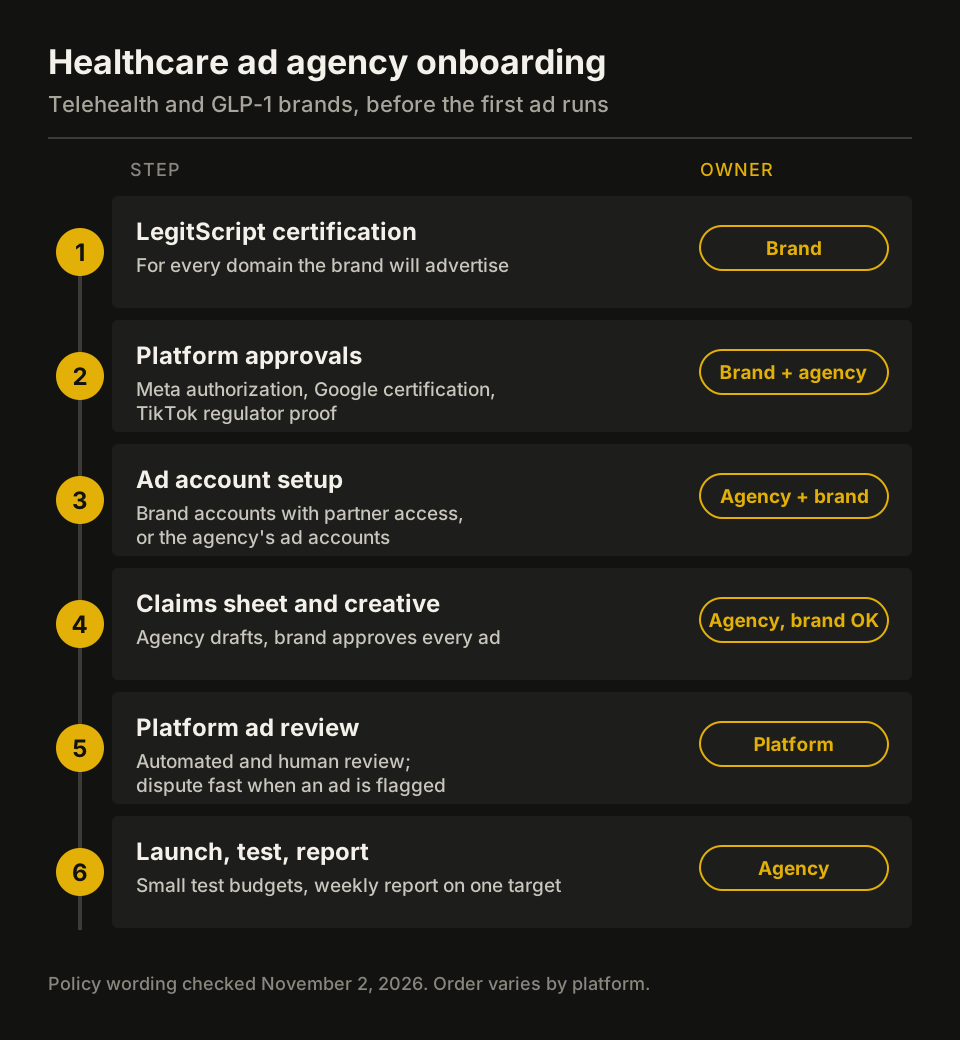
Onboarding with a healthcare ad agency follows the order in the diagram above: certification, approvals, accounts, claims, review, launch. The table shows who does what at each step for a GLP-1 telehealth brand.
| Step | Brand does | Agency does |
|---|---|---|
| 1. Eligibility | Shares LegitScript status, licensing, pharmacy partner, states served | Checks each target platform’s requirements against them |
| 2. Approvals | Submits or signs platform applications | Prepares the forms and documents, tracks status |
| 3. Accounts | Grants access or agrees to run on agency accounts | Builds account structure, tracking and conversion events |
| 4. Claims and creative | Provides the claims sheet, approves every ad | Writes ads, landing pages and pre-landers from the sheet |
| 5. Platform review | Answers documentation requests | Disputes wrong rejections, fixes real ones |
| 6. Launch and report | Sets the target and shares order data | Tests angles on small budgets, scales winners, reports weekly |
How long each step takes depends on the platform and on the brand’s paperwork. A brand that arrives with LegitScript already active skips the longest wait. For questions to ask before signing, see our checklist on how to choose a GLP-1 marketing agency.
What to have ready before the first call
A telehealth brand gets more from a first call with a healthcare advertising agency when these are ready:
- LegitScript status for each domain you plan to advertise.
- Current platform status: which accounts you have, which approvals, any open rejections.
- Your offer: product, price, what’s included, states served.
- Your claims sheet, or the claims you’d like to make and the proof behind them.
- Your target, such as cost per started patient, and what you pay today.
- The channels you run now and what each returns.
FAQ
What does a healthcare advertising agency do?
It plans, writes and buys ads for health businesses. For a telehealth brand that means platform approvals, compliant creative, account setup, media buying and reporting against a cost target.
Does a healthcare ad agency need LegitScript certification?
No. LegitScript certifies the telehealth brand, pharmacy or provider. The agency checks that the brand holds it, because Meta and Google require it before a telehealth provider can promote prescription drugs.
What is the difference between a medical advertising agency and a telehealth paid-media agency?
Medical advertising agencies often serve drug makers or local practices. A telehealth paid-media agency runs national direct-to-consumer campaigns on Meta, Google, TikTok and native networks, inside each platform’s prescription drug rules.
Sources
- Meta Transparency Center, Advertising Standards: Drugs and Pharmaceuticals (LegitScript for online pharmacies and telehealth providers; authorization from Meta; under-18 targeting not allowed; US, Canada, New Zealand; general telehealth ads need no written authorization; change log Jun 11, 2024, Oct 31, 2024, Feb 26, 2025) · accessed
- Google Ads, Healthcare and medicines policy (US telemedicine providers accredited by LegitScript; advertisers must also be certified with Google) · accessed
- Google Ads Help, Apply for healthcare-related advertising (organization types on the form) · accessed
- TikTok Ads, Healthcare and pharmaceuticals policy (Last updated: September 2026; US prescription medicine and online pharmacy rules) · accessed
- LegitScript, Certification Applications Rise 59%, Led by 101% Growth in Telemedicine (September 22, 2026; 10,000 certified websites; Scott Roth quote) · accessed
- LegitScript, Certified But Still Getting Disapproved? Key takeaways from our telehealth advertising webinar (May 13, 2026) · accessed
- FDA, FDA Warns 30 Telehealth Companies Against Illegal Marketing of Compounded GLP-1s (March 3, 2026) · accessed
- FDA, FDA Launches Crackdown on Deceptive Drug Advertising (September 9, 2025; approximately 100 cease-and-desist letters, thousands of letters) · accessed
- FDA, Basics of Drug Ads and the Office of Prescription Drug Promotion (written comments to pharmaceutical sponsors on proposed promotional communications) · accessed