Content marketing in healthcare means publishing explainers, comparison pages and guides on a brand’s own site to earn search traffic instead of buying all of it. For a GLP-1 telehealth brand, every health claim needs the same FTC substantiation a paid ad would need, and Google holds it to a higher bar as “Your Money or Your Life” content.
Why content marketing works differently for a prescription telehealth brand
Content marketing works differently for a prescription telehealth brand than for most health businesses, because nothing it publishes gets a platform review before it goes live. A Meta or Google ad for a GLP-1 program goes through the platform’s ad review, and the advertiser usually needs LegitScript certification before it can run prescription ads at all. A blog post or comparison page on the brand’s own site has no such gate: hit publish, and it is live.
That gap is why content carries real claims risk. A comparison page that puts a brand’s compounded GLP-1 program next to a branded, FDA-approved drug can slide into implying the two are the same product, a specific line FDA has flagged in telehealth marketing (see our guide on compounded GLP-1 advertising claims the FDA flags for the exact wording). A generic content-marketing guide never covers this, because it is not writing for a brand that sells a prescription. Content marketing is also only one piece of the channel mix; our GLP-1 marketing strategy guide covers how it fits with paid and partner channels.
What a GLP-1 telehealth brand can publish, and what needs sign-off first
What a GLP-1 telehealth brand can publish safely depends on the claim each piece makes, not its format. A how-it-works explainer and a patient testimonial can sit on the same blog, but they carry very different risk and need different sign-off before they go live.
| Content type | Claims risk | What drives the risk | Who signs off before publish |
|---|---|---|---|
| Explainer (how GLP-1 medications work, how prior authorization works) | Low | General education, no claim about a specific outcome | Marketing or compliance editor |
| Comparison page (your program vs. another option) | Medium | Can imply “as effective as” or “the same as” a competitor’s approved product | Compliance review; sourced, substantiated language only |
| Patient story or testimonial | High | One person’s result described as typical implies an efficacy claim | Legal or compliance sign-off; many brands also use a medical reviewer |
| Before-and-after image or claim | High | LegitScript’s advertising guidance says to “avoid before-and-afters in the ads themselves” and, if they’re used at all, to put them on landing pages with full disclosures | Legal or compliance sign-off before anything runs |
| Drug name or “generic equivalent” claim | High | FDA’s March 2026 warning letters flagged “claims implying sameness with FDA-approved products” | Medical or regulatory sign-off, sourced to the FDA label only |
Low-risk explainers can usually move fast with one editor’s sign-off. Anything in the high-risk rows should go through the same substantiation check a paid ad would get, before a draft is scheduled rather than after it’s written. For the paid-media side of this same review process, see our guide to healthcare advertising agencies.
FTC and FDA limits on content claims, not just ads
The FTC and FDA limit health claims in content the same way they limit them in paid ads, even though a blog post never runs through an ad platform’s review. The FTC’s Health Products Compliance Guidance, announced December 20, 2022, defines “advertising” to cover “not only traditional TV, radio, print, and internet ads, but also more broadly to the variety of marketing techniques and promotion methods” used to build consumer interest. That definition includes a brand’s own blog post, comparison page or guide, in addition to any media it buys. The same December 20, 2022 announcement notes that the FTC has brought “more than 200 cases challenging false or misleading advertising claims for dietary supplements, foods, over-the-counter drugs, and other health-related products,” the FTC’s own record of what it treats as a health claim gone wrong.
Two parts of the same guidance matter most for a content team specifically. First, the FTC judges a claim by its “net impression,” telling marketers to “consider each ad as a whole, assessing the ‘net impression’ conveyed by all elements of the ad, including the text, product name, and any charts, graphs, and other images.” A comparison page’s headline, layout and chart can create an implied claim even when no single sentence states it outright. Second, any claim that needs backing has to clear a specific bar: “competent and reliable scientific evidence,” meaning studies “conducted and evaluated in an objective manner by experts in the relevant disease, condition, or function” and “generally accepted in the profession to yield accurate and reliable results.” A customer quote or a single study cited out of context does not meet that bar on its own.
FDA’s own warning letters show what this looks like in GLP-1 marketing specifically. On March 3, 2026, FDA warned 30 telehealth companies over compounded GLP-1 marketing, flagging “claims implying sameness with FDA-approved products” and sourcing language that obscures where a compounded drug actually comes from. Neither violation requires a paid ad. Both describe the kind of comparison page or product description a brand’s own content team writes.
That substantiation standard also applies to anyone the brand pays to promote its content, including an outside writer or affiliate. The FTC’s influencer guidance is explicit: “Disclose when you have any financial, employment, personal, or family relationship with a brand.” A sponsored comparison post or a paid mention on someone else’s site carries that disclosure requirement on top of the claims rules above.
Google’s quality bar for health content: E-E-A-T and YMYL
Google holds health content to a higher quality bar than most topics, through two concepts worth knowing by name. Google classifies health, financial and safety topics as “Your Money or Your Life” (YMYL): pages that “could significantly impact the health, financial stability, or safety of people, or the welfare or well-being of society.” A GLP-1 telehealth brand’s content sits squarely inside that category.
Google evaluates YMYL content against E-E-A-T, which it defines as “experience, expertise, authoritativeness, and trustworthiness,” adding that “of these aspects, trust is most important.” For a telehealth brand, that means naming who wrote or clinically reviewed a page, sourcing claims to a primary source instead of another blog, and keeping a visible way for a reader to check who stands behind the content. Google says its systems detect these qualities through “a mix of factors” rather than one isolated signal.
How GLP1.partners’ own content fits this
GLP1.partners’ own content-marketing work is its own comparison sites. Those comparison sites work the same way covered above: they publish pages that educate and compare options inside the same FTC and Google rules a brand’s own site has to follow, and they send qualified traffic toward the brands we work with. For the rest of how we bring brands new patients, Meta on established agency accounts built for GLP-1 scale, Outbrain, TikTok, Instagram influencers and an affiliate network we manage, see our advertising overview.
A step-by-step content plan for a GLP-1 telehealth brand
A step-by-step content plan keeps a GLP-1 telehealth brand’s own site growing without a claims problem showing up after a page is already ranking.
- Pick topics your own prospects search, rather than the agency-shopping terms a vendor would target. Start from the questions your sales and support teams hear most.
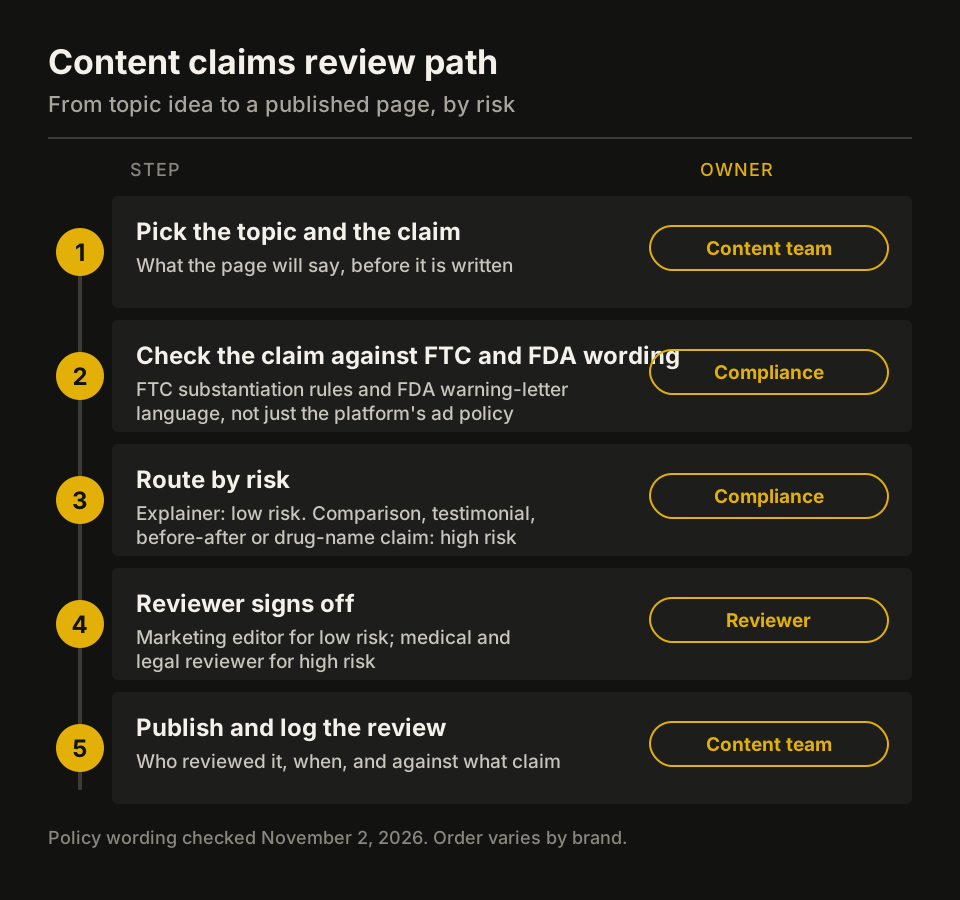
- Classify each piece’s claims risk using the table above before a draft is assigned, so the right reviewer is lined up from the start. If you’re deciding whether to hire this out, our checklist for choosing a GLP-1 marketing agency has the questions to ask a content or SEO vendor.
- Route high-risk pieces to compliance or legal while they’re still an outline, not as a final check on a finished draft. Catching a sameness or efficacy claim early costs a sentence; catching it after publication costs a correction.
- Name who wrote or clinically reviewed the page, cite primary sources such as FDA or a clinical reference instead of another blog, and keep that information visible on the page.
- Publish and log who reviewed it, so a question from a reader, a platform or a regulator has a clear answer.
- Recheck live pages when the underlying policy or label changes. FDA’s warning-letter language and Google’s own quality guidance both get updated, and a page written against last year’s rules can age out of compliance without anyone touching it.
FAQ
What is healthcare content marketing?
Healthcare content marketing is publishing educational or comparison content, such as blog posts, guides and comparison pages, on a health brand’s own site to earn trust and search traffic instead of buying all of it. For a GLP-1 telehealth brand, every claim in that content still needs the same substantiation a paid ad would need.
Why does content marketing matter for a GLP-1 telehealth brand specifically?
It matters because paid ads get a platform review before they run, while a brand’s own content does not. That makes the brand itself responsible for catching an implied-sameness or efficacy claim before a page is published, not after a regulator or platform flags it.
Is content marketing effective in healthcare?
It can be, when the content answers real questions and survives the same claims and sourcing checks a paid ad would face. Content that skips the FTC substantiation or Google’s E-E-A-T expectations risks a correction, a warning letter or simply ranking poorly, regardless of how much of it a brand publishes.
Does every piece of content need a medical reviewer?
No. The decision table above ties the reviewer to the claim, not the format. A general explainer with no outcome claim usually needs only a marketing or compliance editor. A comparison page, testimonial, before-and-after or drug-name claim is the kind FDA and the FTC scrutinize most, so those should get a medical or legal reviewer before they’re written, not after a draft is finished.
Sources
- FTC, Health Products Compliance Guidance (defines "advertising" to include "the variety of marketing techniques and promotion methods" used to drive consumer interest, not only traditional ads) · accessed
- FTC, FTC Announces New Business Guidance for Marketers and Sellers of Health Products (December 20, 2022; announces the Health Products Compliance Guidance; "more than 200 cases challenging false or misleading advertising claims") · accessed
- Google Search Central, Creating helpful, reliable, people-first content (defines YMYL, "Your Money or Your Life" topics, and E-E-A-T: experience, expertise, authoritativeness, trustworthiness) · accessed
- FDA, FDA Warns 30 Telehealth Companies Against Illegal Marketing of Compounded GLP-1s (March 3, 2026; "claims implying sameness with FDA-approved products") · accessed
- LegitScript, Certified But Still Getting Disapproved? Key takeaways from our telehealth advertising webinar (May 13, 2026; before-and-after guidance) · accessed
- FTC, Disclosures 101 for Social Media Influencers ("Disclose when you have any financial, employment, personal, or family relationship with a brand") · accessed