To choose a GLP-1 marketing agency, test it on five points before creative samples: the platform approvals your brand needs, who checks each ad’s claims, how it controls affiliates and influencers, how it reports against your target CPA, and the contract terms. Rule out any agency that guarantees approval or promises no bans.
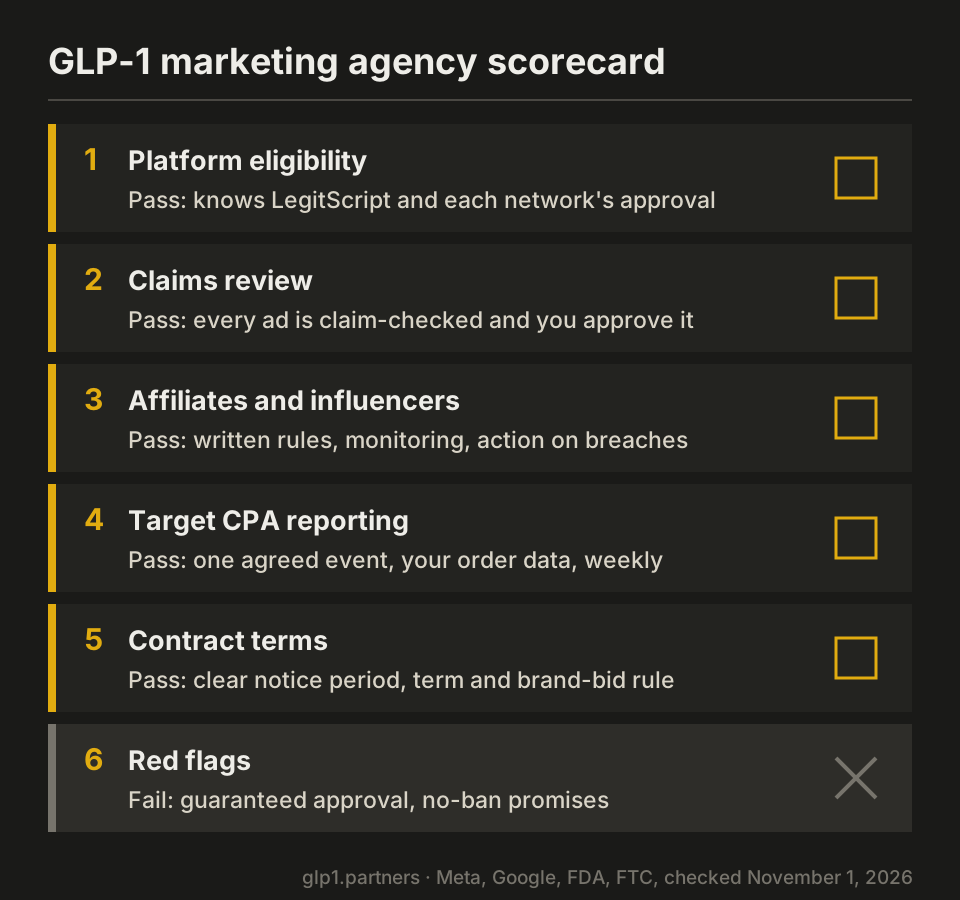
The GLP-1 marketing agency checklist
A GLP-1 marketing agency should give a specific answer to each question below on the first call. Vague answers on rows 1 to 3 cost the most, because they decide whether your ads run at all and whether your brand carries the risk for someone else’s copy.
| Area | Ask the agency | A good answer | A red flag |
|---|---|---|---|
| Platform eligibility | Which approvals does each channel need for a GLP-1 offer, and which do we already have? | Names LegitScript for Meta and Google, and each network’s own approval route | “Approvals don’t matter with our setup” |
| Claims review | Who checks each ad and landing page against FDA and FTC rules before launch? | A named step in the workflow, and you approve every ad | Creative goes live without your sign-off |
| Affiliates and influencers | What rules do your partners follow, and how do you check their ads? | Written claim and brand-bidding rules, regular checks, removal on breach | “Affiliates handle their own compliance” |
| Reporting | What counts as a conversion, and which system is the source of truth? | One agreed event, matched to your order data, reported by channel | Only platform-reported conversions |
| Contract | What is the notice period, the minimum term and the brand-bidding rule? | All three written in the agreement | Long lock-in with no performance review |
| GLP-1 track record | Which GLP-1 offers have you run, on which channels? | GLP-1 or telehealth work, described by channel and target | Case studies from other categories only |
Ask the same questions of every GLP-1 marketing company on your list, and write the answers down. Agencies that sound alike in a pitch usually split clearly on rows 1 and 3.
Platform eligibility: LegitScript and ad approvals come first
Platform eligibility is the first test because no media plan works if the ads can’t serve. Meta and Google both tie prescription drug and telehealth ads to LegitScript certification, and that certification belongs to your brand, not the agency.
Meta’s Drugs and Pharmaceuticals policy, checked on November 1, 2026, says:
“Meta requires online pharmacies and telehealth providers to be actively certified with LegitScript.”
Meta adds that once certified, they “must request authorization from Meta,” and may only target people 18 or older in eligible countries. Google’s Healthcare and medicines policy, checked the same day, says “Google allows telemedicine providers if they’re accredited by LegitScript’s Healthcare Merchant Certification Program” and that “Advertisers must also be certified with Google.”
Demand for certification is rising. LegitScript reported on September 22, 2026 a 59% increase in certification applications over the past year and “a 101% increase in telemedicine applications specifically.” An agency’s launch plan should start from where your application stands.
Questions that separate agencies on eligibility:
- Which of our channels need LegitScript, and which use the network’s own review?
- What does your plan do while our certification or Meta authorization is pending?
- How do you handle networks whose public policy restricts prescription drug ads?
The rules differ platform by platform. Our LegitScript requirements by ad platform guide lists the dated wording for Meta, Google, Microsoft, TikTok, Outbrain, Taboola and AppLovin.
Claims compliance: who checks every GLP-1 ad
Claims compliance decides whether your brand shows up in an FDA letter, and the agency writes most of the words that would be quoted. On March 3, 2026 FDA announced warning letters to 30 telehealth companies over compounded GLP-1 marketing, citing claims “implying sameness with FDA-approved products.”
The FTC sets the evidence bar for any health claim. Its Health Products Compliance Guidance says claims about the health benefits or safety of drugs “require substantiation in the form of competent and reliable scientific evidence.”
Ask each agency:
- Who reviews ads and landing pages for FDA and FTC issues, and at what step?
- Do we approve every ad before it goes live?
- Which phrases do you never use for compounded semaglutide or tirzepatide?
- How do you handle before-and-after images and promised weight loss in creative?
An agency that can list the flagged phrases without looking them up has done this before. The full list from the letters is in compounded GLP-1 advertising claims the FDA flags.
Affiliates and influencers: the agency’s partners are your ads
Under the FTC Endorsement Guides, your brand answers for what affiliates and influencers say about it, whoever recruited them. The Guides at 16 CFR 255.1(d) say “Advertisers are subject to liability for misleading or unsubstantiated statements made through endorsements,” and that advertisers should “Monitor their endorsers’ compliance.”
That makes partner control a buying question. Ask:
- Do affiliates and influencers get a written list of allowed and banned claims?
- Can partners bid on our brand name in search? Where is that rule written?
- How often do you check partner ads and pages, and what happens after a breach?
- Do we see which partner sent each order?
A brand-side view of where partner ads appear and which terms let you act is in how brands monitor GLP-1 affiliate ads.
Reporting: how a GLP-1 agency should measure against your target CPA
A GLP-1 agency should report against one target you agree before launch, checked against your own order data. Pick the metric: cost per completed intake, per first paid order or per started patient. Then agree which system decides what counted.
Points to settle in writing:
| Reporting point | What to agree |
|---|---|
| Conversion event | One event, defined in plain words (for example, first paid order) |
| Source of truth | Your own order data, not platform-reported conversions |
| Breakdown | Spend and results by channel, and by partner for affiliates |
| Cadence | A fixed weekly report against the target |
| Tracking | Events sent to Meta and others stay inside each platform’s health data rules |
Platform numbers and backend orders rarely match for telehealth brands, so a report built only on platform data can look better than your bank account. How public GLP-1 brands count acquisition cost is in our guide to telehealth customer acquisition cost.
Contract terms to read before signing
Contract terms decide how fast you can change course if the numbers miss. Read the agreement for these points before the first invoice:
- Notice period. How many days’ notice ends the agreement?
- Minimum term. Is there a lock-in, and is it tied to a performance review?
- Exclusivity. Does the agency work with competing GLP-1 brands, and is either side exclusive?
- Ad approval. Is your sign-off on every ad written into the contract?
- Brand bidding. Is the rule for affiliates and partners in the agreement itself?
- Hand-over. What do you receive at the end: reports, creative files and campaign history?
Red flags in a GLP-1 agency pitch
Some pitch lines should end the conversation. Each one either breaks a platform rule or promises something no agency controls.
- Guaranteed ad approval, or a promise that accounts will never be restricted.
- An offer to run prescription drug ads without your LegitScript certification where the platform requires it.
- Creative with promised pounds lost, before-and-after photos or “same as Ozempic” lines.
- Results quoted from other categories, presented as GLP-1 results.
- Reports with clicks and leads only, and no link to your orders.
- No written rule on affiliate brand bidding.
A step-by-step way to compare GLP-1 agencies
Comparing GLP-1 agencies takes six steps, and you can run all of them without us.
- Write your numbers down. Licensed states, current cost per patient, monthly capacity and your certification status.
- Shortlist agencies with GLP-1 or telehealth work. Ask for channels and targets, not logos.
- Send the checklist before the call. Score the written answers on the checklist table.
- Ask for a sample ad and its review notes. See how claims were checked.
- Read the contract against the six terms above.
- Start with a test budget and one agreed target. Judge the first weeks on your order data.
How the GLP1.partners media team runs it
We run GLP-1 and telehealth traffic at scale with platform approvals on every network we buy. On the first call we ask for the brand’s numbers and its certification status, because those decide which channels can start first.
- Meta: established agency accounts built for GLP-1 scale, with a dedicated Meta agency contact. The brand brings its LegitScript certification.
- Outbrain: established accounts with a dedicated setup for GLP-1.
- TikTok: creative made for the format and its ad rules.
- Instagram influencers, our own comparison sites and an affiliate network we manage, all measured against the brand’s target.
The brand approves every ad and sets the target, and we report by channel every week. If you want to see how we answer the checklist, start with our GLP-1 marketing agency page.
FAQ
Does a GLP-1 marketing agency need LegitScript certification?
No. LegitScript certifies the telehealth brand or pharmacy, not the agency. Meta and Google require the brand’s certification for telehealth and prescription drug ads, so the agency should ask for it early.
Should a GLP-1 brand hire a specialist or a general healthcare agency?
A specialist already knows the approvals, claim rules and conversion events in this category. A general healthcare agency can work if it answers the checklist above as specifically as a specialist would.
What questions should I ask a telehealth marketing agency on the first call?
Ask which approvals each channel needs, who checks ad claims, how partners are controlled, what counts as a conversion, and what the notice period is. Specific answers to those five matter more than case-study design.
Sources
- Meta Transparency Center, Advertising Standards: Drugs and Pharmaceuticals · accessed
- Google Ads, Healthcare and medicines policy · accessed
- LegitScript, Certification Applications Rise 59%, Led by 101% Growth in Telemedicine (September 22, 2026, self-reported) · accessed
- FDA, FDA Warns 30 Telehealth Companies Against Illegal Marketing of Compounded GLP-1s (March 3, 2026) · accessed
- FTC, Health Products Compliance Guidance · accessed
- FTC Endorsement Guides, 16 CFR 255.1 (Cornell LII) · accessed