Telehealth customer acquisition cost (CAC) is acquisition spend divided by new paying patients in the same period. For a GLP-1 brand, set it on one event, the paid first order, and check it again at the first refill. Hims & Hers and LifeMD, two public telehealth companies selling GLP-1 care, disclose quarterly acquisition spend but no per-patient figure.
What Hims & Hers and LifeMD disclose about acquisition spend
Hims & Hers reports a line called “customer acquisition costs” and LifeMD reports “advertising and marketing expenses”. Neither company reports a cost per new patient. These are the figures from their latest filings:
| Company, period | Reported line | Amount | Context in the same filing |
|---|---|---|---|
| Hims & Hers, FY2025 (10-K, filed February 23, 2026) | Customer acquisition costs | $798.5M (FY2024: $594.5M) | Marketing expenses $919.3M; revenue $2,347.6M; Subscribers up 13% to about 2,511,000 |
| Hims & Hers, Q1 2026 (10-Q, filed May 11, 2026) | Customer acquisition costs | $192.8M (Q1 2025: $201.6M) | Marketing $222.0M; revenue $608.1M; Subscribers about 2.6M (up 9%) |
| Hims & Hers, Q2 2026 (10-Q, filed August 10, 2026) | Customer acquisition costs | $229.5M (Q2 2025: $188.4M) | Marketing $262.2M (up 20%); revenue $753.2M (up 38%); Subscribers about 2.9M (up 19%, includes the Eucalyptus acquisition) |
| LifeMD, Q1 2026 (10-Q, filed May 6, 2026) | Advertising and marketing expenses | $29.9M (Q1 2025: $22.3M) | Total revenues $50.2M; “over 365,000 active patient subscribers” on March 31, 2026 |
| LifeMD, Q2 2026 (10-Q, filed August 5, 2026) | Advertising and marketing expenses | $28.0M (Q2 2025: $22.2M) | Total revenues $47.3M; “approximately 356,000 active patient subscribers” on June 30, 2026 |
Filings checked on October 30, 2026. Neither company had filed its Q3 2026 10-Q on that date.
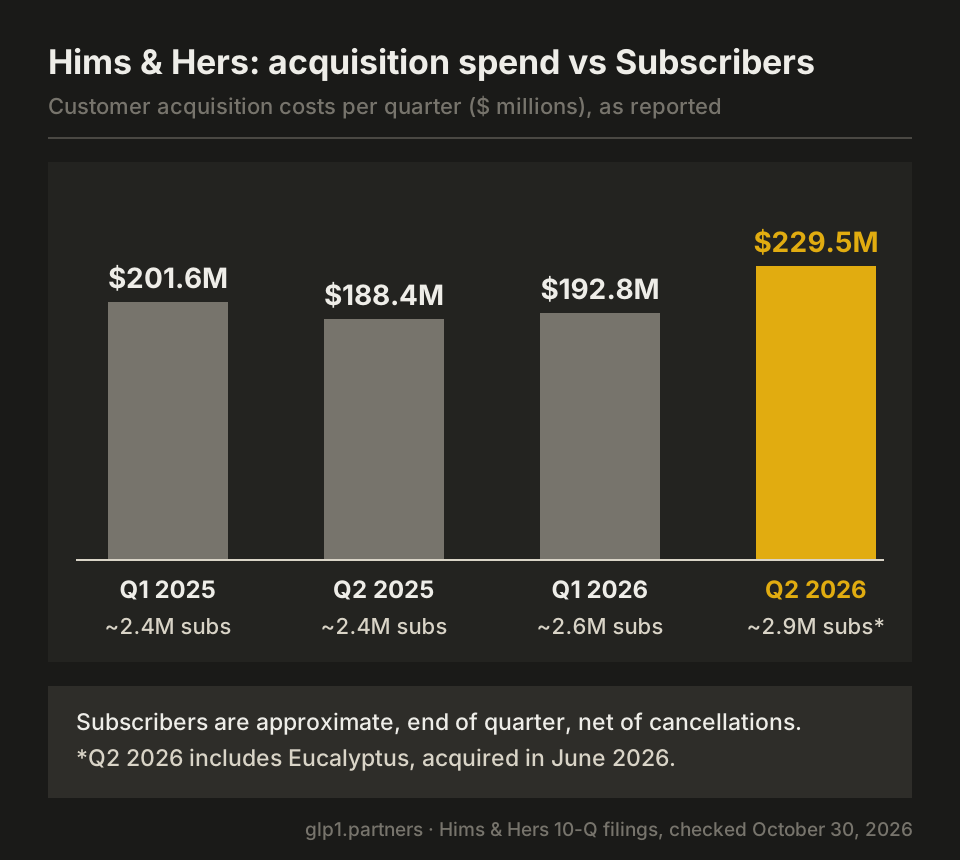
The Hims line is broader than “cost to win a customer”. Its Q2 2026 10-Q defines customer acquisition costs as “the advertising and media costs associated with our efforts to acquire new customers, promote our brands, and build awareness for our products and services.” It includes digital, social, TV, radio and out-of-home media and excludes content production.
The filings also give reasons for the swings. Q1 2026 fell on “management’s decision to focus on more efficient acquisition channels.” Q2 2026 rose “primarily a result of management’s decision to increase investment in search and affiliate marketing.” In between, Hims’ March 2026 “2026 US WL Announcement” moved its US weight-loss offering toward branded GLP-1 medications, with compounded GLP-1 “on a limited scale”, so the 2026 quarters sit on both sides of a product change.
LifeMD management described the trend on the Q1 2026 call: “Customer acquisition costs improved 4% to 5% sequentially in Q1 even as volumes effectively doubled, from roughly 300 to 400 new patients per day to 600 to 1 thousand patients per day.” It did not give a dollar figure per patient.
Why a per-patient CAC can’t be read from Hims or LifeMD filings
A spend line divided by a subscriber count does not give a per-patient CAC, for four reasons found in the filings themselves:
- Subscribers are a point-in-time count. Hims’ 10-K defines them as customers who “have agreed to be automatically billed on a recurring basis”. The change between quarters is new customers minus cancellations, so it understates how many customers the spend bought.
- Acquisitions add customers no ad paid for. Hims’ Q2 2026 Subscriber count includes Eucalyptus, an Australian platform bought in June 2026.
- The spend lines include awareness. Hims’ definition covers brand promotion and TV. LifeMD’s line covers all advertising and marketing across primary care, weight management and its other services.
- LifeMD’s count fell while spend held. Active patient subscribers went from over 365,000 to about 356,000 between March and June 2026, while quarterly spend stayed at $28M to $30M. Cancellations outnumbered new patients that quarter, and the count can’t show how many the spend bought.
The filings show scale and direction, and your own CAC still has to come from your order system.
Which event a GLP-1 CAC should be set on
Set a GLP-1 CAC on the paid first order and check it at the first refill. Every earlier event is cheaper and easier to count, and that is why vendor CAC numbers disagree: they price different rungs of the same funnel.
| Event | What you are paying for | Who reports it | What it hides |
|---|---|---|---|
| Lead (email or quiz start) | Interest | Ad platform | Leads who never finish intake |
| Intake completed | A finished questionnaire | Your intake tool | Drop-off at consult and payment |
| Provider consult | A clinician’s time | Your EHR or provider network | Consults that end without a prescription |
| Prescription decision | A provider’s decision | Your provider network | Patients who never pay |
| Paid first order | A paying patient | Your order system | Refunds and cancellations before the second order |
| First refill | A patient who stayed | Your order system | Nothing at this stage; this is the check |
One dated anchor shows how far apart the rungs sit. LocaliQ’s 2026 search benchmarks put the average cost per lead for Health & Fitness at $67.36 (last updated June 1, 2026). That is a lead price across a broad category and says nothing about a paid GLP-1 order.
To turn your contribution per patient into a target CPA, use the method in how to scale a GLP-1 telehealth brand.
How the GLP1.partners media team works against a brand’s CAC target
The GLP1.partners media team takes the brand’s CAC target, and the event that target is set on, as the starting point. Every channel is then reported against that one number each week. We run GLP-1 and telehealth traffic at scale with platform approvals on every network we buy.
- Meta: established agency accounts built for GLP-1 scale, with a dedicated Meta agency contact. The brand brings its LegitScript certification.
- Outbrain: established Outbrain accounts with a dedicated setup for GLP-1.
- TikTok, and Instagram influencers, each with creative made for its own format.
- Our own comparison sites and an affiliate network we manage, both held to the brand’s CAC target.
More on the channel mix is on our paid media page.
How to read a telehealth CAC benchmark
Before you compare your CAC to a published range, check five things. None of the four GLP-1 ranges in the table below states all five.
- Event: lead, consult, paid first order or refill.
- Scope: paid media only, or fully loaded with agency fees, creative and tools.
- Period: which months, and before or after a product or price change.
- Spend level: CAC can move with monthly budget.
- Data source: a filing, a platform dataset, or the author’s own accounts.
Applied to the GLP-1 numbers that rank for this query (all checked October 30, 2026):
| Source (vendor page) | GLP-1 claim | Event stated | Data source stated |
|---|---|---|---|
| ClinicAds, telehealth marketing guide 2026 | “$150 to $250” for GLP-1 weight loss | Patient who “completes intake and starts a plan” | “agency averages” |
| Telehealth Media | “$180-320 fully-loaded CAC” compounded, “$250-400” brand-name, at “$100-300K monthly spend” | Net new paying patients | None stated |
| Roveia (June 2, 2026) | $250 to $500 | Not defined | None stated |
| Bask Health, telehealth P&L | “$50 to $929 per patient” (all telehealth) | Not defined | None stated |
These ranges may well reflect what each author has seen. Without an event and a data source, though, you can’t tell whether your CAC is high or theirs was measured on a cheaper rung.
Platform costs and limits a GLP-1 brand meets before the first patient
Two Meta rules shape a GLP-1 brand’s CAC before any ad runs: LegitScript certification with Meta authorization, and limits on health data that affect what Meta can count.
- LegitScript certification on Meta. Meta says: “Meta requires online pharmacies and telehealth providers to be actively certified with LegitScript.” Advertisers must also “Obtain authorization from Meta” and may only target the United States, Canada or New Zealand. Which other platforms ask for it is in LegitScript by ad platform.
- Meta’s health data limits. Meta lists “telemedicine platform, pharmacy” among its health and wellness data source examples, and sites in that category can face data-sharing restrictions. Lower-funnel events may reach Meta only in part, so platform-reported CAC drifts from your order data. See Meta’s health data rules for telehealth tracking.
Policy checked on October 30, 2026.
What lowers GLP-1 CAC without breaking the target
GLP-1 CAC comes down when the brand fixes what it counts and where patients drop out before it adds spend. These steps work with or without an agency.
- Write down the event. Paid first order, with a refill check at the second billing date.
- Count CAC in your own order system. Use platform numbers as a second opinion, given Meta’s health data limits.
- Find the leak between intake and first order. Measure intake-to-consult, consult-to-prescription decision and decision-to-payment separately. A drop at payment points to pricing or checkout.
- Check refill rate by channel. A channel with a cheap first order and weak refills costs more than it looks.
- Subtract refunds and cancellations before the second order from your new-patient count before you divide.
- Add channels one at a time with a fixed test budget, and judge each on blended CAC.
- Price affiliate payouts as a CAC line. A payout per sale is part of the same target. How those deals are usually set up is in how GLP-1 affiliate programs work.
FAQ
What is telehealth CAC?
Telehealth CAC is the cost to win one new paying patient: acquisition spend divided by new paying patients in the same period. GLP-1 brands should define “paying” as a paid first order.
How do you calculate patient acquisition cost?
Take acquisition spend for a period (paid media alone, or fully loaded) and divide it by new paid first orders in that period, after removing refunds and cancellations before the second order. State which version you used.
What is a good customer acquisition cost for a GLP-1 brand?
A good CAC is one your contribution per patient pays back inside the window you set. Several vendor pages, including Bask Health and ClinicAds, cite an LTV:CAC ratio of 3:1 as a rule of thumb. Your own refill data matters more than any published range.
Does Hims & Hers report its customer acquisition cost?
Hims & Hers reports total customer acquisition costs each quarter ($229.5M in Q2 2026), not a cost per customer. Per-customer figures quoted online are third-party calculations, not numbers Hims reports.
Sources
- Hims & Hers Health, Form 10-Q for the quarter ended June 30, 2026 (filed August 10, 2026) · accessed
- Hims & Hers Health, Form 10-Q for the quarter ended March 31, 2026 (filed May 11, 2026) · accessed
- Hims & Hers Health, Form 10-K for the year ended December 31, 2025 (filed February 23, 2026) · accessed
- LifeMD, Form 10-Q for the quarter ended June 30, 2026 (filed August 5, 2026) · accessed
- LifeMD, Form 10-Q for the quarter ended March 31, 2026 (filed May 6, 2026) · accessed
- LifeMD Q1 2026 earnings call transcript (The Motley Fool, May 6, 2026) · accessed
- SEC EDGAR, Hims & Hers Health filing history (no Q3 2026 10-Q as of access date) · accessed
- SEC EDGAR, LifeMD filing history (no Q3 2026 10-Q as of access date) · accessed
- LocaliQ, Search Advertising Benchmarks 2026 (last updated June 1, 2026) · accessed
- Meta Transparency Center, Advertising Standards: Drugs and Pharmaceuticals · accessed
- Meta Business Help Center, About data source categories in Meta Events Manager · accessed
- ClinicAds, Telehealth marketing guide 2026 (vendor claim) · accessed
- Telehealth Media, Telehealth patient acquisition cost (vendor claim) · accessed
- Roveia, GLP-1 customer acquisition costs (June 2, 2026, vendor claim) · accessed
- Bask Health, Telehealth P&L (vendor claim) · accessed