GLP-1 patient retention means keeping an already-approved patient refilling instead of lapsing. Patients drop off from cost, side effects, a result that falls short of expectations, or friction at the refill step. Reactivation outreach wins some back, and each channel it uses carries its own consent and disclosure rules.
This isn’t the patient-communications work a pharma manufacturer buys from a patient engagement agency. It’s what a GLP-1 telehealth brand (or a growth partner working on its behalf) does inside its own refill and support operations.
Where GLP-1 patients drop off between refills
Refill drop-off traces back to the same handful of triggers on nearly every GLP-1 program: what the patient pays, how the drug makes them feel, and whether anyone reaches them before the next charge.
Cost shows up as a second or third charge that feels bigger once the novelty of starting treatment has worn off. Side effects and expectation mismatch show up as patients who started for one outcome, hit a plateau or a symptom they didn’t plan for, and quietly stop rather than call anyone. Friction shows up as a failed card, a missed reminder, or simply no contact between the first order and the next billing date. Nobody told the patient anything was coming.
None of this is new information if you already track your funnel. For the full seven-stage metric map, from the first ad click through the first refill, see our guide to the GLP-1 patient journey. This page goes deeper on that guide’s stage 7: the refill stage itself, and what a brand actually does about it.
What a reactivation flow looks like operationally
A reactivation flow is a sequence of touches triggered the moment refill signals go quiet, not a single blast sent after the patient has already lapsed for a month.
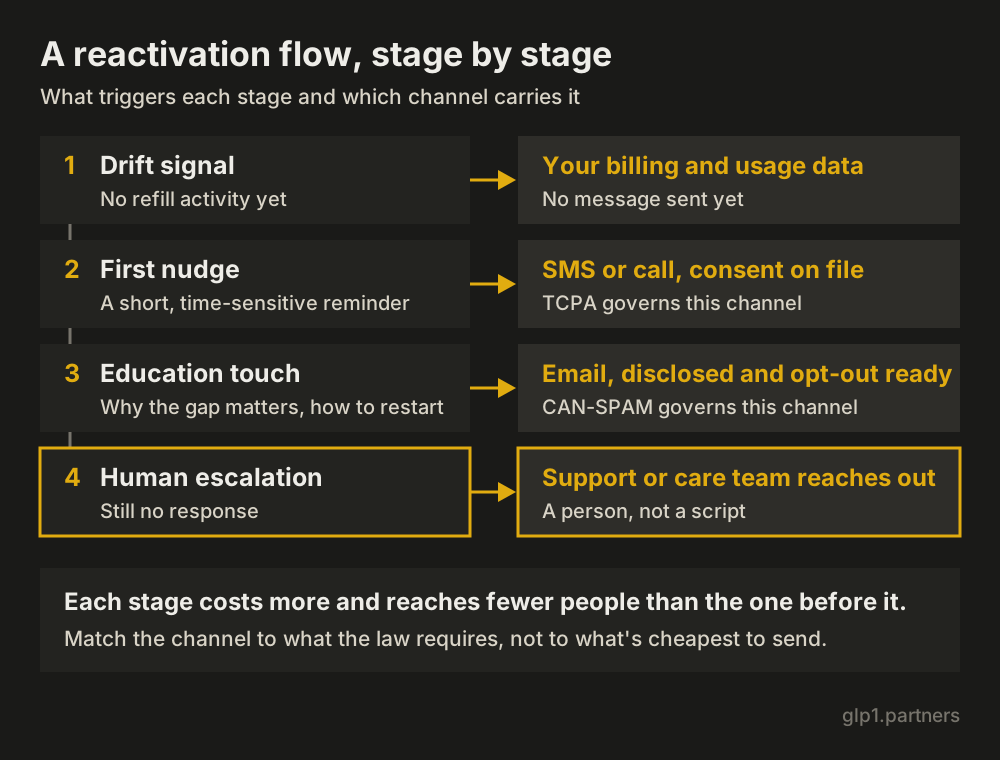
The four stages work like this:
- Drift signal. No order confirmed, no refund request, no obvious reason, just activity that has gone quiet ahead of the next billing date. This stage sends nothing; it decides when stage two fires.
- First nudge. A short, time-sensitive reminder, usually by text or a call, aimed at the patient who still has a live reason to act (a refill window that’s about to close, a card that’s about to expire).
- Education touch. A longer message, usually email, that explains why the gap matters and how to pick back up. This is where you make the case, not just the reminder.
- Human escalation. If neither touch gets a response, a support or care-team person reaches out directly. This stage is the most expensive per patient and the one most likely to actually save the relationship.
The reason to split it this way, rather than running one generic “best practices” reminder sequence, is that SMS and email aren’t interchangeable. They carry different timing, different expectations, and (as the next section covers) different legal requirements.
What outreach rules a reactivation flow has to respect
A reactivation flow has to follow different rules for each channel it uses: the Telephone Consumer Protection Act for texts and calls, the CAN-SPAM Act for email, and a separate set of rules entirely for anything that goes to an ad platform rather than directly to the patient.
| Channel | What the law requires | What it means for a reactivation message | Source |
|---|---|---|---|
| SMS and calls | The Telephone Consumer Protection Act bars certain automated calls “without the prior express consent of the called party” | Get consent before you send automated refill texts or calls, and keep a record of it: a signup-time checkbox the patient agreed to is the kind of thing you want on file | 47 U.S.C. § 227(b), via Cornell Law School Legal Information Institute |
| The CAN-SPAM Act applies to every commercial email, business-to-business included (“the law makes no exception for business-to-business email”), and requires a clear, conspicuous ad disclosure and a working opt-out honored within 10 business days | Label a reactivation email as what it is, give it a real opt-out link, and process opt-outs fast: violations can run up to $53,088 per email | FTC, CAN-SPAM Act: A Compliance Guide for Business | |
| Ad-platform tracking (Meta Pixel, Conversions API) | A separate rule set entirely, covering what health data can reach an ad platform at all | Don’t confuse “can I text this patient” with “can I send this event to Meta.” Direct outreach and ad-platform tracking are different channels with different law behind them | Covered on our Meta health data restrictions page (not repeated here) |
The TCPA’s own text sets the baseline for the SMS and calls row above: prior express consent is required before certain automated calls go out. In practice, document that consent at the time you capture it rather than inferring it later from someone’s status as a patient.
Why retention changes what you can pay to acquire a patient
A stronger refill rate raises what a brand can afford to pay to acquire a patient, because the first order stops being the whole return on that spend and starts being a down payment on several more.
This is a growth-economics argument as much as an operational one. Two brands can pay the exact same cost per first order and end up with very different economics depending on how many of those patients are still paying three months later. We cover the calculation itself, including the event your CAC should actually count, in telehealth customer acquisition cost. This page isn’t going to redo that math. It’s just flagging that retention is the lever sitting underneath it.
How the GLP1.partners media team thinks about retention
The GLP1.partners media team works on acquisition. We still care about retention, because it tells us whether the traffic we sent was ever a good match for the brand in the first place.
As the GLP1.partners media team put it: “Affiliates whose customers keep refilling are the ones who give customers all the information they need and make them want to stay with the brand.” A visitor who was sold an accurate picture of the product, the price and what to expect is a visitor who’s still around for the second charge. A visitor who clicked on a mismatched promise usually isn’t. That’s why refill rate by source matters as much as cost by source: a cheap source with a weak refill rate isn’t actually cheap.
A reactivation checklist a brand can run this month
- Define “drift” for your own program: the number of days past a missed billing date where you’ll trigger stage one, before a patient has formally canceled.
- Confirm you have documented consent on file for every patient you plan to text or call, not just email.
- Write the SMS nudge and the email education touch as two separate messages with two separate jobs. Don’t send the same copy twice on two channels.
- Add a clear, working opt-out to every reactivation email, and route opt-outs somewhere that actually removes the patient within 10 business days.
- Set a trigger for stage four: a fixed number of unanswered touches, after which a person, not another automated message, reaches out.
- Keep drug names, dosages and condition details out of any data feed that touches an ad platform. That’s a separate rulebook from the one in the table above.
- Report refill rate by original acquisition source, so you can see which channels bring patients who stay past the first order.
FAQ
What is patient engagement for a GLP-1 brand?
For a GLP-1 telehealth brand, patient engagement means the reminders, education and support that keep an already-approved patient active between orders. It’s a different service from the patient engagement agencies that handle communications programs for drug manufacturers. This is a brand’s own refill and retention operation, often run with a growth partner.
Why do GLP-1 patients stop refilling?
GLP-1 patients stop refilling mainly for three reasons: the ongoing cost, side effects or a result that doesn’t match what they expected, and friction at the refill step itself, such as a failed card or no contact between orders.
Do I need consent to text a patient about a refill?
Get consent first. The Telephone Consumer Protection Act requires the called party’s prior express consent before certain automated calls go out, and automated refill texts should be handled the same way. Document that consent rather than assuming it from the fact that someone is already a patient.
Is a refill text the same thing as retargeting a patient on Meta?
No. A refill text or email is direct outreach governed by the TCPA and CAN-SPAM. Sending a patient’s health data to an ad platform for retargeting is a separate question, governed by that platform’s own rules. See our guide to Meta health data restrictions for telehealth.