To become a GLP-1 affiliate, pick one traffic source that GLP-1 programs accept, get a live site or audience ready with a disclosure next to every link, and learn the brand’s claim rules. Then find a program, get its terms in writing, and run a small first 30 days before you scale.
A GLP-1 affiliate sends visitors to a GLP-1 telehealth brand through a tracking link and earns a commission when a visitor buys. The brand sells a prescription service, so the rules on traffic and claims are tighter than in most niches. This guide covers the order to do things in, with each brand’s rule quoted from its own program page, checked November 1, 2026.
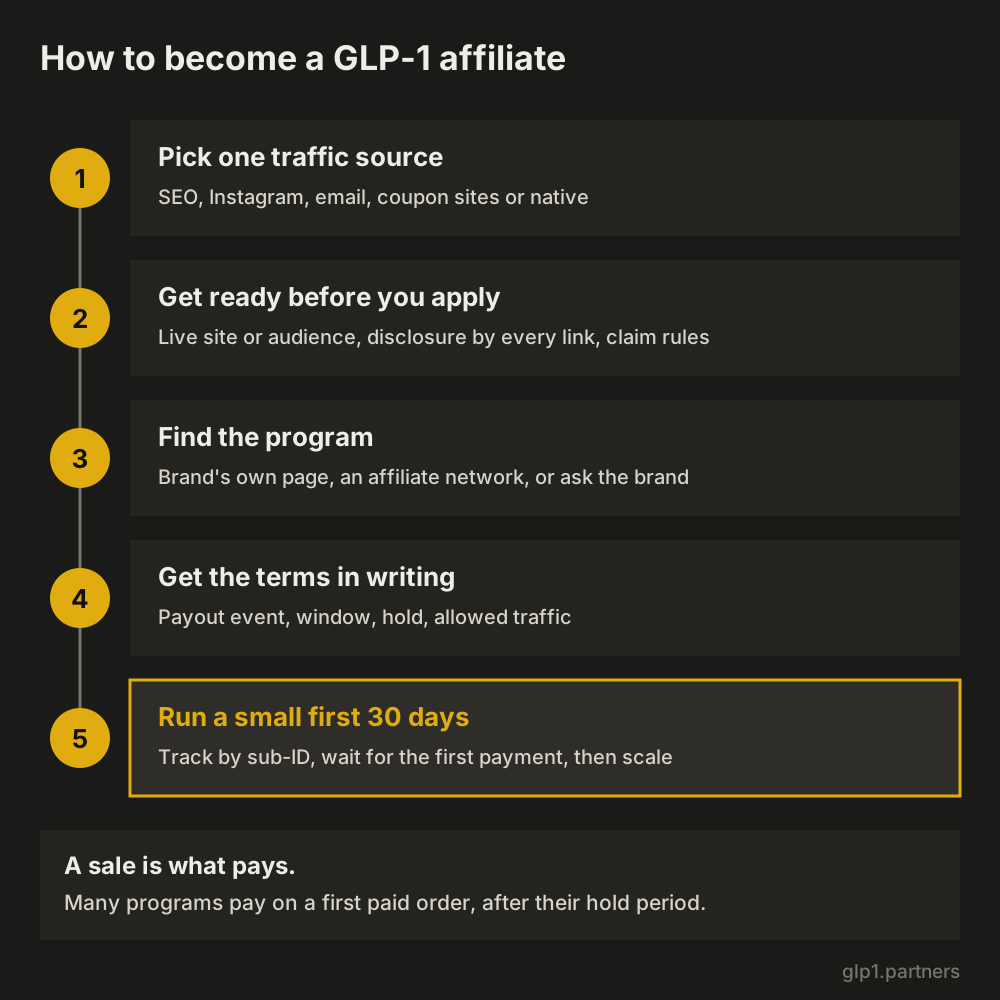
Step 1: choose a traffic source GLP-1 programs accept
The traffic source decides which GLP-1 programs will approve you, so choose it before you apply anywhere. The program pages ask most for content sites and creators. Paid social from your own ad account is the hardest, because Meta requires the advertiser to be certified: “Meta requires online pharmacies and telehealth providers to be actively certified with LegitScript.”
| Traffic source | What GLP-1 programs say | What to sort out first |
|---|---|---|
| SEO and content sites | Found asks for “an active website or platform with content that aligns with Found’s products and audience.” HealthRX lists SEO publishers and reviewers among the partners it wants | Published pages on the topic before you apply |
| Meta and other paid social | HealthRX: “Never on Google or Meta for prescription products from your own ad accounts, and never as TikTok branded content.” | Written approval from the brand for any paid social |
| Native (Outbrain, Taboola) | HealthRX asks affiliates to send paid media plans on other platforms to its partner team first. Taboola restricts online pharmacies, and those campaigns must “Have prior permission from Taboola” | The brand’s OK and the network’s own approval |
| Email and newsletters | HealthRX lists newsletter writers as a partner type. Under CAN-SPAM, “Both the company whose product is promoted in the message and the company that actually sends the message” may be held responsible | Your own opt-in list and the brand’s email rules in writing |
| Coupon and deal sites | Split by program: Found won’t approve them, HealthRX lists comparison and deal sites among the partners it wants. GLP1.partners accepts coupon and deal sites | Which brands accept coupon traffic, see coupon sites and GLP-1 offers |
| Instagram influencers | Good Girl Rx asks creators to send drafts for review before posting; Mondae requires partners to disclose the relationship | A disclosure in every post, plus the brand’s review step |
| Push and pop traffic | GLP1.partners doesn’t accept push or pop traffic | Pick another source from this table |
If you already run one of these sources in another niche, start there. A content site with health or weight pages, or an Instagram audience that talks about weight loss, is a shorter path than learning a new channel and a new vertical at the same time.
Step 2: what you need before you apply to a GLP-1 program
Before you apply to a GLP-1 affiliate program, have three things in place: somewhere real to send traffic from, a disclosure next to each affiliate link, and a working knowledge of the claims you can’t make. Programs look at all three when they review your application.
A live site or audience
GLP-1 programs approve publishers they can check. Found says it “will not approve any coupon sites, browser extensions, non-working websites.” A half-built site or an empty profile gives the program nothing to review.
Disclosures under the FTC Endorsement Guides
Every GLP-1 affiliate link needs a disclosure the reader can’t miss. The FTC’s Endorsement Guides (16 CFR Part 255) apply to affiliates. The FTC is specific on three points:
- Placement. The FTC’s FAQ: “A single disclosure on your home page won’t be sufficient.” Put “Paid link” or a plain sentence next to each link.
- Wording. The FTC’s Disclosures 101 guide says: “Don’t use vague or confusing terms like ‘sp,’ ‘spon,’ or ‘collab.’”
- Platform tools. The same guide: “Don’t assume that a platform’s disclosure tool is good enough.” On Instagram, use the paid-partnership label and say it in the post too.
The claim rules
GLP-1 brands ban outcome claims, and the FDA’s enforcement on compounded GLP-1 makes the brand’s claim list part of your job. Brand pages are blunt about it. HealthRX: “Never promise medical outcomes.” Mondae: “Partners may not make claims about weight loss results or promise that anyone will be prescribed medication.”
On March 3, 2026 the FDA warned 30 telehealth companies over compounded GLP-1 marketing, citing “claims implying sameness with FDA-approved products.” Your page is the brand’s advertising, so never write “generic,” “same as Ozempic” or “FDA approved” about a compounded drug. The lines FDA has flagged are collected in misleading GLP-1 ad claims and the FDA.
GLP1.partners applies these rules on its GLP-1 offers: brand-approved claims only, no before-and-after images, no weight-loss result claims and no bidding on brand names.
Step 3: where GLP-1 affiliate programs live
GLP-1 affiliate programs live in three places: on the brand’s own site (often a footer link), on an affiliate network, or with the brand’s partner team when nothing is public. Found states “We partner with Impact to manage our affiliate program,” and HealthRX lists its program on both Awin and Katalys. Many brands show no link at all.
The search method, step by step, is in how to find out if a GLP-1 brand has an affiliate program. When you compare what you find, the offers fall into a few types:
- Telehealth subscription plans. Monthly or multi-month plans for GLP-1 weight-loss care.
- Branded or compounded drugs. Some brands sell both. Compounded offers carry the extra claim rules from Step 2.
- Lead-stage offers. A few programs pay before the first order. TrimRx’s FlexOffers listing pays per “valid Credit Card Submit.”
Step 4: get the GLP-1 program’s terms in writing
Before you send traffic, get four GLP-1 program terms in writing: the payout event, the window, the hold and the traffic you may use. In most programs the payout event is a sale, and clicks, quiz starts and sign-ups earn nothing. Good Girl Rx defines it as “a first paid, doctor-approved order placed by a new customer through your unique link,” and says it never pays on “quiz starts, sign-ups, or approvals alone.”
Three terms decide when that sale turns into money, and each program sets them differently:
- The window. Good Girl Rx: “Your unique link tracks clicks for 14 days.” HealthRX uses a “30-day last-click cookie.”
- The trigger. Mondae counts a signup once the medication “has shipped from the pharmacy.” HealthRX pays on “first orders on 3-month and longer plans” and nothing on monthly plans.
- The hold. Good Girl Rx: “A commission locks after the customer’s first refill ships or 45 days, whichever comes first.” A refund before the lock reverses it.
Industry payout models range from a flat CPA per new customer to tiers by plan length, a percentage of the sale, or a recurring amount per active subscriber. The full click-to-payout cycle, with eight programs side by side, is in how GLP-1 affiliate programs work.
Step 5: your first 30 days as a GLP-1 affiliate
The first 30 days as a GLP-1 affiliate are a test of the program as much as of your traffic. Send a small amount, label every source, and don’t scale until the first payment arrives. Good Girl Rx, for example, pays monthly after the month closes, net-30, with a $50 minimum that rolls forward, so a first payment can land well after day 30.
- Week 1: set up tracking. Put your tracking link on one or two pages or posts. Use sub-IDs to label the traffic source only, never with personal or health details.
- Week 2: send limited traffic. Watch whether clicks show up in the program’s dashboard and whether the brand’s landing page matches what your page promises.
- Week 3: check the first conversions. Compare sales in your report with the window and trigger you got in writing. Ask the program about any order you expected and don’t see.
- Week 4: check the hold and the payment date. See which commissions are pending, when each one locks and when the first payment is due. Add traffic once that payment arrives as the terms said, or move it to a program whose terms held up better.
Keep the brand’s approved claims and your disclosure on every new page you add during the test. A page that breaks the rules can cost you the account before the first payment.
FAQ
Do you need a website to become a GLP-1 affiliate?
Not always, but you need a real audience the program can check. Content programs such as Found ask for “an active website or platform,” and creator programs accept Instagram or other social accounts with a disclosure in each post.
Can a beginner join a GLP-1 affiliate program?
Yes, if the traffic source is real and the content follows the brand’s claim rules. The program pages we checked ask about the site or platform and its content, not your years in affiliate marketing, so publish first and apply second.
Can GLP-1 affiliates run Meta ads?
Usually not from their own ad account. Meta requires telehealth providers to be LegitScript certified, and HealthRX bans prescription ads “on Google or Meta” from affiliates’ own accounts. Ask the brand in writing before you spend.
Is GLP-1 affiliate marketing legal?
Affiliate links to telehealth brands are a normal part of the category, and the brands run public programs for them. The rules that apply to you are the FTC Endorsement Guides on disclosure, the brand’s claim rules, and the ad platform’s own policy for any paid traffic.
How do GLP-1 affiliates get paid?
GLP-1 affiliates get paid per sale, after the program’s hold period, on the program’s payment cycle. Our GLP-1 affiliate program pays weekly or monthly depending on the deal, and a conversion is a sale.
Sources
- Found, Affiliates · accessed
- HealthRX, Affiliates · accessed
- Good Girl Rx, Affiliate Program · accessed
- Mondae, Partner Program · accessed
- FTC, FTC's Endorsement Guides: What People Are Asking · accessed
- FTC, Disclosures 101 for Social Media Influencers · accessed
- eCFR, 16 CFR Part 255 (Guides Concerning the Use of Endorsements and Testimonials in Advertising) · accessed
- FTC, CAN-SPAM Act: A Compliance Guide for Business · accessed
- Meta Transparency Center, Advertising Standards: Drugs and Pharmaceuticals · accessed
- FlexOffers, TrimRx affiliate program · accessed
- Taboola Realize Help Center, Restricted Content, Products, and Services · accessed
- FDA, FDA Warns 30 Telehealth Companies Against Illegal Marketing of Compounded GLP-1s (March 3, 2026) · accessed