Moving from nutra to GLP-1 telehealth offers changes five things. You get offers through approved programs, not open catalogs. The conversion is a paid order that a clinician has reviewed. Traffic is US-only. Creative follows the brand’s approved claims. And payouts sit in a hold before they lock.
If you already run nutra and have decided to test GLP-1, the comparison of nutra vs telehealth affiliate offers below goes row by row: what carries over from your nutra setup, what breaks on day one, and which GLP-1 “supplement” offers aren’t GLP-1 offers at all. GLP1.partners doesn’t accept push or pop traffic on GLP-1 offers, so push and pop buyers should read the traffic section first. Whether the vertical is worth it at all is a separate question, covered in is GLP-1 affiliate marketing worth it.
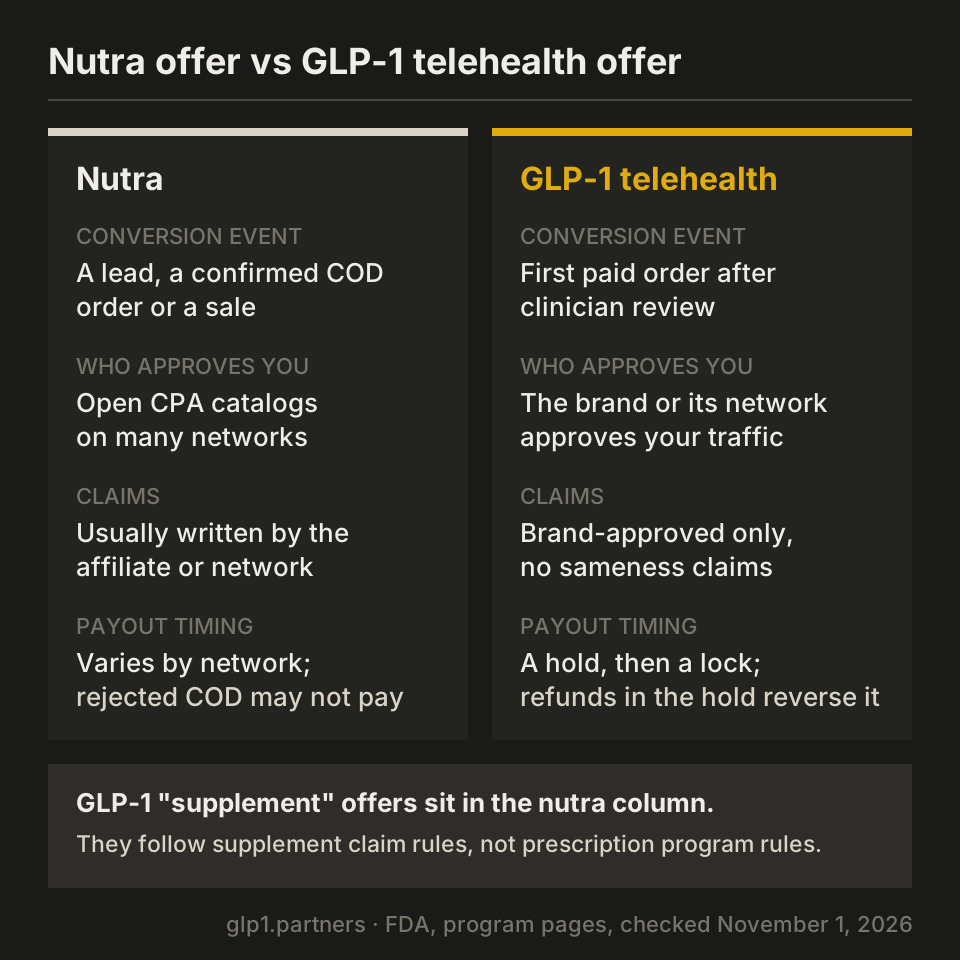
Nutra vs GLP-1 telehealth offers, side by side
Nutra and GLP-1 telehealth offers differ on every row that decides your margin: who gives you the offer, what counts as a conversion, where the traffic can come from and when the money becomes yours. The nutra column describes the vertical in general terms. The GLP-1 column comes from FDA, FTC, platform and program pages, checked November 1, 2026.
| Dimension | Typical nutra offer | Prescription GLP-1 telehealth offer |
|---|---|---|
| Product | Supplements and other health products sold through performance ads | A telehealth program where a licensed clinician reviews the customer’s intake and may prescribe semaglutide or tirzepatide (branded or compounded) |
| Offer access | Open CPA catalogs on many networks | Direct from the brand, or through a network the brand works with, after your traffic is approved |
| Payout models | CPA, CPL and COD are common; some networks offer RevShare | Mostly CPA on a first paid order |
| What converts | A lead, a confirmed COD order or a sale, depending on the offer | A first paid order after clinician review. At programs such as Good Girl Rx, quiz starts and sign-ups alone don’t pay |
| Who decides the conversion | The buyer and the call center or checkout | The clinician review and the brand’s billing, after the visitor leaves your page |
| Geo | Tier 1 to Tier 3; Tier 2 and 3 are popular for push and pop | US only. Ask each brand which states it serves |
| Main traffic | Push and popunder, plus native and SEO content | Content, search, native with brand-approved pre-landers, and paid social on brand-approved terms |
| Creative | Usually written by the affiliate or the network | Brand-approved claims only. Compounded drugs can’t be called generic or “the same as” an FDA-approved drug |
| Certification | Rarely an affiliate question | Meta requires telehealth advertisers of prescription drugs to hold LegitScript certification. That certification sits with the brand and doesn’t cover your own ad account |
| Payout timing | Varies by network | A hold, then a lock. Good Girl Rx: “A commission locks after the customer’s first refill ships or 45 days, whichever comes first.” |
| Clawbacks | Rejected or returned COD orders may not pay | Refunds or cancellations inside the hold reverse the payout |
The nutra column draws on a nutra vertical guide from the ad network ROI Ads (updated July 31, 2026), which says “Push notifications and popunder ads are the go-to formats for running nutra campaigns.” For a switcher, that line matters more than any payout row (see the traffic section below).
GLP-1 supplement offers are a different product
A “GLP-1 supplement” offer is a dietary supplement sold on a GLP-1 angle, and it isn’t a prescription GLP-1 offer. Networks pitch these products to the same audience as a bridge between the two verticals: XenTraffic’s Q1 2026 offer roundup (March 12, 2026) lists a “Supplement Bridge” play sold as “Natural GLP-1 Support” and a “Fiber / Gut Health Bridge.” They follow supplement claim rules, which apply to the pre-lander as much as to the product page. ClickBank’s product rules ban “Drugs that require a prescription,” so the “GLP-1” offers listed there are of this kind; we cover them in ClickBank GLP-1 offers.
GLP-1 offers fall into these categories:
- Prescription telehealth subscription. Monthly or multi-month plans where a clinician reviews the intake and may prescribe. This is what GLP1.partners runs, with offers direct from US GLP-1 brands.
- Consult-first offers. The brand charges for a visit before any medication. The payout event may be the paid consult or the first medication order, so check which.
- Branded vs compounded messaging. Brands that sell compounded semaglutide or tirzepatide can’t present it as FDA-approved or as the same as the branded drug. The FDA’s telehealth page lists “describing a compounded drug as a generic version of an FDA-approved drug or the same as a drug approved by FDA” as a misleading claim.
- Supplement “GLP-1 support” products. Outside the prescription category. Sold like nutra, with nutra’s claim risk.
The demand behind supplement offers is real. Reuters reported on October 20, 2026 that, according to a Nutrition Business Journal survey, “Nearly half of GLP-1 users started taking new vitamins and supplements after beginning the drugs.”
Enforcement on these products was thin as of mid-2025. SupplySide Supplement Journal reported on May 27, 2025 that there had been “only one supplement-related GLP-1 warning letter,” sent to Veronvy on December 10, 2024, with FDA treating the products as “unapproved new drugs.” The same Reuters report says regulators are now “considering new rules around how these products come to market.” The FTC’s substantiation standard applies either way. Its Health Products Compliance Guidance says health claims need “competent and reliable scientific evidence” and that “Randomized, controlled human clinical trials (RCTs) are the most reliable form of evidence.” A pre-lander that tells readers a fiber capsule works “like a GLP-1” is making exactly that kind of claim.
How the GLP-1 conversion and payout timing differ
A GLP-1 payout fires later than a nutra payout, and it can still reverse after it fires. In most nutra flows the conversion happens at checkout or on a confirmed COD order. In a GLP-1 flow the visitor leaves your page, fills in a medical intake, waits for a clinician, and only then pays for a first order. Then a hold starts.
Three terms decide your cash flow, and none of them shows up in the payout number:
- The payout event. A first paid order, a shipped medication or a paid consult. The later the event, the fewer of your clicks become payable conversions.
- The hold. In the Good Girl Rx terms quoted in the table, the lock comes at the first refill or day 45. The same page adds: “Refunds or cancellations in that window claw back.”
- The payment cycle. Cycles differ from program to program, so compare them before you compare rates.
If you came from COD, the useful habit is the same one you already have: track validated conversions, not front-end ones. The difference is the gap between the two. Your tracker will show sign-ups days before the brand shows payable orders, and some of those sign-ups will never turn into orders, because the visitor doesn’t finish or the clinician doesn’t prescribe. Budget for a test that runs past the first hold, or you’ll judge the offer on numbers that haven’t settled.
Eight public programs, followed from click to payout, are compared in how GLP-1 affiliate programs work. Rates are in GLP-1 affiliate commissions.
Which nutra traffic carries over to GLP-1
Content, search and native traffic carry over to GLP-1 with new rules. Push and pop don’t carry over to GLP1.partners offers at all. The table below covers the sources nutra buyers run most, with platform rules checked November 1, 2026.
| Nutra traffic source | GLP-1 fit | Reason |
|---|---|---|
| Push notifications | Not accepted by GLP1.partners | GLP1.partners doesn’t take push traffic on any GLP-1 offer |
| Popunder and pop traffic | Not accepted by GLP1.partners | Same rule as push |
| Native (Outbrain and similar) | Allowed with conditions | Outbrain’s public guidelines say “Ads must not promote the sale or use of illegal, prescription, or recreational drugs,” and list before/after photos as prohibited thumbnails. GLP-1 campaigns there run through platform approval, so follow the brand’s approved setup |
| Coupon and deal sites | Accepted by GLP1.partners | Show only the codes, prices and offers the brand gives you |
| SEO and content sites | Allowed with conditions | Clear affiliate disclosure under the FTC Endorsement Guides, and no sameness claims on compounded offers |
| Meta | Brand-approved terms only | Meta ties prescription-drug ads from telehealth providers to LegitScript certification, which the brand holds |
| TikTok | Brand-approved terms only | TikTok’s US section says prescription medicine ads “May be allowed if the following requirements are met,” including restricting ads to audiences 18 or older |
| Depends on the program | Ask the brand for its email rules, in writing, before the first send |
Push and pop are nutra’s go-to formats, so these two rows decide whether a nutra team can bring its current traffic to our offers. If your whole operation runs on push and pop, testing GLP-1 means building a new traffic source first. Native buyers have the shortest path: the formats carry over, and the change sits in the pre-lander and the claims.
The sources we accept from affiliates, with their rules, are listed on the GLP1.partners publisher page.
Creative rules that change on day one
GLP-1 creative has to follow the brand’s approved claims, carry an affiliate disclosure and avoid the sameness claims the FDA has already written to telehealth brands about. On March 3, 2026 the FDA announced warning letters to 30 telehealth companies, saying “Primary violations identified in the letters included making claims implying sameness with FDA-approved products.”
Before your first GLP-1 test, check every ad, pre-lander and email against this list:
- Claims. Use only the claims the brand approves. No weight-loss result promises, no “lose X pounds” headlines, no medical claims you wrote yourself.
- Compounded wording. Never call a compounded drug “generic,” “the same as” a branded drug or FDA-approved.
- Before/after. Drop before/after images. Outbrain bans them as thumbnails.
- Pricing. Show only the prices and offers the brand gives you, and update them when the brand does.
- Disclosures. Put a clear affiliate disclosure beside each link, following the FTC Endorsement Guides.
- Personas. No fake doctors, fake news layouts or celebrity endorsements on pre-landers.
- Brand bidding. Don’t bid on the brand’s name or trademarks unless the brand says yes in writing.
- States. Confirm which states the brand serves before you target.
- Payout terms. Get the payout event, hold and payment cycle in writing.
- Sub-IDs. Label traffic sources only. No names, emails or health details in sub-IDs or URLs.
Most of these will feel familiar if you’ve run white-hat nutra. The new parts are the compounded wording rule and the fact that the brand owns the claim list. If you’re comparing networks that carry GLP-1 offers, see telehealth affiliate networks. For how GLP-1 compares with other high-paying verticals, see highest-paying affiliate niches.
FAQ
What is nutra in affiliate marketing?
Nutra is the affiliate vertical for supplements and other health products sold through performance ads, usually on CPA, CPL or COD payouts. Prescription GLP-1 telehealth offers sit outside it, even when they reach a similar audience.
Can I run GLP-1 offers on push or pop traffic?
Not with GLP1.partners. We don’t accept push or pop traffic on GLP-1 offers. Other programs set their own rules, so check each brand’s terms in writing.
Is a GLP-1 supplement offer the same as a GLP-1 offer?
No. A GLP-1 supplement is a dietary supplement sold on a GLP-1 angle, and it follows supplement claim rules. A GLP-1 telehealth offer is a prescription program with a clinician review and a hold on the payout.
Sources
- ROI Ads, Nutra vertical guide (published January 4, 2026, updated July 31, 2026; ad-network blog) · accessed
- Good Girl Rx, Affiliate Program · accessed
- FDA, For telehealth companies: what to know when promoting compounded drugs · accessed
- FDA, FDA warns 30 telehealth companies against illegal marketing of compounded GLP-1s (March 3, 2026) · accessed
- FTC, Health Products Compliance Guidance · accessed
- FTC, FTC's Endorsement Guides: What People Are Asking · accessed
- SupplySide Supplement Journal, Regulators mostly silent on GLP-1 supplement claims (May 27, 2025) · accessed
- Reuters (Nicholas P. Brown), As weight-loss drug users turn to dietary supplements, doctors, regulators raise flags (October 20, 2026), syndicated by Internazionale · accessed
- XenTraffic, The GLP-1 Wave: Best Nutra & Telehealth Offers Converting Right Now (Q1 2026) (March 12, 2026; network blog) · accessed
- ClickBank, Selling Physical Products, Prohibited Products List (updated August 7, 2026) · accessed
- Outbrain, Advertiser guidelines · accessed
- TikTok Ads, Healthcare and pharmaceuticals ad policy (United States section) · accessed
- Meta Transparency Center, Drugs and Pharmaceuticals · accessed