An online pharmacy affiliate program pays you for orders from a pharmacy or telehealth brand, including GLP-1 weight-loss programs. Before you promote one, check that the pharmacy is state licensed and requires a prescription, that the brand holds LegitScript or NABP, and that your ads follow FTC disclosure and platform rules.
Policy checked on November 2, 2026.
Online pharmacy affiliate program types
Online pharmacy affiliate programs come in four types, and only some of them involve prescription drugs. Most “best pharmacy affiliate programs” lists mix them together, which hides the rules that apply to each.
| Program type | What the visitor buys | Prescription needed | Main rule set |
|---|---|---|---|
| Pharmacy retail | Over-the-counter health and beauty products from a pharmacy’s online store | No | FTC disclosure, network terms |
| Prescription discount card | A card or coupon used at a retail pharmacy | The visitor already has one | FTC disclosure, program terms |
| Telehealth Rx program (GLP-1 and others) | A consult with a licensed provider who may prescribe, then delivery from a partner pharmacy | Yes, written by the provider | LegitScript, platform Rx rules, FTC, FDA |
| Overseas “pharma” networks | Prescription drugs shipped across borders, often without a prescription | Often skipped | Fails FDA’s safe signs; see the warning signs below |
GLP-1 offers sit in the telehealth Rx row. The visitor doesn’t buy semaglutide or tirzepatide from the affiliate link. They sign up for a program, a licensed provider decides whether to prescribe, and a pharmacy fills the order. That matters for demand: KFF’s poll published November 14, 2025 found that about one in six adults who had taken a GLP-1 drug (17%) “got them from an online provider or website.”
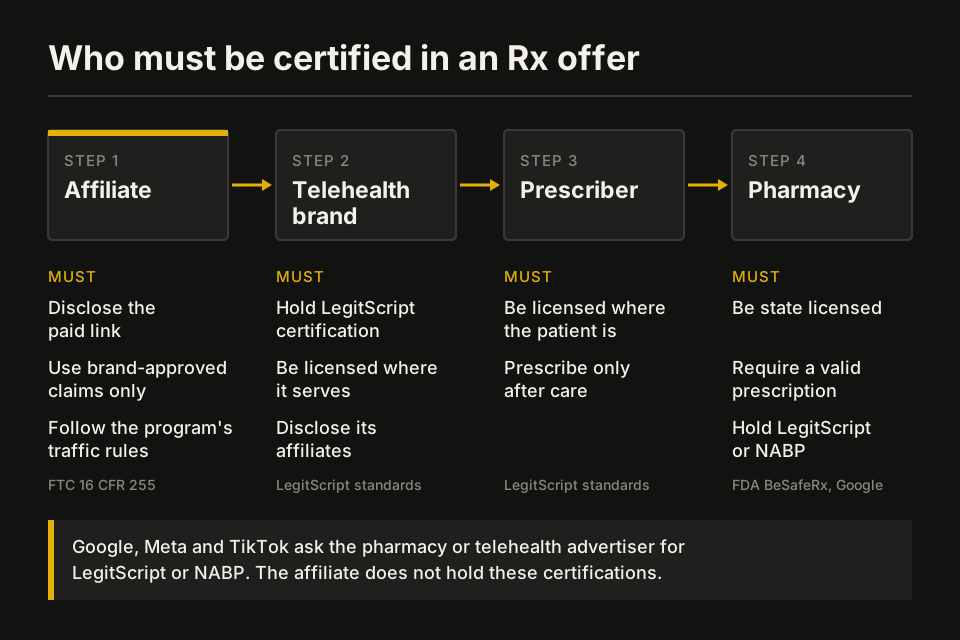
Who must be certified in an Rx affiliate offer
In an Rx affiliate offer, the certifications belong to the telehealth brand and the pharmacy, not to the affiliate. LegitScript certifies the brand and its sites; LegitScript or NABP covers the pharmacy. What reaches the affiliate is the duty to follow the brand’s rules.
LegitScript’s Healthcare Certification lists nine standards, including “Affiliates and Partners,” “Validity of Prescription” and “Advertising.” Three lines from that page shape what an affiliate can do:
- “A merchant’s affiliates and partners must comply with all program standards.”
- “Applicants must ensure that all advertisements are accurate, transparent, and not misleading to the public in any way.”
- “A prescription or prescription drug must not be prescribed or dispensed prior to the provision of care.”
LegitScript’s terms (Version September 15, 2026) also say the applicant “will fully disclose affiliates in the application,” and define affiliates broadly as anyone with “a commercial and/or professional relationship” with the company. In practice, a certified GLP-1 brand answers for its partners, so expect its program terms to pass claims and creative rules down to you.
Demand for this certification is rising. LegitScript announced on September 22, 2026 that telemedicine certification applications more than doubled over the past year, “a rise of 101% that outpaced the 59% increase recorded across all of its certification programmes,” as ppc.land reported on September 25, 2026. For the difference between the two certifiers, see LegitScript vs NABP.
How to check an online pharmacy before you promote it
Check an online pharmacy against FDA’s BeSafeRx signs before you send it a single visitor. A pharmacy that skips the prescription puts your traffic, your ad accounts and your network standing at risk.
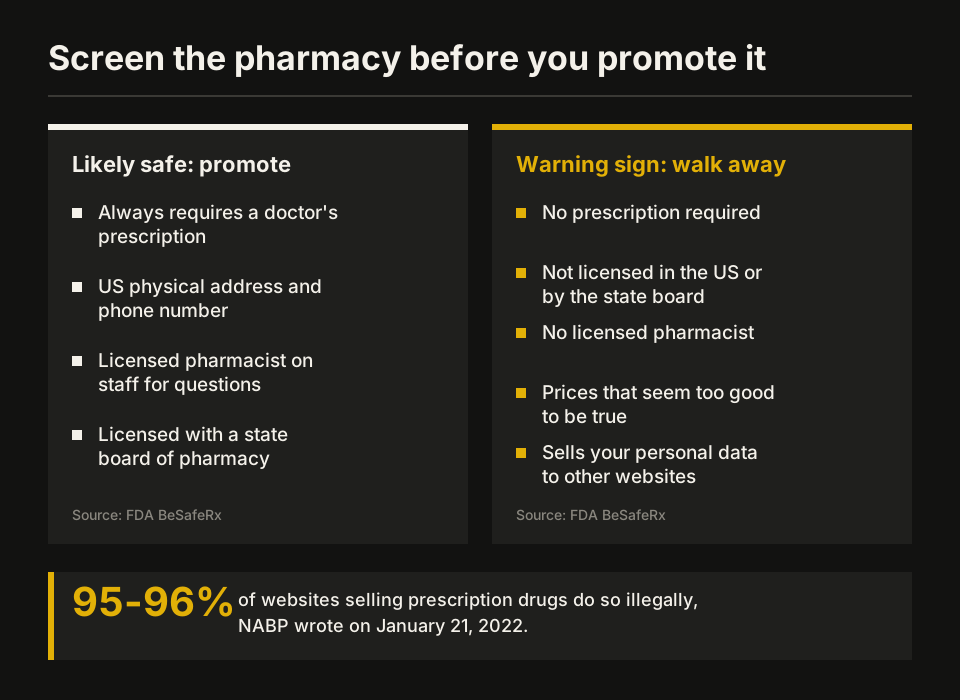
The odds are against an unknown pharmacy site. NABP wrote on January 21, 2022 that its research has “consistently found that 95%-96% of websites selling prescription drugs are doing so illegally.” FDA keeps an Internet Pharmacy Warning Letters list that opens with “Unsafe online pharmacies offer potentially dangerous prescription drugs to U.S. consumers.”
GLP-1 offers carry extra checks. FDA’s GLP-1 concerns page (content current as of October 1, 2026) says the agency “is aware of fraudulent compounded semaglutide and tirzepatide marketed in the U.S.” and warns about products “falsely labeled ‘for research purposes’ or ‘not for human consumption.’” A GLP-1 offer that ships without a provider visit, or sells “research” vials, fails the screen.
Quick screen for a GLP-1 or Rx pharmacy offer:
- Find the brand in LegitScript’s lookup or NABP’s list, and note the date you checked.
- Confirm a licensed provider sees the visitor before anything ships.
- Confirm the fulfilling pharmacy is licensed in the states the offer serves.
- Read the claims the brand itself makes. If its own page says “no prescription needed,” leave.
Ad platform rules for online pharmacy and telehealth ads
Google, Meta and TikTok all require the pharmacy or telehealth advertiser to hold a third-party certification before prescription ads run in the US. An affiliate’s own ad account doesn’t hold that certification, which limits how Rx offers can be bought directly.
| Platform | What the US rule says | What it means for an affiliate |
|---|---|---|
| Google Ads | “Google allows online pharmacies if they’re accredited by” LegitScript or NABP; telemedicine providers need LegitScript. To keyword-target prescription drug terms, “you must be certified.” | An uncertified affiliate account can’t bid on drug names such as semaglutide |
| Meta | “Meta requires online pharmacies and telehealth providers to be actively certified with LegitScript,” then authorization from Meta; 18+ only, in the US, Canada or New Zealand An affiliate isn’t a certified pharmacy or telehealth provider, so Rx drug ads run from the brand’s side | |
| TikTok | Online pharmacy ads “may be allowed” with “proof of certification by a third-party licensing organization,” such as NABP or LegitScript; prescription medicine ads 18+ | Same: the certified advertiser carries the approval |
Platform details for GLP-1 brands on Meta are in our Meta prescription drug ads guide.
Which traffic Rx affiliate programs allow
Rx affiliate programs allow most content and audience traffic, restrict paid ads that name the drug, and set their own lines on coupons, email and brand bidding. Read each program’s terms; the table shows how the rules usually fall.
| Traffic source | Status on Rx and GLP-1 offers | Reason |
|---|---|---|
| SEO and content sites | Allowed with conditions | FTC disclosure next to the link; brand-approved claims |
| Email to your own list | Allowed if the program allows it | Program terms; claims rules still apply |
| Coupon and deal sites | Varies by program | Some brands limit codes and cashback |
| Search ads on drug names | Not allowed without certification | Google requires certification to keyword-target Rx terms |
| Meta or TikTok ads naming the drug | Brand-side only | Platforms require LegitScript or NABP plus approval |
| Bidding on the brand’s name | Usually banned | Program terms |
| Incentivized traffic | Often banned | Program terms |
| Push and pop traffic | Not accepted by GLP1.partners | Our traffic rules |
What Rx and GLP-1 affiliates may and may not say
Rx and GLP-1 affiliates may describe the program as the brand describes it, and may not make claims the brand couldn’t make itself. The FTC’s Endorsement Guides put liability on both sides: “Endorsers may be liable for statements made in the course of their endorsements,” and advertisers “are subject to liability for misleading or unsubstantiated statements made through endorsements.”
| You may say | You may not say |
|---|---|
| The program’s price and what it includes, as the brand publishes them | “No prescription needed” |
| That a licensed provider reviews each visitor and decides on treatment | “Generic Wegovy,” “same as Ozempic,” or “FDA approved” for a compounded drug |
| How ordering and delivery work | Promised pounds lost or results framed as typical |
| Your own experience, if you had it | That you used the product when you didn’t |
| “I get commissions for purchases made through links in this post” | Nothing at all about the commission |
On disclosure wording, the FTC says “the closer the disclosure is to your recommendation, the better,” and that “‘Paid link’ right next to an affiliate link should be an adequate disclosure.” The phrase “affiliate link” alone may not be understood. The drug-equivalence lines FDA has flagged in letters to telehealth companies are listed in our guide to compounded GLP-1 claims the FDA flags.
How online pharmacy affiliate programs pay
Online pharmacy affiliate programs pay by type. Retail pharmacy stores usually pay a percentage of each order; discount cards pay per use or per claim; telehealth Rx programs, GLP-1 included, usually pay a flat amount once the first order is completed and validated.
- Percentage of order. Common for over-the-counter pharmacy stores.
- Per claim or per use. Common for prescription discount cards.
- Flat CPA on a sale. Common for GLP-1 and other telehealth programs, often after a hold while the order is validated.
- Recurring or revenue share. Some telehealth programs pay on refills or subscription months.
What reverses a payout, and how holds work in GLP-1, is covered in how GLP-1 affiliate programs work.
How GLP1.partners works with GLP-1 affiliates
GLP1.partners runs US GLP-1 telehealth offers for affiliates through our publisher program.
- A conversion is a sale.
- Payments are weekly or monthly, depending on the deal.
- Coupon and deal sites are accepted. Push and pop traffic are not.
- On the brand side, we run GLP-1 and telehealth traffic at scale with platform approvals on every network we buy.
- How we compare and beat another offer is settled person to person, per deal.
FAQ
Are online pharmacy affiliate programs legal in the US?
Online pharmacy affiliate programs are legal when the pharmacy is licensed and requires a valid prescription, and when the affiliate discloses the paid relationship. Programs tied to sites that ship prescription drugs without a prescription fail FDA’s BeSafeRx signs, and promoting them puts your accounts and network standing at risk.
Do I need LegitScript to be an Rx affiliate?
An Rx affiliate doesn’t get LegitScript certification. The telehealth brand and the pharmacy hold it. LegitScript expects a certified merchant’s “affiliates and partners” to comply with its standards, so the brand passes those rules down to you through its program terms.
Can I run Google ads for a GLP-1 pharmacy offer?
You can run Google ads to your own content, but an uncertified account can’t keyword-target prescription drug terms. Google says that to target those terms “you must be certified,” and it names online pharmacies, telemedicine providers and pharmaceutical manufacturers among the business types that need certification.
Sources
- Google Ads Help, Healthcare and medicines policy (US online pharmacies and telemedicine) · accessed
- Google Ads Help, Restricted drug terms (certification to keyword-target prescription drug terms) · accessed
- Meta Transparency Center, Advertising Standards: Drugs and Pharmaceuticals · accessed
- TikTok Business Help Center, Healthcare and pharmaceuticals ad policy (United States; last updated September 2026) · accessed
- LegitScript, Healthcare Certification (standards incl. Affiliates and Partners, Validity of Prescription, Advertising) · accessed
- LegitScript, Healthcare Certification Terms and Conditions (Version September 15, 2026) · accessed
- NABP, Congress Holds Registries and Registrars Accountable for Rogue Online Pharmacies (January 21, 2022) · accessed
- FDA BeSafeRx, Considering an online pharmacy? (content current as of September 21, 2020) · accessed
- FDA, FDA's Concerns with Unapproved GLP-1 Drugs Used for Weight Loss (content current as of October 1, 2026) · accessed
- FDA, Internet Pharmacy Warning Letters (content current as of July 17, 2026) · accessed
- 16 CFR 255.1, General considerations (Endorsement Guides; Cornell LII copy) · accessed
- FTC, FTC's Endorsement Guides: What People Are Asking · accessed
- KFF Health Tracking Poll: Prescription Drug Costs, Views on Trump Administration Actions, and GLP-1 Use (November 14, 2025) · accessed
- ppc.land, Telemedicine applications to ad certifier LegitScript jump 101% in a year (September 25, 2026) · accessed