A compounding pharmacy for a telehealth business is usually a state-licensed 503A pharmacy that fills each GLP-1 prescription for a named patient and ships it to that patient’s state. A 503B outsourcing facility registers with FDA and follows manufacturing rules, but its route to compounded semaglutide and tirzepatide is closed today.
Policy checked on November 6, 2026.
What FDA tells telehealth companies about their pharmacy
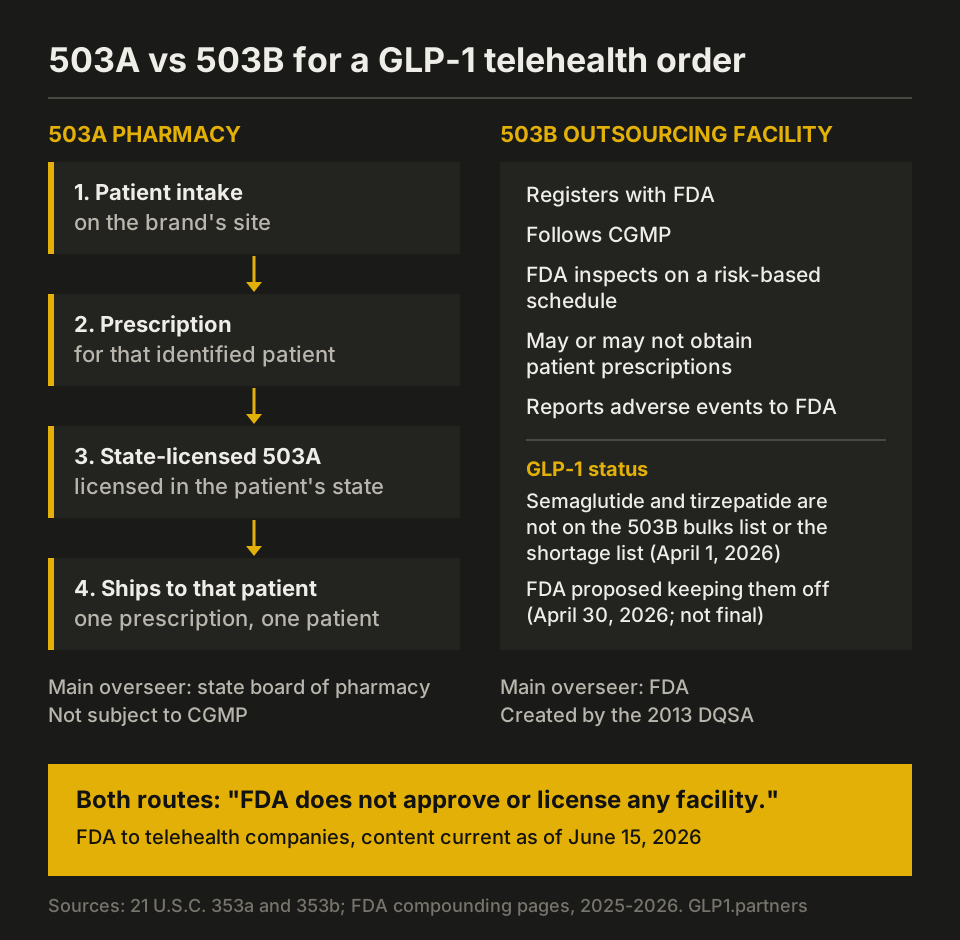
FDA’s guidance page for telehealth companies, current as of June 15, 2026, names two pharmacy claims to avoid. Telehealth companies should not use branding that falsely or misleadingly implies they are the compounder. They also should not claim a drug comes from an FDA-approved or FDA-licensed pharmacy or outsourcing facility, because, in FDA’s words, “FDA does not approve or license any facility.”
FDA enforces this. On March 3, 2026, FDA sent 30 warning letters to telehealth companies over compounded GLP-1 marketing. The release says firms sold drugs under their own brand “without qualification,” which suggested the telehealth firm was the compounder.
503A vs 503B for a telehealth pharmacy partner
The 503A vs 503B choice for a telehealth brand comes down to how prescriptions, oversight and GLP-1 supply work under each section of the FD&C Act. Our compounded GLP-1 explainer covers the general rules. This table covers what changes for the brand.
| For the telehealth brand | 503A pharmacy | 503B outsourcing facility |
|---|---|---|
| Prescription | Compounds “for an identified individual patient based on the receipt of a valid prescription order” (21 U.S.C. 353a) | “may or may not obtain prescriptions for identified individual patients” (21 U.S.C. 353b) |
| Who checks it day to day | State board of pharmacy, with FDA surveillance and for-cause inspections | FDA, on a risk-based inspection schedule |
| Manufacturing standard | Not subject to CGMP | Subject to CGMP |
| Public lookup | State board license search | FDA Registered Outsourcing Facilities list |
| Adverse events | Federal law does not require reports to FDA from state-licensed pharmacies that are not outsourcing facilities | Must submit adverse event reports to FDA |
| Compounded GLP-1 today | Allowed for a named patient when the product is not “essentially a copy” under FDA’s test | Semaglutide and tirzepatide are not on the 503B bulks list or the shortage list |
FDA’s April 1, 2026 update says a 503A product is “essentially a copy” when it has the same active ingredient as a commercially available drug in the same, similar or easily substitutable strength and route, unless “a prescriber determines and documents” a change that makes a significant difference for that patient. On the 503B side, FDA proposed on April 30, 2026 to keep semaglutide, tirzepatide and liraglutide off the bulks list. The FDA Commissioner said in the release: “When FDA-approved drugs are available, outsourcing facilities cannot lawfully compound using bulk drug substances unless there is a clear clinical need.” The proposal is not final.
Some large brands own part of the chain. Hims & Hers’ 10-Q for the quarter ended September 30, 2024 reports that it acquired “MedisourceRx, a 503B compounding outsourcing facility,” in September 2024.
How GLP1.partners works with brands once the pharmacy is set
GLP1.partners brings customers to GLP-1 telehealth brands once the pharmacy, clinicians and LegitScript certification are in place. We run GLP-1 and telehealth traffic at scale with platform approvals on every network we buy:
- Meta, on established agency accounts built for GLP-1 scale, with a dedicated Meta agency contact.
- Outbrain, TikTok and Instagram influencers.
- Our own comparison sites and an affiliate network we manage.
We also scale telehealth brands outside GLP-1. The order of steps for a new brand is in our guide to starting a GLP-1 telehealth company.
What you can and can’t say about your pharmacy partner
What a telehealth brand says about its pharmacy partner lands on its site, its ads and its affiliates’ pages, so the wording needs to match FDA’s reminders. FDA’s February 6, 2026 statement adds that companies “cannot claim that non-FDA-approved compounded products are generic versions” or “the same as drugs approved by FDA.”
| Statement on your site or ads | What the rules say | Use it? |
|---|---|---|
| “Filled by a state-licensed pharmacy” | FDA tells patients to “fill the prescription at a state-licensed pharmacy” | Fine if true for every state you sell in |
| “Compounded by [named partner pharmacy]” | FDA objects to branding that implies the telehealth company is the compounder | Fine, and it answers that concern |
| “Made at an FDA-registered outsourcing facility” | Registration is listed by FDA; it is not approval | Fine only if the facility is on FDA’s current list |
| “FDA-approved pharmacy” or “FDA-licensed pharmacy” | “FDA does not approve or license any facility” | No |
| Brand name on the product “without qualification” | Cited in the March 3, 2026 letters as implying the brand is the compounder | No |
| “Generic semaglutide” or “same as Wegovy” | FDA: compounded products cannot be called generic versions or the same as approved drugs | No |
| “Same active ingredient as Ozempic” | FDA: companies “cannot state compounded drugs use the same active ingredient as the FDA-approved drugs” | No |
The full list of phrases FDA quoted in its letters is in our guide to compounded GLP-1 claims the FDA flags.
How to vet a compounding pharmacy partner
Vetting a compounding pharmacy partner means checking each claim it makes against a public source, not its sales page. Almost every result for this search is a pharmacy describing itself. These eight checks show where to look.
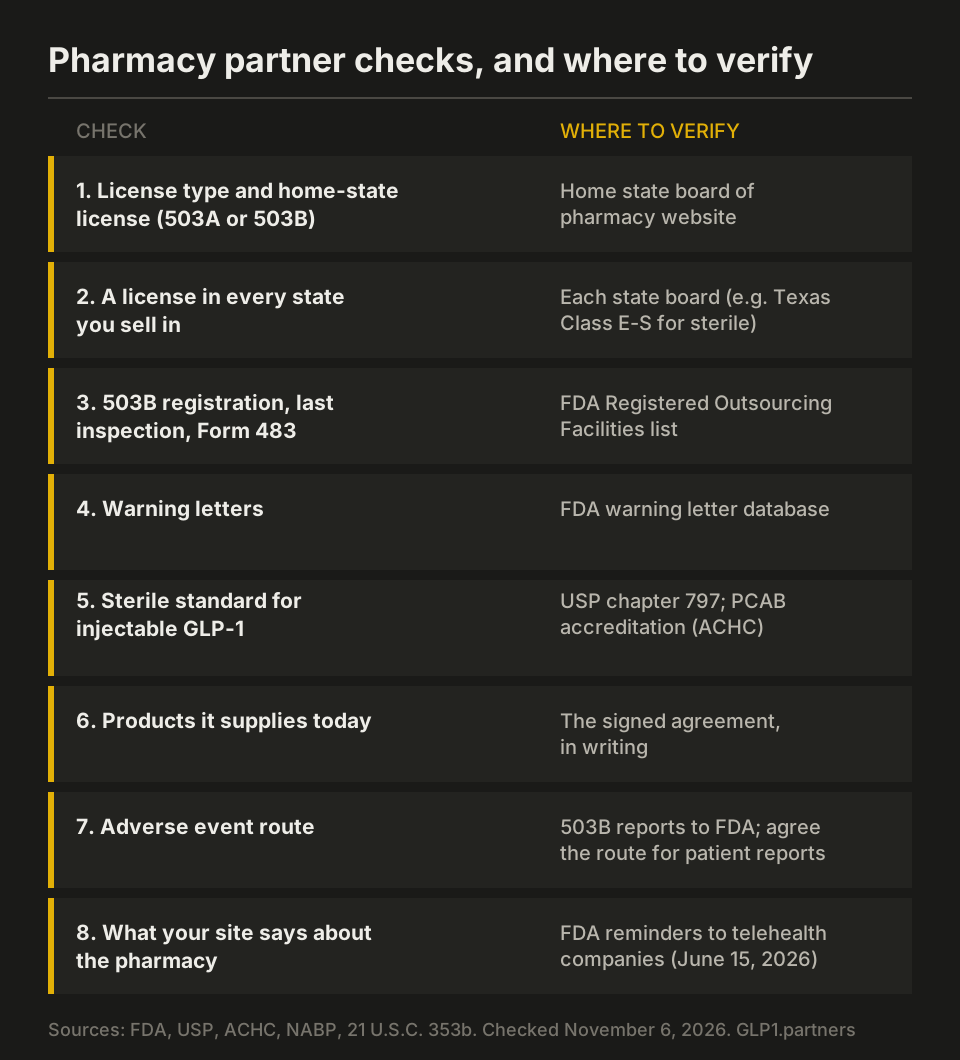
- License type and home state. Confirm 503A or 503B and look up the license on the home state board’s site.
- Every state you sell in. A pharmacy can only serve patients where it holds the right license. Texas, for example, requires nonresident pharmacies that compound sterile preparations to hold a Class E-S license, according to NABP.
- 503B registration and inspections. FDA’s Registered Outsourcing Facilities list, updated October 29, 2026, shows registration dates, the last inspection, whether a Form 483 was issued and recalls. FDA notes a 483 “does not constitute a final agency determination,” and the list leaves out state board actions.
- Warning letters. Search FDA’s warning letter database for the pharmacy’s exact legal name.
- Sterile standard. Injectable GLP-1 is a sterile preparation. USP chapter 797 sets the sterile compounding standard, official since November 1, 2023. PCAB accreditation from ACHC is a third-party check that covers sterile compounding under USP 797.
- Products in writing. Get the products it supplies today, and how it tells you when one changes, in the signed agreement.
- Adverse events. Agree how patient reports reach the pharmacy and your prescribers.
- Your own claims. Read your site’s pharmacy wording against the table above before launch.
LegitScript reviews the pharmacy too. Its Healthcare Certification standards say partner pharmacies that fill prescriptions “are generally required to be LegitScript-certified or accredited by another recognized body,” and applicants must give the “Compliance status for all affiliates and partner pharmacies.”
State licenses and shipping across state lines
State licensure is the working limit on where a 503A partner can ship GLP-1. Federal law adds a second rule. Under 21 U.S.C. 353a, a pharmacy in a state without an FDA memorandum of understanding may ship out of state only “quantities that do not exceed 5 percent of the total prescription orders” it dispenses.
That rule is unsettled. FDA’s compounding page for states, current as of August 28, 2026, says a court remanded the standard MOU to FDA in September 2021 and that FDA “intends to engage in notice-and-comment rulemaking.” Ask a 503A partner, in writing, how it handles out-of-state volume today and if the rule changes.
Quality, testing and adverse event reporting
Adverse event reporting differs by route, and the gap shows up in FDA’s numbers. As of May 31, 2026, FDA had received 990 adverse event reports tied to compounded semaglutide and more than 730 tied to compounded tirzepatide. FDA says reports are likely undercounted because federal law doesn’t require state-licensed pharmacies that are not outsourcing facilities to report adverse events to FDA.
FDA also warns that some fraudulent labels list pharmacies that “do not exist,” and others name a licensed pharmacy that did not compound the product. Naming the real partner, with a license any reader can look up, keeps a brand out of that confusion.
What this means for your campaigns
Your pharmacy partner shapes your ads before the first campaign goes live. These steps are for the brand side:
- Sign a pharmacy whose licenses cover every state you plan to target, and set campaign geography to match.
- Write one approved line about the pharmacy, such as “compounded by [partner], a state-licensed pharmacy,” and use it on the site, ads and affiliate materials.
- Remove “FDA-approved pharmacy,” “generic” and “same as” wording everywhere, including affiliate pages.
- Finish LegitScript certification with the final pharmacy named. Meta’s drug ad policy says it “requires online pharmacies and telehealth providers to be actively certified with LegitScript.”
- Re-check the FDA lists and the partner’s licenses when you add states or products.
FAQ
Can a 503A pharmacy ship compounded semaglutide to other states?
Yes, to patients in states where it holds the required license, on a prescription for each named patient. The federal 5% out-of-state limit for pharmacies in states without an FDA MOU sits in the statute, and FDA’s rulemaking on it is still pending.
Can a 503B facility compound GLP-1 without a patient-specific prescription?
A 503B facility may compound without patient prescriptions in general. For semaglutide and tirzepatide, FDA’s April 1, 2026 update says neither is on the 503B bulks list or the shortage list, so the bulk route is closed.
Is a pharmacy on FDA’s outsourcing facility list FDA approved?
No. The list shows facilities whose registration FDA found complete and whose fee was paid. FDA says it “does not approve or license any facility.”
Do telehealth companies own their pharmacies?
Some do. A brand can contract an outside pharmacy or own part of the chain: Hims & Hers acquired the 503B facility MedisourceRx in September 2024.
Sources
- FDA, FDA to Telehealth Companies: What to Know When Promoting Compounded Drugs (content current as of June 15, 2026) · accessed
- FDA, Compounding and the FDA: Questions and Answers (content current as of September 16, 2025) · accessed
- FDA, Registered Outsourcing Facilities (updated as of October 29, 2026) · accessed
- FDA, FDA clarifies policies for compounders as national GLP-1 supply begins to stabilize (content current as of April 1, 2026) · accessed
- FDA, FDA Proposes to Exclude Semaglutide, Tirzepatide, and Liraglutide on 503B Bulks List (April 30, 2026) · accessed
- FDA, FDA Warns 30 Telehealth Companies Against Illegal Marketing of Compounded GLP-1s (March 3, 2026) · accessed
- FDA, FDA Intends to Take Action Against Non-FDA-Approved GLP-1 Drugs (February 6, 2026) · accessed
- FDA, FDA's Concerns with Unapproved GLP-1 Drugs Used for Weight Loss (content current as of October 1, 2026; adverse event reports as of May 31, 2026) · accessed
- FDA, FDA Implementation of the Compounding Quality Act (content current as of August 28, 2026) · accessed
- 21 U.S.C. 353a, Pharmacy compounding (section 503A), Cornell LII · accessed
- 21 U.S.C. 353b, Outsourcing facilities (section 503B), Cornell LII · accessed
- USP, General Chapter <797> Pharmaceutical Compounding: Sterile Preparations (official November 1, 2023) · accessed
- ACHC, PCAB Accreditation for compounding pharmacies · accessed
- NABP, VPP inspection for a Texas Class E-S license (nonresident sterile compounding) · accessed
- Hims & Hers Health, Form 10-Q for the quarter ended September 30, 2024 (SEC): MedisourceRx acquisition · accessed
- LegitScript, Healthcare Certification (Standard 4, Affiliates and Partners) · accessed
- Meta Transparency Center, Advertising Standards: Drugs and Pharmaceuticals · accessed