A telehealth business model is the way a virtual care company gets paid: by patients (cash pay), by insurers, or by partners such as employers. Most US GLP-1 telehealth brands are cash-pay: a monthly membership for the clinical service, medication billed with it or separately, and refills that pay back the cost of winning each patient.
The main telehealth business models
Telehealth business models differ by who pays the bill. The table sorts the four common types, with an example from a public filing where one exists.
| Model | Who pays | How revenue comes in | Example from filings | Main risk |
|---|---|---|---|---|
| Direct-to-consumer cash pay | The patient | Membership or subscription, plus medication | Hims & Hers; LifeMD’s brands | Cost to acquire each patient, churn |
| Insurance-billed virtual care | Insurer, plus patient copay | Claims per visit or service | LifeMD has accepted commercial and government insurance since June 2024; its network covered about 175 million lives on June 30, 2026 | Reimbursement rates, prior authorization |
| Partner or employer (B2B2C) | A partner that brings its own members | Program or platform fees | LifeMD’s collaboration with Medifast, which paid LifeMD $10 million to support it | One partner can be most of the revenue |
| Platform or white label (B2B) | Other telehealth brands | Software and service fees | None in these filings | Price pressure from other platforms |
Many companies run more than one. LifeMD describes its LifeMD+ membership as an entry point that works “through both cash-pay and insurance reimbursement models.” For GLP-1 weight loss, the cash-pay model is the one most new brands start with, and the rest of this page follows it.
How a GLP-1 telehealth brand makes money
A GLP-1 telehealth brand makes money from five streams. The membership is the base; medication, consults, add-ons and insurance sit on top of it.
| Revenue stream | What the patient pays for | Public example (dated) |
|---|---|---|
| Membership | Access to providers, messaging, follow-ups | Hims & Hers, March 26, 2026: “$39 for the first month, auto-renews at $149/month thereafter” |
| Medication | The drug, billed with the plan or separately | Hims & Hers: “cash-pay prices starting at $149 a month”; “Medication is not available without a membership” |
| One-time consult | A single visit with no ongoing plan | LifeMD offers “both one-time and subscription-based access to its telehealth platform” |
| Bundles and add-ons | Care plus medication in one package, labs, coaching | LifeMD booked $5.1M from bundled contracts in Q2 2026; its weight program includes “metabolic coaching, lab work, and prescription services” |
| Insurance | Visits billed to a payer | LifeMD, since June 2024 |
LifeMD’s Q2 2026 split shows how much of the money is recurring. Telehealth subscription revenue was $29.3M (62% of revenue) and product revenue $18.0M (38%). Its Weight Management Program had about 108,000 patient subscribers on June 30, 2026.
At Hims & Hers, revenue per subscriber rose as weight loss grew. Monthly Revenue per Average Subscriber was $92 in Q2 2026, up from $76 a year earlier, which the 10-Q puts down to “uptake of our weight loss offerings.” The same filing says a majority of Hims’ US revenue still came from non-GLP-1 offerings that quarter.
How GLP1.partners fits into a GLP-1 brand’s model
GLP1.partners works on the cost line that decides whether the model pays: acquiring paying patients. The GLP1.partners media team takes the brand’s target cost per patient and the event it is set on, then reports every channel against that number each week. We run GLP-1 and telehealth traffic at scale with platform approvals on every network we buy.
- Meta: established agency accounts built for GLP-1 scale, with a dedicated Meta agency contact. The brand brings its LegitScript certification.
- Outbrain: established Outbrain accounts with a dedicated setup for GLP-1.
- TikTok, and Instagram influencers, with creative made for each format.
- Our own comparison sites and an affiliate network we manage, held to the same target.
What we do for brands is on our GLP-1 telehealth growth page.
Branded vs compounded GLP-1: how the drug route changes the model
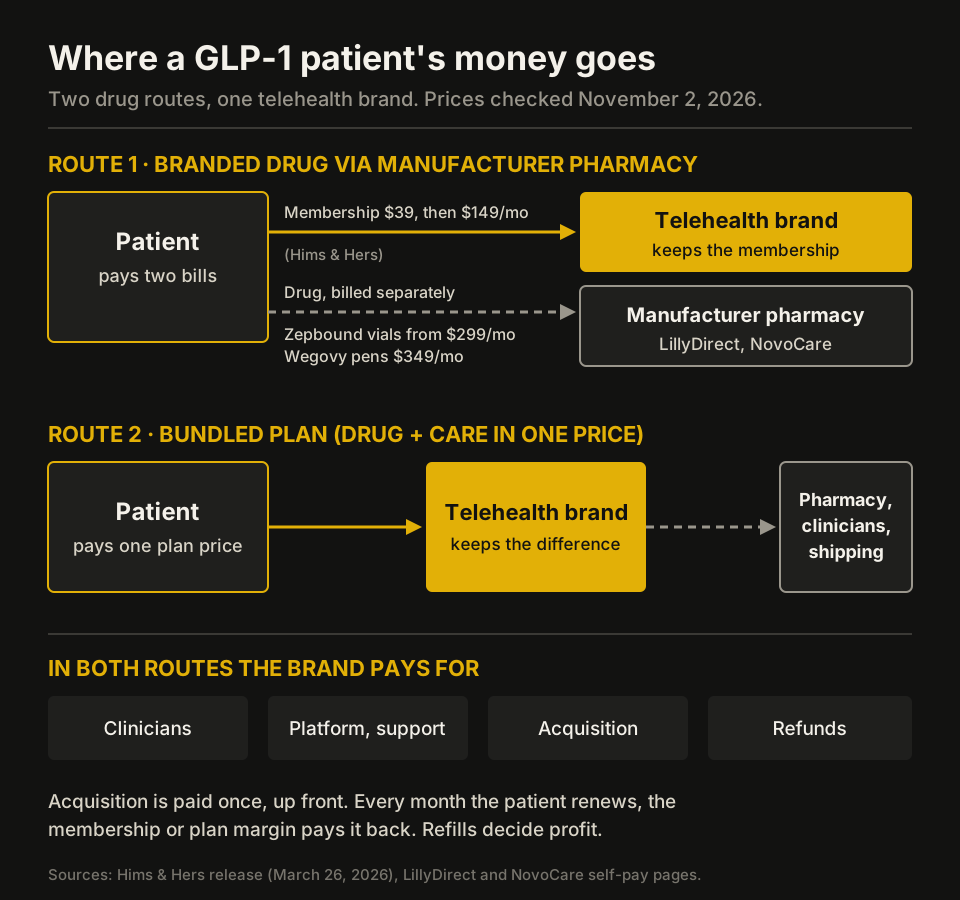
The drug route decides where the medication money lands. With branded GLP-1s sold through a manufacturer’s pharmacy, the patient often pays the drug maker’s pharmacy directly, and the brand earns on the membership. With a bundled plan, the drug runs through the brand’s own price and margin.
Manufacturer self-pay prices, checked November 2, 2026:
- Zepbound (LillyDirect): vials start at $299 a month. Higher doses cost $449 a month when the patient refills within 45 days, and $499 to $699 if not.
- Wegovy (NovoCare): pens are $349 a month after a $199 intro price for the first 2 fills. The pill runs $149 to $299 a month. The list price is $1,349.02 per package.
Hims & Hers shows the branded route in practice. Since April 23, 2026 its providers “can now send prescriptions for Zepbound vials and KwikPen, as well as Foundayo, to the LillyDirect pharmacy.” In March 2026 Hims moved its US weight loss offering toward branded GLP-1s, with compounded GLP-1s “on a limited scale.”
Compounded GLP-1s rested on drug shortages that FDA has since declared over. FDA found the tirzepatide shortage resolved on December 19, 2024 and the semaglutide shortage on February 21, 2025. Its enforcement discretion for 503B outsourcing facilities ran until March 19, 2025 for tirzepatide and May 22, 2025 for semaglutide. What compounding still allows is covered in our compounded GLP-1 explainer.
Refill economics: why retention decides a GLP-1 brand’s margin
Refills are where a GLP-1 telehealth brand earns back what it spent to win the patient. The first month is often discounted ($39 at Hims), so a patient who leaves after month 1 has paid $39 toward whatever it cost to win them. Each renewal after that adds margin.
The public filings and price pages show three ways refill timing moves the numbers:
- Billing cadence. Hims’ 10-Q says longer subscriptions bring “lower recurring costs and higher gross margins as compared to 30-day Subscriptions.” Its shift toward shorter, monthly cadences on weight loss “has impacted our gross margins.”
- On-time refills. Lilly’s higher-dose Zepbound price of $449 holds only when the patient refills within 45 days. A late refill costs the patient $50 to $250 more a month.
- Long-term subscribers. Hims says it expects “to retain a significant majority of revenue from Subscribers who maintain a Subscription for more than two years.” Most of a GLP-1 patient’s value arrives in later months.
Stage-by-stage refill and drop-off metrics are in our guide to GLP-1 patient metrics from first ad to refill.
Is a telehealth business profitable? What Hims and LifeMD report
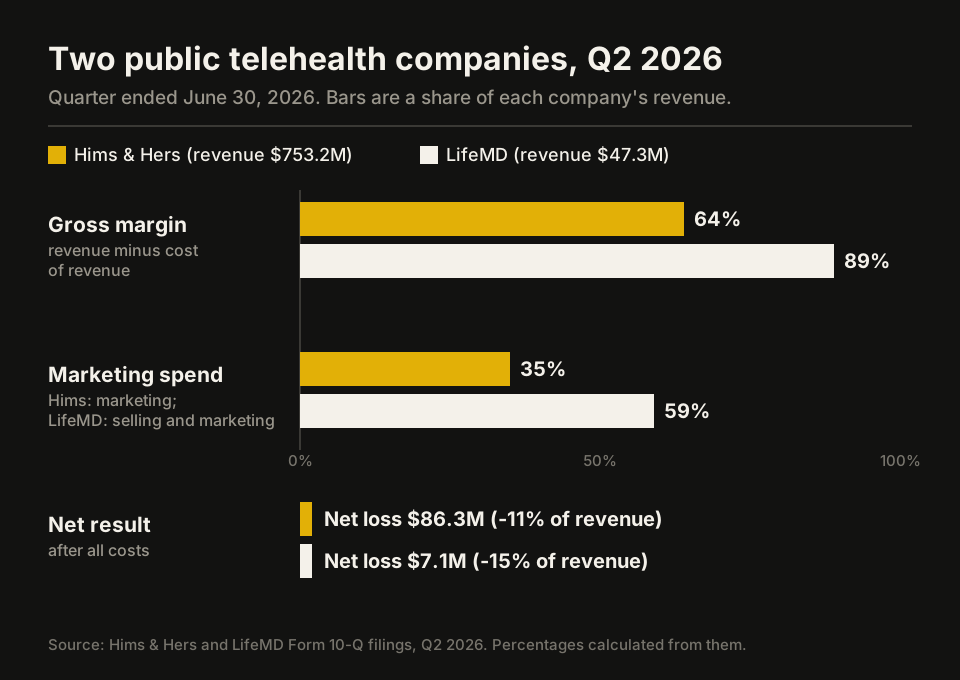
A telehealth business can be profitable, but the two public GLP-1 telehealth companies both lost money in Q2 2026. Hims & Hers earned $128.4M on $2,347.6M of revenue in 2025 (a 5% net margin), then posted an $86.3M net loss in the quarter ended June 30, 2026. LifeMD lost $7.1M in the same quarter.
| Q2 2026 (quarter ended June 30) | Hims & Hers | LifeMD |
|---|---|---|
| Revenue | $753.2M (up 38%) | $47.3M (down from $49.0M) |
| Gross margin | 64% (76% a year earlier) | 89% (86% a year earlier) |
| Marketing line | Marketing $262.2M, of which customer acquisition costs $229.5M | Selling and marketing $28.0M |
| Marketing as share of revenue (our calculation) | 35% | 59% |
| Net result | Loss of $86.3M | Loss of $7.1M |
Filings checked November 2, 2026. Neither company had filed its Q3 2026 10-Q on that date.
The two gross margins measure different things, so don’t compare them directly. LifeMD’s filing says it books prescription revenue “as either principal or agent” depending on each pharmacy agreement. Booked as agent, only LifeMD’s net share counts as revenue. Hims’ cost of revenue includes product, packaging, shipping and medical consultation costs, and the 10-Q blames the lower margin on “weight loss offerings, which have shorter shipping cadences and increased fulfillment costs.”
Marketing is the line both filings have in common. Hims & Hers and LifeMD each spent more than a third of Q2 2026 revenue on it, and it was the largest operating expense at both companies that quarter.
Where acquisition cost fits in a telehealth business model
Acquisition cost is one of the largest costs in a cash-pay GLP-1 telehealth model, and it is paid before the patient’s first refill. Hims’ customer acquisition costs were $229.5M in Q2 2026, about 30% of revenue by our calculation.
A brand can only afford what its refills pay back. Work out the contribution per patient over your payback window (revenue minus drug, pharmacy, provider, refund and support costs), then set a target cost per paying patient below it. The method is in how to scale a GLP-1 telehealth brand. What the public filings can and can’t tell you about cost per patient is in our guide to telehealth customer acquisition cost.
How to model your own GLP-1 telehealth economics
You can build a first model of your own GLP-1 telehealth business in an afternoon with these steps:
- Pick the drug route. Branded through a manufacturer pharmacy, bundled through a partner pharmacy, or both. This decides whether medication revenue is yours.
- List revenue per patient by month. Intro month, standard membership, medication margin if you bundle, and add-ons.
- List cost per patient by month. Provider fees, pharmacy and shipping, payment processing, refunds and support.
- Get the retention curve. Use your own month 2, 3 and 6 renewal rates. Without data, run a low and a high case instead of guessing one number.
- Calculate contribution per patient over 3, 6 and 12 months.
- Set the acquisition target below the contribution for the payback window you can fund.
- Check fixed costs. Platform, licensing, LegitScript certification and staff come out of total contribution, not per patient.
- Rerun the model when prices change. Update it whenever a manufacturer’s self-pay price, your pharmacy cost or your own offer changes.
FAQ
How do telehealth companies make money?
Telehealth companies make money from patients (memberships, consult fees, medication), from insurers (claims per visit) or from partners (program and platform fees). GLP-1 weight loss brands mostly use cash-pay memberships with medication billed with the plan or separately.
Is a GLP-1 telehealth business profitable?
It can be, once enough patients stay past the first few refills to pay back acquisition. Hims & Hers had a 5% net margin in 2025 and a net loss in Q2 2026. LifeMD also lost money in Q2 2026.
What is the best telehealth business model for a GLP-1 brand?
There is no single best model. A cash-pay membership is the fastest to launch and to market. Insurance billing widens the audience but adds claims and prior authorization work. Many brands add a second model once the first works.
Sources
- Hims & Hers Health, Form 10-Q for the quarter ended June 30, 2026 (filed August 10, 2026): revenue $753.2M, gross margin 64% vs 76%, customer acquisition costs $229.5M, marketing $262.2M, net loss $86.3M, Monthly Revenue per Average Subscriber $92, membership program, shipping cadence and margin, long-term revenue retention · accessed
- Hims & Hers Health, Form 10-K for the year ended December 31, 2025 (filed February 23, 2026): revenue $2,347.6M, net income $128.4M, gross margin 74% · accessed
- LifeMD, Form 10-Q for the quarter ended June 30, 2026 (filed August 5, 2026): telehealth revenue $47.3M (subscription 62%, product 38%), gross profit 89%, selling and marketing $28.0M, net loss $7.1M, principal vs agent pharmacy revenue, insurance since June 2024, about 108,000 weight management patient subscribers · accessed
- SEC EDGAR, Hims & Hers Health filing history (no Q3 2026 10-Q as of access date) · accessed
- SEC EDGAR, LifeMD filing history (no Q3 2026 10-Q as of access date) · accessed
- Hims & Hers, Wegovy pill and Wegovy pen now available with Hims & Hers (March 26, 2026): membership $39 first month, auto-renews at $149/month; medication cash-pay from $149 a month; 'Medication is not available without a membership' · accessed
- Hims & Hers, Full range of FDA-approved GLP-1s available on Hims & Hers (April 23, 2026): Zepbound and Foundayo prescriptions sent to the LillyDirect pharmacy · accessed
- Eli Lilly, LillyDirect Zepbound self-pay prices (vials from $299/month; $449/month for higher doses when refilled within 45 days, otherwise $499 to $699) · accessed
- Novo Nordisk, NovoCare Wegovy cost and savings (pen self-pay $349/month after a $199 intro for 2 fills; pill $149 to $299/month; list price $1,349.02) · accessed
- FDA, FDA clarifies policies for compounders as national GLP-1 supply begins to stabilize (updated April 1, 2026) · accessed