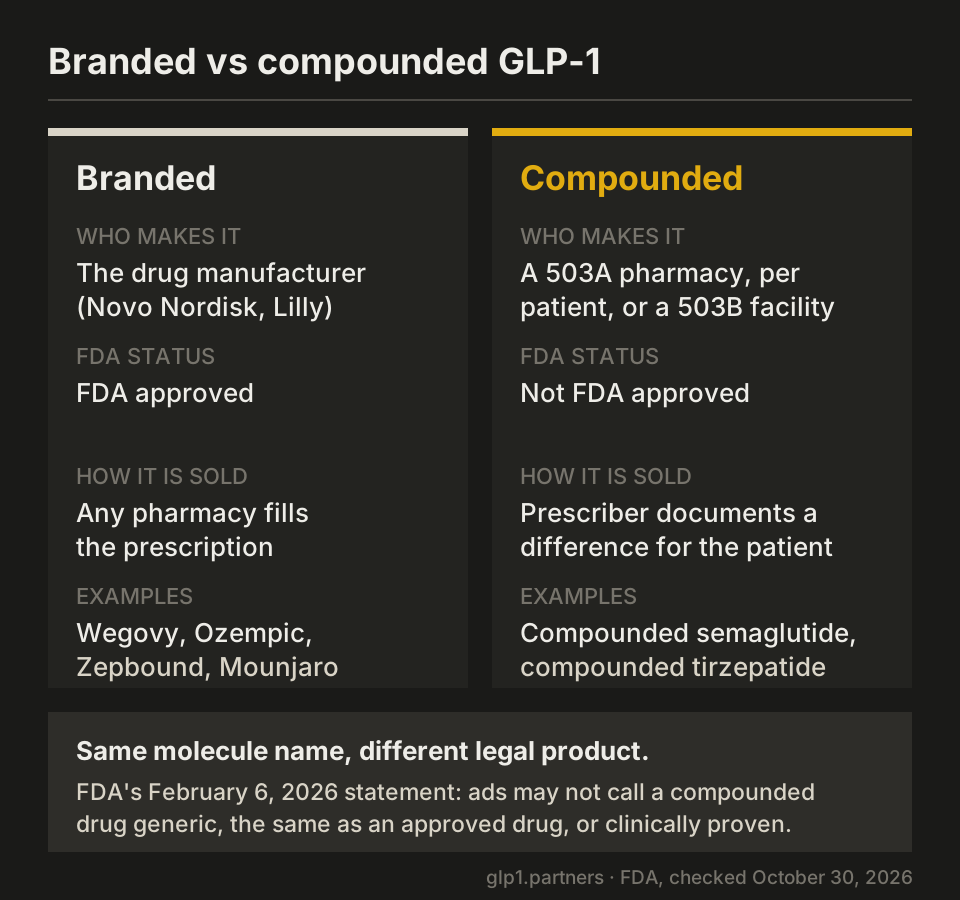
Compounded GLP-1 is semaglutide or tirzepatide prepared by a compounding pharmacy instead of the drug’s manufacturer. It is legal when the pharmacy follows federal compounding rules, but it is not FDA approved. In 2026 the FDA’s enforcement has focused on how telehealth companies market it, not on compounding itself.
What compounded GLP-1 is
Compounding means a pharmacist or physician prepares a drug for a patient instead of dispensing a manufactured product. FDA’s Q&A page describes it as a way to treat a patient who “cannot be treated with an FDA-approved medication,” and states plainly: “Compounded drugs are not FDA-approved.”
In the GLP-1 market, “compounded” almost always means one of two molecules, sometimes a third:
| Molecule | FDA-approved brands | Compounded version sold as |
|---|---|---|
| Semaglutide | Ozempic, Wegovy (injection and pill), Rybelsus | Compounded semaglutide, often with an added ingredient such as B12 |
| Tirzepatide | Mounjaro, Zepbound | Compounded tirzepatide, injection or oral |
| Liraglutide | Victoza, Saxenda, generics | Rarely compounded at scale |
Some newer molecules can’t be compounded at all. FDA’s page on unapproved GLP-1 drugs (current as of October 1, 2026) says “Retatrutide and cagrilintide cannot be used in compounding under federal law,” and that salt forms such as semaglutide sodium and semaglutide acetate are “different active ingredients” with no known lawful basis for compounding.
503A vs 503B: the two kinds of compounder
Federal law splits compounders into two groups, and the rules for compounded GLP-1 differ between them.
| 503A pharmacy | 503B outsourcing facility | |
|---|---|---|
| Who | State-licensed pharmacy or physician | Facility registered with FDA (created by the 2013 Drug Quality and Security Act) |
| Main overseer | State board of pharmacy | FDA |
| Manufacturing standard | Not subject to CGMP | Subject to CGMP |
| Basis for compounding GLP-1 now | A prescription for an identified patient | Bulk substances only via the bulks list or shortage list (semaglutide and tirzepatide are on neither) |
For a telehealth brand, the 503A route is the one that matters. The pharmacy compounds for an individual patient on a prescription from the brand’s affiliated provider.
Is compounded GLP-1 still legal in 2026?
Yes, under conditions. Compounded semaglutide and tirzepatide are legal when a 503A pharmacy compounds them for a specific patient and the product is not “essentially a copy” of the approved drug. The shortage-era exception that let pharmacies make copies freely ended in 2025.
FDA’s April 1, 2026 update spells out the test. A compounded drug is “essentially a copy” if it has the same active ingredient as the approved product, in the same, similar or an easily substitutable strength, usable by the same route. The exception is when “a prescriber determines and documents” a change “that produces a significant difference” for an identified patient. FDA notes that adding an ingredient such as vitamin B12 does not by itself make a product different: semaglutide with B12 can still be “essentially a copy.” FDA also says it doesn’t currently intend to act against a 503A compounder that fills “four or fewer prescriptions” of a copy in a calendar month.
| Date | What changed |
|---|---|
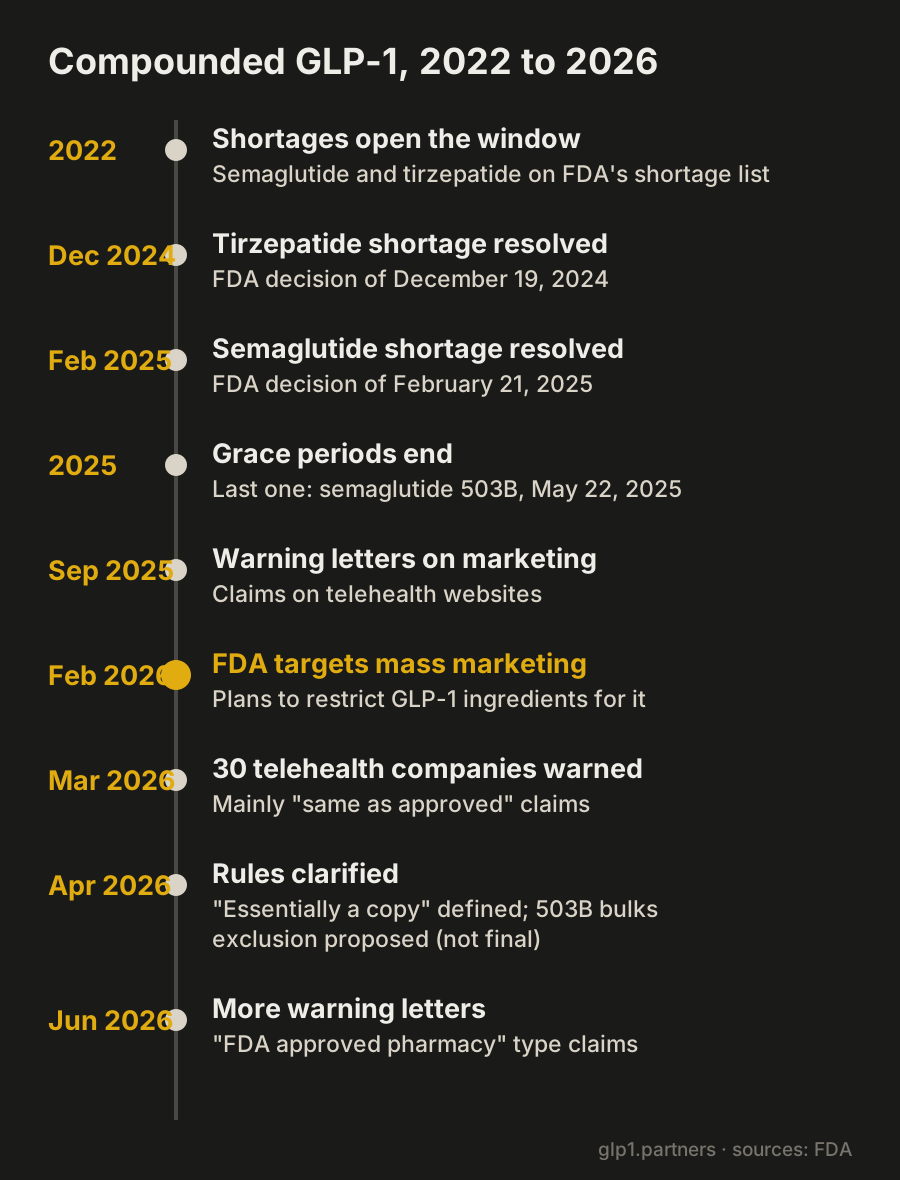
| 2022 | Semaglutide and tirzepatide go on FDA’s shortage list; compounders may make copies during the shortage |
| December 19, 2024 | FDA confirms the tirzepatide shortage is resolved |
| February 21, 2025 | FDA declares the semaglutide shortage resolved |
| March 19, 2025 | Grace period ends for 503B facilities compounding tirzepatide (503A ended earlier) |
| April 24, 2025 | Grace period ends for 503A pharmacies compounding semaglutide (court denied an injunction) |
| May 22, 2025 | Grace period ends for 503B facilities compounding semaglutide |
| February 6, 2026 | FDA announces it will restrict GLP-1 ingredients for “mass-marketed” compounded drugs and lists banned claims |
| April 1, 2026 | FDA clarifies the “essentially a copy” test |
| April 30, 2026 | FDA proposes keeping semaglutide, tirzepatide and liraglutide off the 503B bulks list (not final) |
The pattern in the letters is consistent. The March 3, 2026 wave cited “claims implying sameness with FDA-approved products,” and the June 8, 2026 letter to Altru Telehealth objected to an “FDA approved active ingredient” claim, so the letters target the words on websites and in ads.
What changed for compounded GLP-1 marketing
Compounded GLP-1 marketing changed more in 2026 than compounding did. FDA’s February 6, 2026 statement says companies “cannot claim that non-FDA-approved compounded products are generic versions or the same as drugs approved by FDA,” cannot “state compounded drugs use the same active ingredient as the FDA-approved drugs,” and cannot say they are “clinically proven to produce results.”
Hims & Hers adjusted its model. Hims & Hers’ 10-Q for the quarter ended June 30, 2026 says its US weight loss business now focuses on branded GLP-1 medications, with compounded products offered on a limited scale. Many smaller brands still sell compounded plans, often next to branded pens.
For the full list of phrases FDA quoted, letter by letter, see compounded GLP-1 advertising claims the FDA flags.
How compounded GLP-1 brands get patients online
Compounded GLP-1 brands get patients through the same channels as branded ones. The difference is the copy and the landing page, which must describe the product as compounded and avoid every claim FDA has flagged.
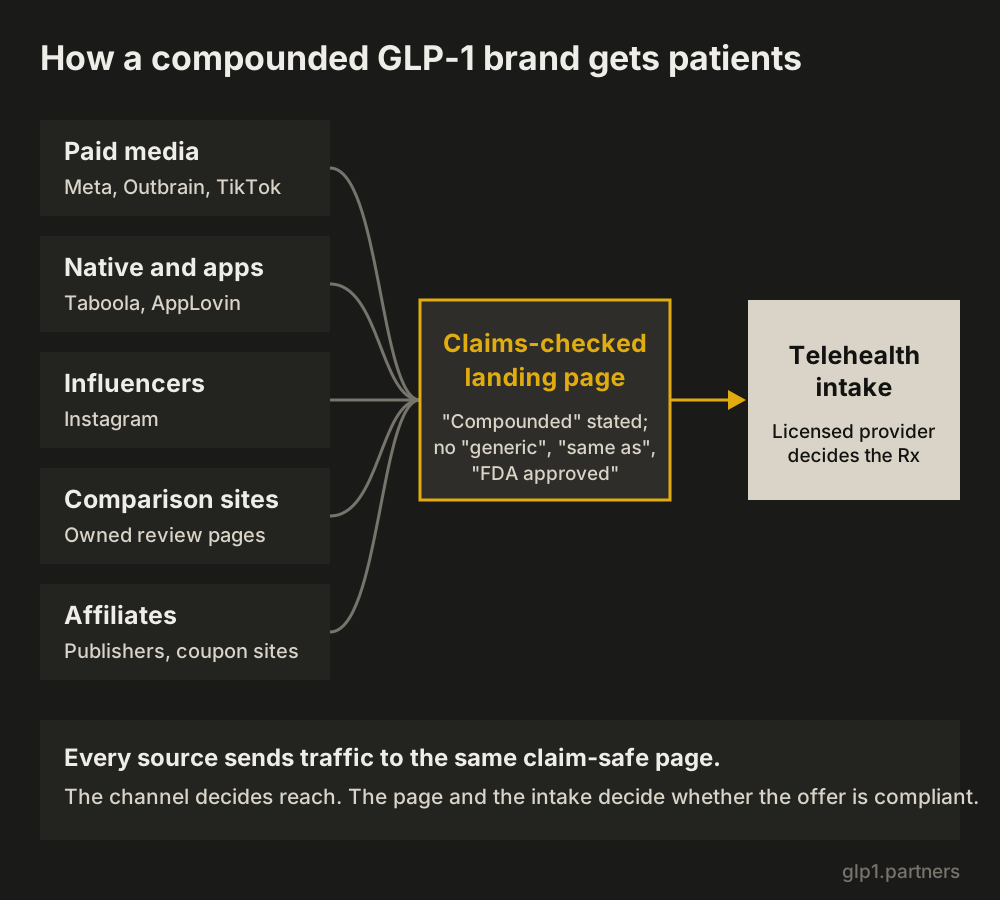
| Channel | How it works for a compounded GLP-1 offer | Our guide |
|---|---|---|
| Meta (Facebook, Instagram) | Prescription drug ads need LegitScript and Meta authorization; Meta’s drug pages set no separate compounded rule | Meta prescription drug ad policy |
| Outbrain | Native ads to advertorials and pre-landers; Outbrain’s own review decides GLP-1 eligibility | Outbrain GLP-1 ads |
| TikTok | Weight management and healthcare rules, regulator proof, 18+ | TikTok GLP-1 ads |
| Taboola, AppLovin | Prior permission (Taboola) or network discretion (AppLovin) | Taboola, AppLovin |
| Microsoft Ads | Names compounding: compounded weight-loss drugs must carry a compounding label | LegitScript by ad platform |
| Instagram influencers | Influencers talk about the program and the provider experience | Influencer marketing |
| Comparison sites | Review pages that list providers with price and plan type, including whether the drug is compounded | Comparison site listings |
| Affiliates | Publishers paid per sale through the brand’s program | How GLP-1 affiliate programs work |
Three practical rules hold across every channel:
- Say “compounded.” Name the product as compounded semaglutide or compounded tirzepatide on the landing page and in the checkout. Microsoft’s policy requires compounded weight-loss drugs to carry a “This is a compounded drug” label.
- Keep the brand drugs out of the copy. No “same as Ozempic,” no “generic Wegovy,” no trial results from the branded drugs. FDA’s letters quote exactly these lines.
- Let the provider decide. Ads and pages sell access to a licensed provider and a program. Whether a patient gets a compounded drug, and which one, is the provider’s call.
Compounded GLP-1 affiliate programs
Many GLP-1 affiliate programs pay on compounded plans. Our GLP-1 affiliate commissions guide lists published payouts next to each brand’s compounded prices, and most brands in it sell compounded semaglutide or tirzepatide on a subscription.
Three things an affiliate should check before promoting a compounded offer:
- What counts as a conversion. Some programs pay on signup, others only when the medication ships after the provider approves it. Compounded offers with a provider review can convert later than the click suggests.
- The brand’s approved claims. Your page is the brand’s advertising. Ask for the brand’s claim list, and never write “generic,” “same as” or “FDA approved.”
- Branded vs compounded payouts. Brands that sell both often pay one rate. Check before you build content around branded pens.
The Henry Meds and Hims & Hers profiles show how two brands with compounded menus run their programs.
If you already promote a compounded GLP-1 offer, send us your current GLP-1 payout. We’ll beat it. The terms are on our payout match page.
How GLP1.partners runs compounded GLP-1 campaigns
We work with GLP-1 telehealth brands whether their menu is branded, compounded or both. We run GLP-1 and telehealth traffic at scale with platform approvals on every network we buy.
- Meta: established agency accounts built for GLP-1 scale, with a dedicated Meta agency contact. The brand brings its LegitScript certification.
- Outbrain: established Outbrain accounts with a dedicated setup for GLP-1.
- TikTok, Taboola and AppLovin: campaigns set up within each network’s healthcare rules.
- Instagram influencers, our own comparison sites and an affiliate network we manage, all sending traffic to the same claims-checked pages.
FAQ
Is compounded semaglutide the same as Ozempic?
No. Compounded semaglutide uses the same molecule name, but it is made by a compounding pharmacy and is not FDA approved. FDA bars marketing that calls it the same as, or a generic of, Ozempic or Wegovy.
Can telehealth companies still sell compounded tirzepatide?
Yes, through 503A pharmacies, on a prescription for an individual patient, when the product isn’t “essentially a copy” of Zepbound or Mounjaro under FDA’s test. The shortage-era exception for copies ended in March 2025 for tirzepatide.
Why did the FDA send warning letters to telehealth companies?
The FDA letters of 2025 and 2026 cite false or misleading marketing: calling compounded drugs generic or the same as approved drugs, claiming FDA approval or “clinically proven” results, and branding that made the telehealth company look like the compounder.
Can you run Meta ads for compounded GLP-1?
Meta’s prescription drug rules apply: LegitScript certification, Meta authorization, adults 18+, and eligible countries. Meta’s drug policy pages set no separate rule for compounded drugs, checked October 30, 2026. The FDA claim rules still govern what the ad says.
Do GLP-1 affiliate programs pay on compounded plans?
Yes. Most published GLP-1 affiliate programs we track pay on compounded semaglutide or tirzepatide subscriptions, either per signup or when the medication ships.
Sources
- FDA, Compounding and the FDA: Questions and Answers (content current as of September 16, 2025) · accessed
- FDA, FDA clarifies policies for compounders as national GLP-1 supply begins to stabilize (content current as of April 1, 2026) · accessed
- FDA, FDA Intends to Take Action Against Non-FDA-Approved GLP-1 Drugs (February 6, 2026) · accessed
- FDA, FDA Warns 30 Telehealth Companies Against Illegal Marketing of Compounded GLP-1s (March 3, 2026) · accessed
- FDA, FDA Proposes to Exclude Semaglutide, Tirzepatide, and Liraglutide on 503B Bulks List (April 30, 2026) · accessed
- Federal Register, List of Bulk Drug Substances for Which There Is a Clinical Need Under Section 503B (FR Doc. 2026-08552, May 1, 2026) · accessed
- FDA, FDA's Concerns with Unapproved GLP-1 Drugs Used for Weight Loss (content current as of October 1, 2026) · accessed
- FDA, FDA to Telehealth Companies: What to Know When Promoting Compounded Drugs (content current as of June 15, 2026) · accessed
- FDA warning letter, Altru Telehealth LLC, MARCS-CMS 728274 (June 8, 2026) · accessed
- Hims & Hers Health, Form 10-Q for the quarter ended June 30, 2026 (SEC) · accessed
- Meta Transparency Center, Advertising Standards: Drugs and Pharmaceuticals · accessed
- Microsoft Advertising, Pharmacy and Healthcare policy (last updated October 5, 2026) · accessed