Starting a telehealth company for GLP-1 weight loss runs in a fixed order: set up the entity (usually an MSO plus a physician-owned professional corporation), add licensed clinicians or a white-label platform, sign a pharmacy partner, build a HIPAA-ready platform and website, get LegitScript certified, open payment processing, and only then buy traffic.
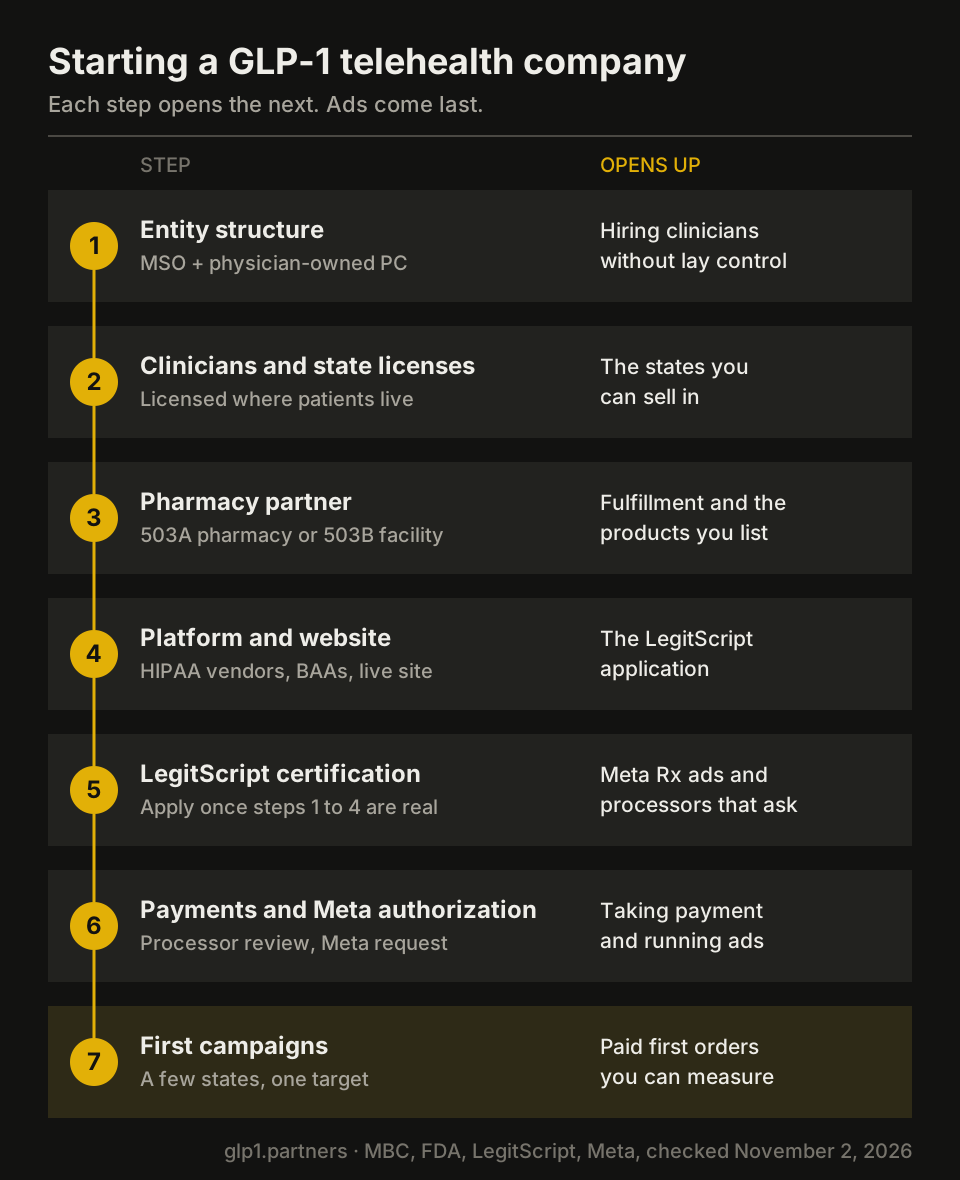
Most telehealth startup guides list these steps as separate topics. For a GLP-1 brand they depend on each other. LegitScript reviews your clinicians, pharmacy and live site, so it can’t come first. Meta won’t run prescription drug ads without LegitScript, so ads can’t come before it. The rest of this page walks through each step with the rule behind it, dated.
Build it yourself or launch on a white-label platform
A new GLP-1 telehealth company chooses between building its own medical and pharmacy stack and renting one from a white-label platform. The choice changes what you own, how fast you launch and what LegitScript reviews.
| Decision | Build your own stack | White-label platform | Main risk |
|---|---|---|---|
| Entity | Your MSO plus a PC owned by a physician you recruit | Platform’s existing medical group treats your patients | A management agreement that gives the MSO clinical control |
| Clinicians | You hire and license them state by state | Platform’s provider network | Gaps between your sales map and provider licenses |
| Pharmacy | You contract and vet the pharmacy | Platform’s pharmacy relationships | A pharmacy with a weak record stalls certification |
| Tech | You buy or build intake, EHR, payments | Included in the platform | Vendors without a business associate contract |
| LegitScript | You apply with your own documents | You still apply, and LegitScript reviews the providers and pharmacy behind your site | Applying before the site and partners are final |
| Control | Full control of brand, data and pricing | Less control, faster start | Being tied to one platform’s terms |
Whichever route you pick, the brand, the website and customer acquisition stay with you.
How GLP1.partners fits into a new GLP-1 telehealth launch
GLP1.partners comes in at step 7: once a brand has its clinicians, pharmacy, LegitScript certification and payments in place, we bring it customers. We run GLP-1 and telehealth traffic at scale with platform approvals on every network we buy.
- Meta. Campaigns run on established agency accounts built for GLP-1 scale, with a dedicated Meta agency contact. The brand brings its own LegitScript certification, and our agency accounts are set up to run it.
- Outbrain and TikTok. Established Outbrain accounts with a dedicated setup for GLP-1, plus TikTok.
- Other channels. Instagram influencers, our own comparison sites and an affiliate network we manage.
- One target. The brand sets the target, such as cost per paid first order, and every channel reports against it each week.
Before step 7, the work is the brand’s. The sections below are the checklist we’d want a new brand to have finished before its first campaign.
Entity structure: MSO and physician-owned PC
A common setup for a non-physician founder starting a GLP-1 telehealth company is two entities: a management services organization (MSO) they own, and a professional corporation (PC) owned by a licensed physician. The reason is the corporate practice of medicine doctrine, which in states such as California bars lay-owned companies from practicing medicine or controlling physicians.
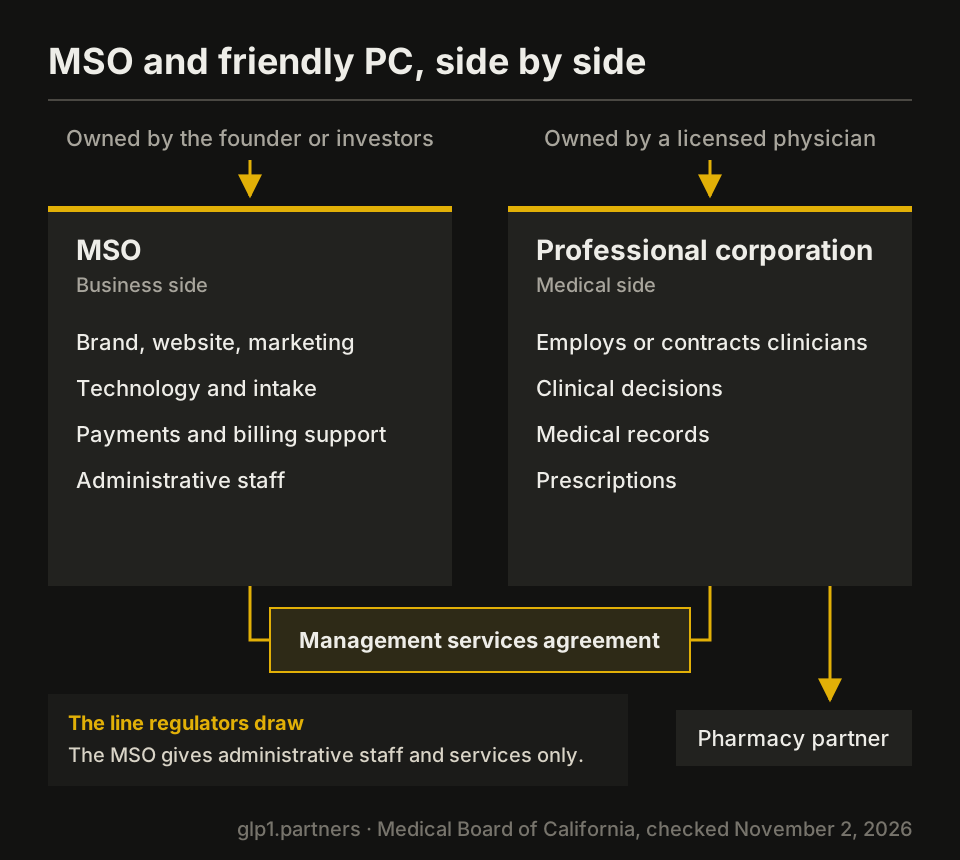
California shows how strict the line can be. The Medical Board of California lists, among structures it considers prohibited, “Non-physicians owning or operating a business that offers patient evaluation, diagnosis, care and/or treatment” and “Management service organizations arranging for, advertising, or providing medical services rather than only providing administrative staff and services for a physician’s medical practice.”
What this means for a GLP-1 brand:
- The PC, not the MSO, employs or contracts the prescribing clinicians.
- Clinical decisions, such as who qualifies for a GLP-1 prescription, stay with clinicians.
- The management services agreement covers business services and fees. A healthcare attorney in your launch states should draft it, because rules differ by state.
- Marketing sits with the MSO, but ad claims about treatment still need clinical sign-off.
Clinicians and state licensure for a telehealth startup
A telehealth company can only treat patients in states where its clinicians hold a license, so the provider roster sets the sales map. Launch in a few states first and add states as licenses come through.
The Interstate Medical Licensure Compact speeds up multi-state licensing for physicians. Its snapshot, updated October 5, 2026, lists 44 member states plus 2 US territories and 240,184 licenses issued as of September 30, 2026. It covers physicians only. Nurse practitioners and physician assistants follow their own state rules.
Checklist for this step:
- Pick launch states from where your pharmacy can ship and your clinicians are licensed.
- Name a medical director inside the PC who owns clinical protocols for GLP-1 intake and follow-up.
- Decide W-2 or contractor status for clinicians with counsel.
- Keep a license list per clinician with expiry dates. LegitScript’s readiness list includes “licensure that matches the service map.”
Pharmacy partner and compounding rules for GLP-1
The pharmacy partner decides which GLP-1 products a telehealth brand can sell and how fast orders ship. FDA separates two kinds of compounders: state-licensed pharmacies under section 503A, and outsourcing facilities that register with FDA under section 503B and must meet “current good manufacturing practice (CGMP) requirements.”
The GLP-1 shortage era is over, and that changed the pharmacy question. FDA determined the tirzepatide injection shortage resolved on December 19, 2024 and the semaglutide shortage resolved on February 21, 2025. As of its April 1, 2026 update, FDA states that “Tirzepatide and semaglutide do not currently appear on the 503B bulks list or on FDA’s drug shortage list.”
What to check in a pharmacy partner:
- Its license type (503A or 503B) and the states it ships to.
- Its inspection and enforcement record. LegitScript’s Q&A tells applicants to “know your providers’ and partners’ records before you submit.”
- Which products it supplies today, in writing.
- Turnaround from approved prescription to shipped order.
The marketing side matters as much. On March 3, 2026, FDA sent 30 warning letters to telehealth companies over “false or misleading claims regarding compounded GLP-1 products offered on their websites.” FDA’s guidance to telehealth companies says “Compounded drugs are not reviewed by the agency for safety, effectiveness or quality prior to marketing.” The claims FDA flags are listed in our guide to compounded GLP-1 claims the FDA flags.
Platform, HIPAA and the website
A telehealth startup needs an intake flow, video or asynchronous visits, e-prescribing, records and payments, either built or bought. Every vendor that handles patient health information for the practice needs a written agreement. HIPAA’s rule at 45 CFR 164.502(e) lets a covered entity disclose protected health information to a business associate only with “satisfactory assurances,” which “must be documented through a written contract.”
The website is part of this step because LegitScript reviews it. Before applying, the site should show:
- Clear wording that a prescription requires a licensed clinician’s evaluation.
- Privacy policy, terms and patient contact details.
- Product and pricing pages that match what the pharmacy supplies.
- No claims you can’t back up, especially “same as” or “generic” language about compounded drugs.
LegitScript certification before any GLP-1 ads
LegitScript certification is the gate between a working telehealth company and paid traffic. Meta’s policy says “Meta requires online pharmacies and telehealth providers to be actively certified with LegitScript,” and adds: “Once they have a LegitScript certification, they must request authorization from Meta.” Meta prescription drug ads can only target people 18 or older in the United States, Canada or New Zealand.
Policy checked on November 2, 2026.
| LegitScript item | What LegitScript publishes |
|---|---|
| Application fee | $975 per website, nonrefundable |
| Annual fee | $2,150 per website (standard certification) |
| Expedited review | $2,500 extra per application |
| Review time | No fixed figure; White Label MD told LegitScript a prepared clinic’s review “typically runs about two weeks” |
Applying early with gaps costs months. In LegitScript’s June 19, 2026 Q&A, White Label MD said “most clinics take three or four months,” blaming “the back-and-forth of deficiency notices when they applied before they were ready.” The readiness list it gave: “complete documentation, licensure that matches the service map, a vetted pharmacy, a compliant site.”
Demand for certification is rising. LegitScript said on September 22, 2026 that applications “for telemedicine certification specifically rose 101%,” as reported by ppc.land. Fee detail and first-year totals are in our LegitScript certification cost breakdown.
Payment processing for a GLP-1 telehealth company
Payment processing is a separate review from LegitScript, run by your processor. Stripe, for example, says “Telemedicine businesses do not need certification from Legitscript,” but “certain licensing and regulatory items must be provided to Stripe for verification as part of the onboarding process.” LegitScript, for its part, says its telemedicine certification is “required by many major credit cards and internet platforms,” so ask each processor what it needs before you sign.
Have these ready for the processor:
- Entity documents for the MSO and PC, and who receives the money.
- Clinician license numbers and how a prescription decision is made.
- Pharmacy partner details.
- Refund, cancellation and subscription terms, shown on the site.
Customer acquisition once the launch gates are open
Customer acquisition for a new GLP-1 telehealth brand starts after certification, Meta authorization and payments are live. KFF’s poll published November 14, 2025 found that 18% of US adults had taken a GLP-1 drug and 12% were currently taking one. Among people who had taken one, 17% got it “from an online provider or website.”
For the first campaigns:
- Start in your licensed states only, with one target event: a paid first order.
- Write a claims sheet that clinicians and the pharmacy have approved, and use it for every ad, landing page and partner.
- Test one or two channels first. The order we see work is in our GLP-1 marketing strategy guide.
- Add affiliates and comparison sites once monitoring is in place.
When one channel pays back, the next stage is scaling, covered in how to scale a GLP-1 telehealth brand past its first channel.
A step-by-step checklist for starting a GLP-1 telehealth company
- Choose your model: your own stack or a white-label platform, using the table above.
- Form the MSO and, with a recruited physician, the PC. Have a healthcare attorney draft the management services agreement for your launch states.
- Recruit clinicians licensed in your first states. Name a medical director.
- Sign a pharmacy partner. Get in writing what it supplies and where it ships.
- Set up intake, prescribing, records and payment tools. Sign a business associate contract with every vendor that touches patient data.
- Publish the website with prescription wording, policies, contact details and claims you can support.
- Apply for LegitScript certification once steps 2 to 6 are final.
- Complete processor onboarding with your licensing documents.
- After certification, request Meta authorization for prescription drug ads.
- Launch campaigns in your licensed states against one target, then add states and channels.
FAQ
Can you start a telehealth company without being a doctor?
Yes. Non-physician founders usually own an MSO that works with a professional corporation owned by a licensed physician. Where a state bans the corporate practice of medicine, as California does, the MSO provides business and administrative services only, and clinical decisions stay with the physician-owned practice.
Do I need LegitScript to start a GLP-1 telehealth business?
You need LegitScript to advertise prescription treatment on Meta, which requires telehealth providers to be “actively certified with LegitScript.” You can incorporate and treat patients before certification, but paid acquisition on Meta waits for it. Some payment processors ask for it too.
How long does it take to launch a telehealth startup?
No official figure exists. LegitScript review alone can take about two weeks for a prepared applicant or three to four months for one that applied early, per White Label MD in LegitScript’s June 19, 2026 Q&A. Entity setup, licensing and pharmacy contracts come before that.
What does it cost to start a telehealth company?
Costs depend on the build-or-buy choice and how many states you launch in. The fixed published item is LegitScript: $975 to apply and $2,150 per year per website. Legal setup, clinician pay, platform fees and the first ad budget vary by brand.
Sources
- Medical Board of California, Physicians and Surgeons Practice Information (corporate practice of medicine; non-physician ownership; management service organizations) · accessed
- 45 CFR 164.502(e), disclosures to business associates (Cornell LII) · accessed
- Interstate Medical Licensure Compact, snapshot stats (updated October 5, 2026; information as of September 30, 2026: 44 member states + 2 US territories, 240,184 licenses issued) · accessed
- FDA, Compounding and the FDA: Questions and Answers (content current as of September 16, 2025) · accessed
- FDA, FDA clarifies policies for compounders as national GLP-1 supply begins to stabilize (content current as of April 1, 2026; tirzepatide shortage resolved December 19, 2024; semaglutide February 21, 2025) · accessed
- FDA, FDA to Telehealth Companies: What to Know When Promoting Compounded Drugs (content current as of June 15, 2026) · accessed
- FDA, FDA Warns 30 Telehealth Companies Against Illegal Marketing of Compounded GLP-1s (March 3, 2026) · accessed
- Meta Transparency Center, Advertising Standards: Drugs and Pharmaceuticals · accessed
- LegitScript, Healthcare Certification (application fee $975 per website, annual fee $2,150 per website, expedited $2,500 per application) · accessed
- LegitScript blog, What It Really Takes for Weight Loss & Longevity Clinics to Get LegitScript-Certified (Q&A with White Label MD, June 19, 2026) · accessed
- ppc.land, Telemedicine applications to ad certifier LegitScript jump 101% in a year (September 25, 2026; LegitScript release of September 22, 2026) · accessed
- LegitScript, Certification for Telemedicine Providers · accessed
- Stripe, Prohibited and Restricted Businesses List FAQs (telemedicine) · accessed
- KFF Health Tracking Poll: Prescription Drug Costs, Views on Trump Administration Actions, and GLP-1 Use (November 14, 2025; 18% ever taken, 12% currently taking; 17% of users got it from an online provider or website) · accessed