“GLP-1 friendly” is a marketing phrase, not a legal or regulatory term, and no FDA, USDA or FTC rule defines or approves it. Brands use it to flag high-protein, high-fiber or portion-controlled products for GLP-1 drug users; USDA’s Food Safety and Inspection Service has approved specific labels carrying the phrase because the labels’ own nutrient claims checked out, not the phrase itself.
That gap matters for any telehealth brand that bundles or recommends a companion product, like a protein shake or fiber supplement, alongside its prescription service, and for the affiliates and influencers who promote it.
Rules and examples checked on November 6, 2026.
Why there’s no official definition
No federal agency, FDA, USDA or FTC, has written a rule that defines “GLP-1 friendly” or sets a bar a product must clear before using it. The closest framework is FDA’s structure/function-claims guidance: conventional foods can carry structure/function claims with no notification to FDA. FDA draws the same line it uses for dietary supplements to decide when such a claim turns into a disease claim: “FDA is likely to interpret the dividing line between structure/function claims and disease claims in a similar manner for conventional foods as for dietary supplements.” A badge that only describes nutrient content (protein grams, fiber grams, calorie count) stays a nutrition statement; one implying the food affects appetite or blood sugar the way the drug does risks reading as a disease claim, which a food cannot make without FDA authorization.
Neither FDA nor USDA has set a standard for the phrase itself. A Yahoo Health report, citing Associated Press reporting, states that “GLP-1 Friendly” and related terms like “GLP-1 Balance” “don’t have an official regulatory standard from either agency,” and attributes USDA’s approval of specific Nestlé and Conagra labels to those labels’ own protein and fiber statements, not to the three-word phrase.
Asked directly about the trend, FDA’s then deputy foods commissioner, now acting FDA commissioner, gave the clearest on-record agency reaction to date: in a March 2026 interview with Bloomberg Law, he said FDA is “aware of the issues” such labels raise, while describing no “future or intended action.” That is a reported interview statement, not an FDA policy page, and it reads as awareness without a commitment to act.
Three agencies, three different questions
FDA, USDA’s Food Safety and Inspection Service and the FTC each ask a different question about this claim, and none has a step that amounts to approving it.
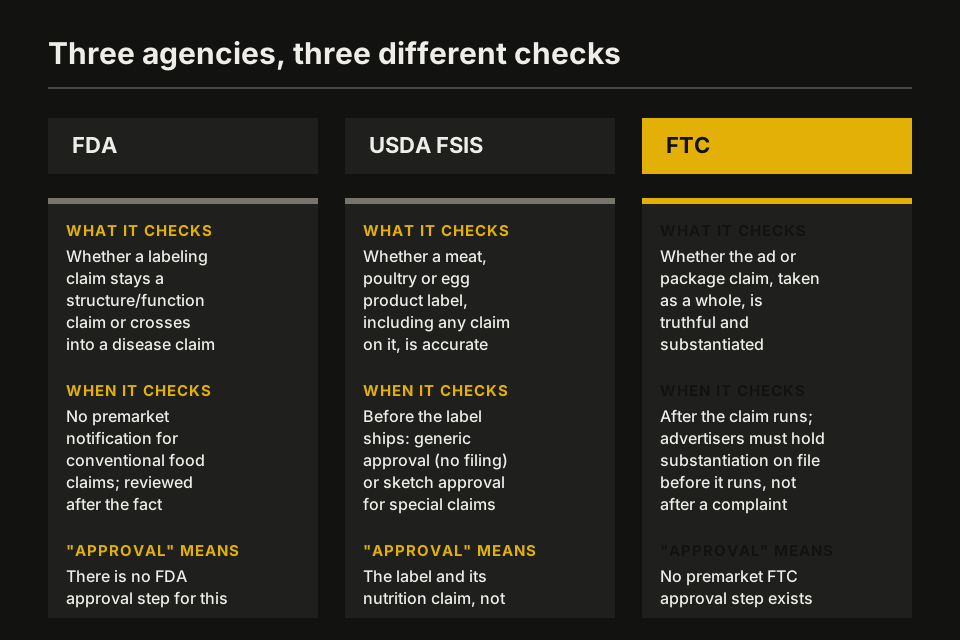
| Agency | What it checks | When it checks | What “approval” means |
|---|---|---|---|
| FDA | Whether a labeling claim stays inside structure/function territory or crosses into a disease claim | No premarket notification for conventional food claims; enforcement, if any, comes later | No FDA approval step exists for this kind of claim on conventional food |
| USDA FSIS | Whether a meat, poultry or egg label, including any claim on it, is accurate | Premarket: generic approval (no filing) for labels with only mandatory content, or sketch approval for labels with a special claim | Approval covers the label’s nutrition claim, not the phrase “GLP-1 friendly” itself |
| FTC | Whether the ad or package claim, as a whole, is truthful and backed by evidence | Substantiation required before an ad runs; FTC enforcement itself comes later | No premarket FTC approval step exists for a health-related claim |
Only products FSIS regulates, meat, poultry and egg-containing items, go through any premarket label review at all. A cereal, shake or supplement regulated by FDA does not, so a cereal brand and a meat-based meal brand can use “GLP-1 friendly” with entirely different paperwork behind the label, or none. Bloomberg Law’s reporting puts a number on the FSIS route: as of June 2, 2026, five companies had filed 21 requests to use “GLP-1 Friendly” or “GLP-1 Lifestyle” wording on meat or poultry labels, and filing a request is not the same as receiving an approval.
Allowed vs. risky wording
The line between a defensible “GLP-1 friendly” claim and a risky one runs through specificity, not through the phrase itself.
| Wording | Status | Why |
|---|---|---|
| A nutrient-content statement (“high protein, high fiber, portion-controlled”) | Allowed | Describes nutrient content, not a drug-like effect |
| The bare phrase “GLP-1 friendly,” with no mechanism claim attached | Allowed, unregulated | No agency has set a bar for it; FTC substantiation still applies to whatever it implies |
| “Works like Ozempic,” “mimics GLP-1,” or similar mechanism language | Risky | Crosses into a disease claim, unlikely to clear the FTC’s substantiation standard |
| “FDA approved” or language implying an agency evaluated the health claim | Risky | Misstates what any approval covers; a USDA approval is of the nutrition claim, not the phrase |
| Using the phrase on a meat, poultry or egg label without FSIS review | Risky | Those categories need a generic or sketch approval before the label ships |
| Coded phrasing (“high protein,” “supports muscle mass”) instead of the literal phrase | Allowed, lower exposure | A narrower claim carries a lighter substantiation burden than the undefined phrase |
Dated examples: who is using the claim and how
Two consumer brands anchor the trend with dated, verifiable rollouts, and most of the category has since moved away from the literal phrase.
Nestlé announced Vital Pursuit in 2024, a food line built to “support GLP-1 users” with products high in protein, fiber and other nutrients; the packaging leans on nutrient content rather than naming a GLP-1 medication directly, per legal-industry analysis of the launch. Conagra added a “GLP-1 Friendly” badge, part of its “On Track” label system, to more than two dozen Healthy Choice products starting in January 2025, and ties the badge to products high in protein, low in calories and a good source of fiber, stating USDA reviewed and approved them.
By 2026, trade coverage shows most competitors hedging away from the literal phrase: an Acosta Group executive told Food Navigator “there haven’t been many brave souls to put that label overtly on their package,” and the same reporting names Conagra as the exception, listing coded alternatives other brands reach for instead, like “high protein” and “supports muscle mass.”
Enforcement and legal-risk signals so far
The claim has drawn scrutiny from a nonprofit ad-monitoring body, pending litigation and one on-record federal comment, none of which amounts to a ban or a clearance.
BBB National Programs opened an inquiry into Ryze Superfoods’ GLP-1-related advertising, and the mushroom-coffee brand agreed in September 2025 to stop marketing its products as appetite suppressants, per Bloomberg Law’s reporting. The same reporting names proposed class actions against Veracity Wellness, Grüns Nutrition, Lemme and Supergut; these are companies facing claims, not companies found liable. Read with the FDA comment above, these signals describe a claim regulators are watching, not one they have cleared or banned.
What this means if your brand or affiliates market a companion product
A telehealth brand that sells or recommends a companion product, a shake, bar or supplement, alongside its prescription program is making a food or supplement claim on top of a drug-program claim, and the two run under different rules.
- Keep “GLP-1 friendly” claims tied to measurable nutrition facts (protein grams, fiber grams, calorie count) rather than the bare phrase alone, so the claim stays a nutrition statement.
- Never say or imply the companion product affects appetite, blood sugar or weight the way the prescription drug does. That is a disease claim, and the FTC’s substantiation standard is unlikely to accept it for a food or supplement.
- Never say a federal agency “approved,” “certified” or “cleared” the health claim. A USDA label approval covers the underlying nutrition claim, not the phrase, and saying otherwise misstates what happened.
- If the companion product contains meat, poultry or egg, budget for FSIS review timing rather than assuming the label can ship on the brand’s own schedule.
- Brief affiliates and influencers who promote the companion product on the same wording limits. See GLP-1 influencer rules for the disclosure side and GLP-1 influencers for who typically runs these campaigns.
For the prescription-program side, read GLP-1 marketing guidelines. For the parallel pattern on compounded-drug claims, read misleading ad claims FDA flags. For how companion-product offers fit an affiliate program’s economics, read nutra to GLP-1 offers.
FAQ
Is “GLP-1 friendly” FDA approved?
No. FDA has no approval step for the phrase. Its structure/function claims guidance lets conventional foods carry structure/function claims with no notification to FDA, which is not the same as approving a marketing phrase.
Can a food say it works like Ozempic or a GLP-1 drug?
No. A claim that a food affects appetite, blood sugar or weight the way a GLP-1 drug does reads as a disease claim, not a nutrient claim, and conventional food packaging cannot carry it.
Does a USDA-approved label mean the health claim itself is true?
Not on its own. Where FSIS has approved such a label, the approval covers its protein, fiber or calorie claims, not a finding that “GLP-1 friendly” itself is accurate or defined.
Is a “GLP-1 friendly” food claim the same as a “GLP-1 support” supplement claim?
No. FDA treats food and supplements under different notification rules: a supplement maker must submit the claim’s text to FDA and disclose that FDA hasn’t evaluated it, while a food maker does neither. The wording can look identical while the paperwork differs.
Sources
- FDA, Structure/Function Claims (content current as of March 28, 2024) · accessed
- FTC, Health Products Compliance Guidance (December 2022) · accessed
- Bloomberg Law, Unverified GLP-1-Related Claims Flood Food, Supplement Markets (July 13, 2026) · accessed
- Yahoo Health, 'GLP-1 Friendly' labels are popping up everywhere, but are they legit? (July 9, 2026) · accessed
- Food Dive, Conagra Brands adds 'GLP-1 friendly' label to some Healthy Choice meals (December 16, 2024) · accessed
- Food Navigator, GLP-1-friendly foods are booming (April 21, 2026) · accessed
- National Agricultural Law Center, Regulation of Food for GLP-1 Drug Users: Labeling Claims · accessed