Yes, influencers can promote a GLP-1 telehealth program in the US, with limits. Every paid post must disclose the payment, claims need the same proof as any ad, and drug benefits need risk information. On Instagram, prescription drug branded content needs Meta’s written pre-authorization. TikTok’s branded content policy prohibits paid weight-loss and telehealth posts.
Policy checked on November 1, 2026.
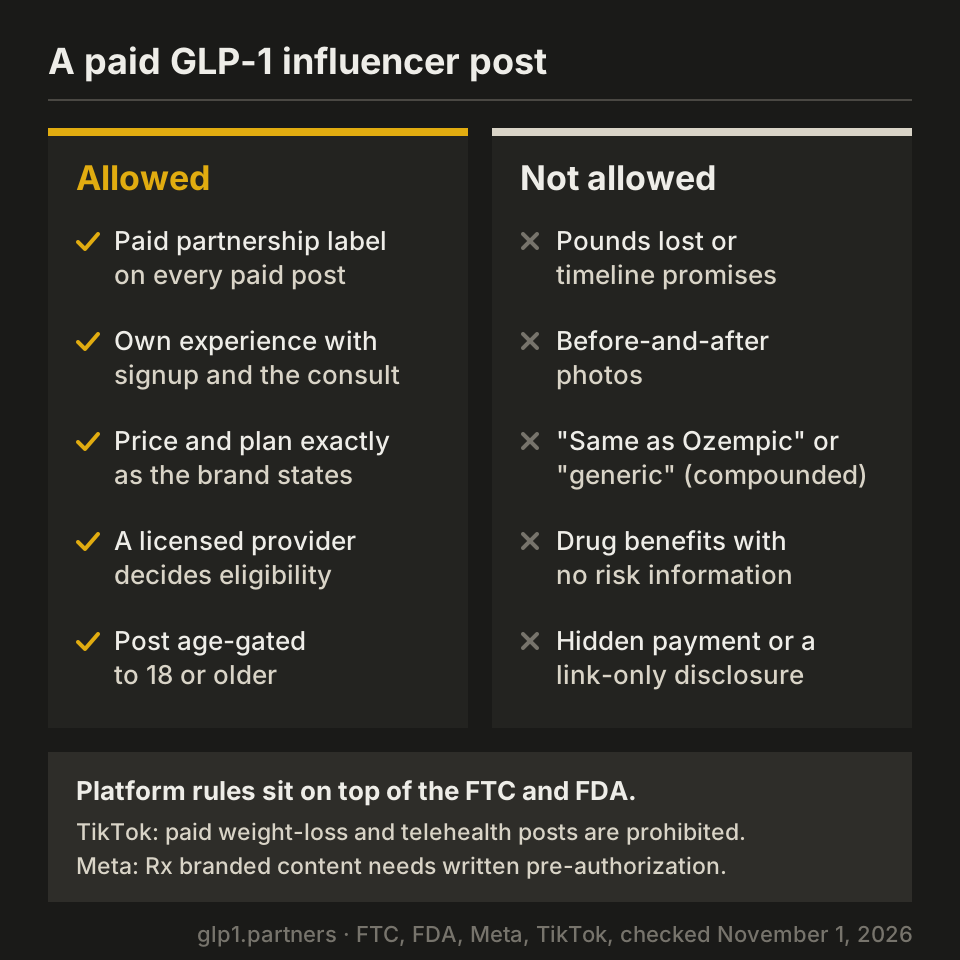
Which rules apply to a paid GLP-1 influencer post
A paid GLP-1 influencer post falls under four rule sets at once. The brand answers for all of them, not only the influencer.
| Rule set | Who wrote it | What it controls in a GLP-1 post |
|---|---|---|
| Endorsement Guides, 16 CFR Part 255 | FTC (revised July 26, 2023) | Disclosure of payment, honest experience, typical results, brand liability |
| Health Products Compliance Guidance | FTC (December 2022) | Proof for health claims, testimonials, dramatic results |
| Prescription drug promotion, 21 CFR 202.1, and misbranding letters | FDA | Risk information next to benefits, claims about compounded drugs |
| Branded content policies | Meta (Instagram, Facebook) and TikTok | Whether the post may run at all, labels, age and country gates |
Can influencers promote GLP-1 on each platform?
Instagram and Facebook allow paid GLP-1 posts under Meta’s conditions, and TikTok prohibits them for weight-loss services and telehealth providers. This decision table reads each platform’s branded content policy as it stood on November 1, 2026.
| Platform | Paid post for a GLP-1 telehealth program | What has to be in place first |
|---|---|---|
| Allowed with restrictions | Meta’s written pre-authorization if the post promotes a prescription drug; paid partnership label; 18+ age gate; US, Canada or New Zealand only for prescription drug posts | |
| Same Meta policy as Instagram | Same as Instagram | |
| TikTok | Prohibited for weight-loss services and telehealth providers | Prescription medicines sit in a separate restricted tier, by invitation from an approved brand, through TikTok One. Get TikTok’s answer in writing before paying anyone |
Of the three, Instagram is the platform with a set route for paid GLP-1 posts. We cover how brands set it up on our Instagram influencer marketing for GLP-1 brands page.
FTC Endorsement Guides: disclosure and brand liability
The FTC’s Endorsement Guides (16 CFR Part 255) make the brand liable for what its influencers say. The revised Guides were published on July 26, 2023 (88 FR 48102).
Section 255.1(d) says: “Advertisers are subject to liability for misleading or unsubstantiated statements made through endorsements or for failing to disclose unexpected material connections between themselves and their endorsers.” The same section tells advertisers to “Monitor their endorsers’ compliance.”
Four parts of the Guides matter most for GLP-1:
- Disclosure: Section 255.5 says a material connection the audience would not expect, such as payment or free product, “must be disclosed clearly and conspicuously.” On social media, Section 255.0(f) says the disclosure “should be unavoidable.” A disclosure hidden behind “more” or a link does not meet that bar.
- Real use: Section 255.1(c) says “the endorser must have been a bona fide user of it at the time the endorsement was given.” An influencer who never went through your program cannot describe it as a user.
- Typical results: under Section 255.2(b), an endorsement may be read as saying “the endorser’s experience is representative of what consumers will generally achieve.” If the brand can’t back that up, the Guides say the ad should clearly disclose what people generally get.
- Proof: Section 255.2(a) says consumer endorsements “themselves are not competent and reliable scientific evidence.”
FTC Health Products Compliance Guidance on testimonials
The FTC’s Health Products Compliance Guidance (December 2022) covers “social media and influencer marketing” as advertising, under the same truth rules as any ad. For GLP-1 weight-loss posts, the testimonial section (III.C.1) matters most. It says:
“Testimonials that report results more dramatic than users can generally expect are likely to be deceptive.”
The guidance adds that “attempts to disclaim dramatic results with statements like ‘Results not typical’ don’t cure the deception.” A caption that says “my results, yours may vary” under a 40-pound story does not fix the claim.
The FTC has used this against a GLP-1 telehealth firm. On July 14, 2025, it said NextMed “used deceptive before and after photos of people who were not their customers” and “published fake testimonials created by hired individuals, employees, and family members.” The proposed order requires NextMed and its principals to pay $150,000.
FDA rules on prescription drug promotion in paid posts
FDA rules apply when a paid post promotes a prescription drug. Under 21 CFR 202.1(e)(1), prescription drug ads “must present a true statement of information in brief summary relating to side effects, contraindications” and effectiveness. Section 202.1(e)(5)(ii) calls an ad misleading if it “fails to present a fair balance” between benefits and risks.
FDA has applied this to influencer posts directly:
- Xeomin, October 31, 2024: FDA’s Office of Prescription Drug Promotion sent Merz an untitled letter about an Instagram reel posted by a paid partner on his own account, in “[p]aid partnership with xeominaesthetic.” FDA said the post made “false or misleading representations and suggestions about the risks and efficacy” of the drug. Risk text appeared only after a black screen, and most of it scrolled at an estimated 5,184 words per minute.
- Zepbound and Mounjaro, September 9, 2025: FDA’s warning letter to Eli Lilly covered a promotional video of an Oprah special that featured “paid consultants (representatives)” and said it “omits important risk information and otherwise minimizes the risks of these drug products.”
- The September 9, 2025 crackdown: FDA announced “approximately 100 cease-and-desist letters” and named “undisclosed paid influencer promotion” as one reason patients struggle to tell evidence from promotion.
These letters went to drug manufacturers. Telehealth brands have received FDA letters about compounded drug claims, covered next. In practice, keep paid posts on the program and the provider experience, not on the drug’s benefits.
Compounded GLP-1: claims influencers can’t make
FDA has addressed telehealth companies directly on compounded GLP-1 claims, and an influencer’s caption counts as the brand’s marketing. FDA’s page for telehealth companies (current as of June 15, 2026) warns against calling a compounded drug “a generic version of an FDA-approved drug,” “the same as a drug approved by FDA,” or “claiming a compounded drug has been FDA-approved.”
So an influencer may not say “it’s the same as Ozempic,” “generic Wegovy” or “FDA approved” about a compounded product. Our guide to compounded GLP-1 explains the product, and our breakdown of misleading ad claims FDA has flagged quotes the warning letters line by line.
Meta branded content policy and the paid partnership label
Meta’s Branded Content Policies cover paid posts on Instagram and Facebook, separate from its ad policies. Three rules apply to GLP-1:
- Prescription drugs need written pre-authorization. Meta lists “Prescription Drugs” among partners that need “written pre-authorization from Meta before engaging in branded content.” Its policy says: “The business partner must apply to Facebook to promote prescription drugs.” Telehealth providers are among the eligible applicants. Posts “must be restricted to people 18 years or older and restricted to the United States, New Zealand, or Canada.”
- Weight loss is age-gated: “Branded content promoting cosmetic surgery, cosmetic procedures, weight loss products, or weight loss services must be age-gated to 18 years or older.”
- The label is required. Instagram’s help page says “our branded content policies require that you use the paid partnership label to tag the brand you are working with.” Meta’s policy says branded content “may only be posted with the use of the branded content tool.”
If the brand turns a post into a partnership ad, Meta’s ad rules apply too. Its Health and Wellness standard (last change log entry July 22, 2026) requires weight-loss ads to be “targeted to people at least 18 years or older” and bans ads that “Close up on specific body area by pinching fat.” Its Drugs and Pharmaceuticals standard requires telehealth providers “to be actively certified with LegitScript.” Our Meta weight loss ads policy guide tracks those rules.
TikTok branded content policy on weight loss and telehealth
TikTok’s Branded Content Policy (effective October 30, 2026) lists “Weight loss products or services” as a prohibited industry, “Including weight loss clinics.” The same prohibited list names “Any medical institutions, treatments or devices, including nutritionists, online pharmacies and telehealth providers.”
Prescription medicines sit in a separate restricted tier. In Canada and the United States, such posts are restricted “to users over the age of 18” and “to the market in which it was originally posted,” and brands must partner with influencers through the TikTok One platform. TikTok also counts a paid review as branded content and requires the “commercial content disclosure toggle.”
A GLP-1 telehealth program is a weight-loss service sold by a telehealth provider, so a paid TikTok post for it hits two prohibited categories. Our TikTok GLP-1 ads guide covers TikTok’s separate rules for paid ads.
What a GLP-1 influencer may and may not say
This table turns the rules above into post copy. It covers paid Instagram posts for a GLP-1 telehealth program.
| Post element | May say or show | May not say or show | Rule behind it |
|---|---|---|---|
| Disclosure | Paid partnership label plus a clear “ad” in the caption | Payment mentioned only in a link, a comment or at the end of a long caption | FTC 255.5, 255.0(f); Meta branded content tool |
| Personal experience | What signup, the consult and the app were like, if the influencer used the program | A program the influencer never used | FTC 255.1(c) |
| Weight results | Nothing about pounds, sizes or timelines | “I lost 30 pounds in 8 weeks,” “you’ll drop a size a month” | FTC 255.2(b); Health Products Guidance III.C.1 |
| Photos | The influencer, the app, the packaging as shipped | Before-and-after photos, pinched-fat close-ups | FTC (NextMed, July 14, 2025); Meta Health and Wellness |
| Drug names and benefits | That a licensed provider decides whether a medication fits | Efficacy or safety claims for a named drug without risk information | 21 CFR 202.1(e)(5)(ii); FDA Xeomin letter |
| Compounded products | “Compounded semaglutide” or “compounded tirzepatide,” named as such | “Same as Ozempic,” “generic Wegovy,” “FDA approved” | FDA telehealth promotion page (June 15, 2026) |
| Eligibility | “A licensed provider reviews your intake” | “Everyone qualifies,” “no doctor needed” | FTC truth-in-advertising; brand’s approved claims |
| Price | The price and plan exactly as the brand publishes them | A monthly price that leaves out the drug, lab work or the consult | FTC (NextMed price claims) |
| Audience | Posts age-gated to 18 or older | Teen audiences, posts aimed at minors | Meta branded content; TikTok restricted tier |
A pre-post checklist for GLP-1 brands
Brands answer for every paid post under FTC 255.1(d), so check each one before it goes live:
- Meta’s written pre-authorization is in place if the post promotes a prescription drug.
- The influencer has tagged your brand with the paid partnership label, and the post is age-gated to 18+.
- The caption has no weight numbers, timelines or before-and-after images.
- Any drug mention sells the program and the provider, not drug benefits.
- Compounded products are named as compounded, never as generic or the same as a brand drug.
- Prices match your live pricing page.
- You keep a copy of the approved post and its caption for your records.
How GLP1.partners runs influencer campaigns
We run GLP-1 influencer campaigns for telehealth brands on Instagram only. The brand approves the talking points, so price, plan details and claims come from what the brand has approved. We run GLP-1 and telehealth traffic at scale with platform approvals on every network we buy, so influencer posts sit next to Meta on established agency accounts with a dedicated Meta agency contact, Outbrain, TikTok ads, our own comparison sites and an affiliate network we manage.
FAQ
Can influencers promote prescription drugs on Instagram?
Yes, with Meta’s written pre-authorization. Meta’s Branded Content Policies list prescription drugs among the categories that need it, telehealth providers are eligible to apply, and posts must be limited to people 18+ in the US, Canada or New Zealand.
Do the FTC rules apply to gifted product, not only cash?
Yes. Section 255.5 names free product as a material connection, and Meta defines branded content as content made “for an exchange of value, such as monetary payment or free gifts.” A free month of a GLP-1 program needs the same disclosure as a fee.
Can a GLP-1 influencer share their own weight loss?
A paid influencer’s weight-loss story reads as a typical-results claim under FTC Section 255.2(b). Unless the brand can show users generally get that result, it should stay out of paid posts, and a “results not typical” line does not cure it.
Sources
- eCFR, 16 CFR Part 255, Guides Concerning the Use of Endorsements and Testimonials in Advertising (revision published 88 FR 48102, July 26, 2023; 255.0(f), 255.1(c)-(d), 255.2(a)-(b), 255.5) · accessed
- FTC Endorsement Guides, 16 CFR 255.1 (Cornell LII) · accessed
- FTC, Health Products Compliance Guidance (December 2022; sections II.A, III.C.1) · accessed
- FTC, FTC Takes Action Against Telemedicine Firm NextMed (July 14, 2025) · accessed
- eCFR, 21 CFR 202.1, Prescription-drug advertisements (202.1(e)(1), (e)(5)(ii)) · accessed
- FDA OPDP, untitled letter to Merz Pharmaceuticals GmbH re Xeomin Instagram post (October 31, 2024) · accessed
- FDA, FDA Launches Crackdown on Deceptive Drug Advertising (September 9, 2025) · accessed
- FDA warning letter, Eli Lilly and Company, MARCS-CMS 716485 (September 9, 2025; Zepbound and Mounjaro, video of an Oprah special with paid consultants) · accessed
- FDA, FDA to Telehealth Companies: What to Know When Promoting Compounded Drugs (content current as of June 15, 2026) · accessed
- Meta Business Help Center, Branded Content Policies (prescription drugs: written pre-authorization, telehealth providers eligible, 18+, US/NZ/CA; weight loss age-gated 18+; branded content tool required) · accessed
- Instagram Help Center, How to use the paid partnership label to tag organic branded content on Instagram · accessed
- Meta Transparency Center, Advertising Standards: Health and Wellness (change log entry July 22, 2026) · accessed
- Meta Transparency Center, Advertising Standards: Drugs and Pharmaceuticals · accessed
- TikTok, Branded Content Policy (effective October 30, 2026; prohibited: weight loss products or services, telehealth providers; restricted: prescription medicines, US and Canada, TikTok One) · accessed