GLP-1 media buying is the work of planning, buying and optimizing paid traffic for a GLP-1 telehealth brand. A media buyer picks the channels, writes ads inside each platform’s health rules, paces budget through each platform’s learning phase, and moves money to whatever holds the brand’s target cost per acquisition on paid orders.
Policy checked on November 1, 2026.
What a GLP-1 media buyer does
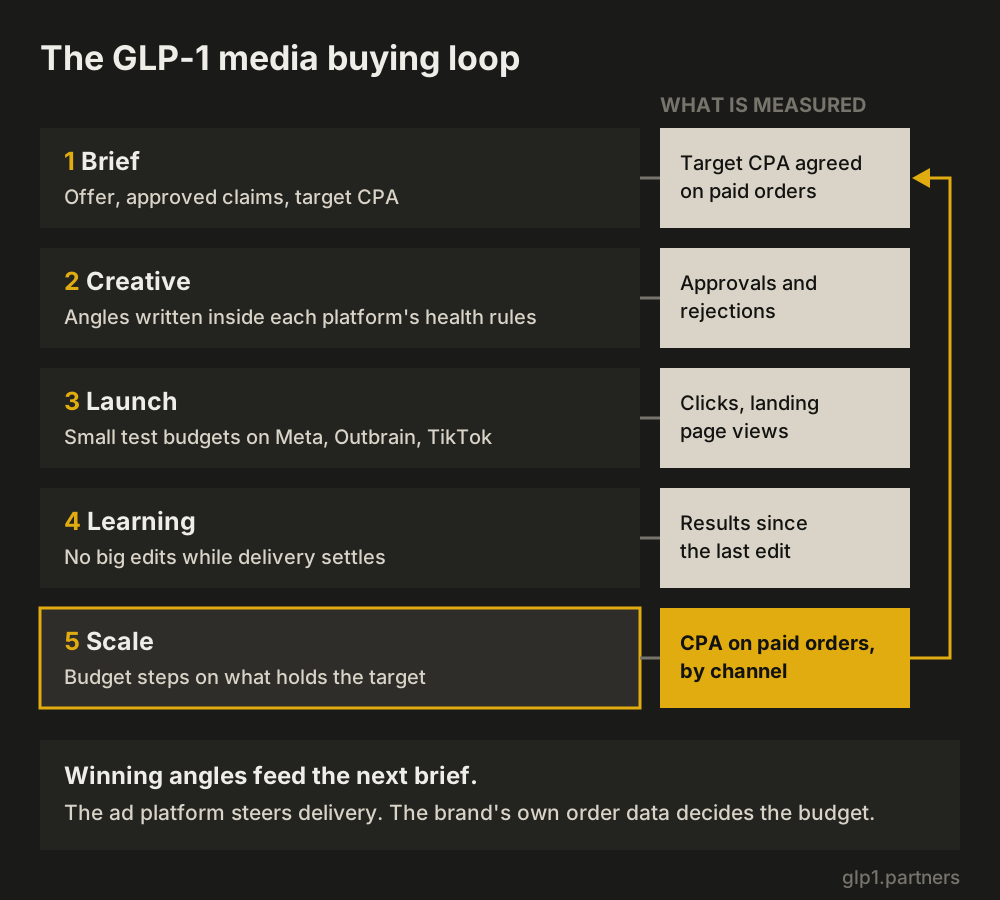
A GLP-1 media buyer owns the paid traffic from the first brief to the weekly budget call. The work runs in five steps, the same five as in the diagram above:
- Brief. Agree on the offer, the claims the brand has approved and one target, usually cost per paid order or per started patient.
- Creative. Write and build ads that pass each platform’s health and weight-loss rules.
- Launch. Open campaigns on a small budget per channel and per angle.
- Learning. Leave the campaigns alone while each platform’s delivery system settles.
- Scale. Raise budget in steps on what holds the target, cut what doesn’t, and feed the winning angles into the next brief.
Telehealth media buying differs from ecommerce buying in three places: the platforms gate prescription offers, the creative rules for weight loss are strict, and the tracking data a health site can send back is limited. The sections below take each one in turn.
How the GLP1.partners media team buys GLP-1 media
We run GLP-1 and telehealth traffic at scale with platform approvals on every network we buy. Our media buying starts from two inputs in the brief, the brand’s target and its LegitScript status, and together they set which channel opens first.
On Meta, we buy on established agency accounts built for GLP-1 scale, with a dedicated Meta agency contact, and the brand brings its LegitScript certification. On Outbrain, we buy on established Outbrain accounts with a dedicated setup for GLP-1 and build the article-style pages native readers expect. On TikTok, the creative is short vertical video made for TikTok and its weight-management rules. Every channel is reported against the one target the brand sets, side by side in a weekly report, and the brand approves every ad before launch. Our page on telehealth advertising for GLP-1 brands shows how the channels fit together.
What each channel needs before GLP-1 media buying starts
Each channel in a GLP-1 media plan has its own gate and its own ad format, and the buyer has to clear the gate and build for the format before any test budget goes out.
| Channel | Gate before launch | What the buyer builds | Where the click lands |
|---|---|---|---|
| Meta (Facebook, Instagram) | Ads that promote a prescription drug need LegitScript certification and Meta authorization | Image and video ads per angle | The brand’s landing page or intake |
| Outbrain | Public guidelines say ads “must not promote the sale or use of illegal, prescription, or recreational drugs”; GLP-1 brands run through approval from Outbrain | Headline and image pairs for recommendation feeds | An article-style pre-lander, then the intake |
| TikTok | US prescription medicine “May be allowed” with “proof of approval and certification,” audiences 18+ | Short vertical video | A fast mobile landing page |
| Taboola, AppLovin | Each network’s own healthcare rules | Formats native to each network | Depends on the network |
Meta’s policy lets advertisers “Promote telehealth services generally” without written authorization. Ads that promote a prescription drug are a different case: Meta requires telehealth providers to be “actively certified with LegitScript,” to target only people in the United States, Canada or New Zealand, to target “people 18 years or older” and to “Obtain authorization from Meta.” A media buyer should know which of the two cases each ad falls into before it is written. For the native side, see our guide to Outbrain ads for GLP-1 brands.
Budget pacing and learning phases
Budget pacing in GLP-1 media buying follows each platform’s learning phase. A new campaign, or one with a big edit, spends its first days with unstable results, and the buyer’s job is to give it enough budget to finish learning without changing it halfway.
| Platform | When learning usually ends (platform’s own wording) | What resets or disrupts it |
|---|---|---|
| Meta | “after about 50 results in the week after the ad set’s last significant edit” | Significant edits; “frequent budget changes” can also send an ad set back into learning |
| TikTok | volatility “starts to decline after about 25 campaign results or 7 days” | Pausing, edits that restart learning, unreasonable budgets or creative volumes |
Meta’s help page says ad sets in learning “are less stable and usually have a higher CPA,” and advises advertisers to “Wait to edit your ad set until it’s out of the learning phase.” Two pacing rules follow for a GLP-1 account:
- Size the test budget to the event, not to a round number. If an ad set can’t reach about 50 results a week on the chosen event, either the budget is too small or the event is too deep.
- Count ad sets. Meta notes that with many ads and ad sets, “the delivery system learns less about each ad and ad set.” Fewer, broader ad sets learn faster than many narrow ones.
Our guide on how to scale Meta ads for a telehealth brand covers the budget steps after learning ends.
Creative testing under health ad rules
Creative testing for a GLP-1 brand runs inside each platform’s weight-loss rules, so the first filter on any new angle is policy, and the second is performance. An angle that wins and then gets rejected costs a learning phase.
The rules that shape GLP-1 creative most often:
- Meta Health and Wellness: weight-loss ads can’t contain “statements of inferiority about physical appearance,” can’t show a “Close up on specific body area by pinching fat,” and can’t use clickbait such as “promises of specific outcomes within a set timeframe without disclaimers or qualifiers.” For prescription weight-loss products, Meta points to its Drugs and Pharmaceuticals policy.
- TikTok Weight Management: “Any weight loss or muscle gain claims must be restricted to audiences aged 18 years or older,” and ads and landing pages “must not explicitly shame users about their bodies, suggest there is an ideal body type.”
- Outbrain: health ads “May not make illegitimate or unproven claims about results.”
A practical test plan writes several angles about the program and the provider experience (access, convenience, a licensed clinician, the steps to start) and tests each on a small budget. Drug names, body-shaming lines and timed results are the first things to check in review, because the rules above name them.
Landing pages and pre-landers for GLP-1 traffic
GLP-1 landing pages have to match the ad and pass the same health rules, because the platforms above review the page as well as the ad. TikTok’s policy says so directly: “Ad content and landing pages” fall under the weight-management rules.
Pre-landers (an article-style page between the ad and the sign-up) are common on native traffic, where readers arrive expecting to read. Outbrain’s guidelines set limits on them. Outbrain bans “Fake navigation or text/images that make a user think that it is a larger editorial site,” and says links “must link to the page or pages reasonably expected by the reader.” A compliant pre-lander reads as the brand’s own page, explains the program and leads to the intake.
What to test on the page side:
- headline and first screen that repeat the ad’s promise
- one clear next step into the intake
- page speed on mobile
- the same approved claims as the ads
Reporting GLP-1 media buying against the brand’s target
A GLP-1 media buyer reports every channel against the one target the brand agreed in the brief, counted in the brand’s own order data, because ad platforms may receive less data from a health site. Meta assigns websites to data source categories, and for restricted categories it may restrict “the sharing of specific mid and lower funnel events” or fully restrict the sharing of all events.
Meta’s advice for restricted events is to “explore alternative events” and to consider “more upper-funnel events to maintain effective audience targeting and campaign optimization.” With full restrictions in place, Meta suggests campaign objectives that work without shared data: Awareness, Engagements and Traffic.
That changes how a buyer reads results:
- The optimization event steers delivery. It is often an earlier step than the paid order.
- The brand’s own order data (paid orders, started patients, refunds) is the scoreboard for budget decisions.
- Each channel’s spend is joined to the brand’s orders by date and source every week, so channels are compared on the same number.
Agree on the counted event before the first dollar is spent. If the provider declines some intakes, a cost per intake looks cheaper than the real cost per paying patient. How to set the target itself, from margin and retention, is in our guide to scaling a GLP-1 telehealth brand.
Questions to ask a GLP-1 media buyer
A GLP-1 media buyer should answer these on the first call without hedging:
- Which of my ads need prescription-drug authorization on each platform, and which count as general telehealth ads?
- What event will each channel optimize for, and how will you judge it against my paid orders?
- How much test budget does each ad set need to finish learning on that event?
- How many angles do you test at once, and who checks each one against the health rules before launch?
- Do you build the landing pages and pre-landers, and who reviews their claims?
- What will you do if Meta restricts my mid and lower funnel events?
- When do you raise budget, by how much, and when do you cut a channel?
For a wider checklist on contracts, affiliates and red flags, see how to choose a GLP-1 marketing agency.
FAQ
What is GLP-1 media buying?
GLP-1 media buying is paid traffic buying for GLP-1 telehealth brands: choosing channels, writing ads that pass health ad rules, pacing budget through learning phases and scaling what meets the brand’s target cost per paying patient.
Which channels work for GLP-1 telehealth ads?
Meta, Outbrain and TikTok are the core paid channels, with networks such as Taboola and AppLovin added once the funnel converts. Each has its own healthcare rules, and Meta requires LegitScript certification and authorization for ads that promote a prescription drug.
How long should a GLP-1 campaign run before judging it?
A GLP-1 campaign should run until it leaves the learning phase. Meta says that usually takes about 50 results in the week after the last significant edit. TikTok says volatility starts to decline after about 25 campaign results or 7 days.
Can a media buyer track GLP-1 conversions on Meta?
Often only partly. Meta may restrict mid and lower funnel events for health sites. Buyers then optimize on an earlier event that still arrives and judge results on the brand’s own paid orders.
Sources
- Meta Business Help Center, About the learning phase · accessed
- Meta Business Help Center, Understand data sharing restrictions based on data source categories · accessed
- Meta Transparency Center, Advertising Standards: Drugs and Pharmaceuticals · accessed
- Meta Transparency Center, Advertising Standards: Health and Wellness · accessed
- TikTok Business Help Center, Learning Phase (last updated June 2026) · accessed
- TikTok Business Help Center, Weight management ad policy (last updated September 2026) · accessed
- TikTok Business Help Center, Healthcare and pharmaceuticals ad policy, United States: prescription medicine (last updated September 2026) · accessed
- Outbrain, Our Advertising Guidelines (no date on page) · accessed