A Facebook ads agency plans, buys and tests Meta ads on Facebook and Instagram for other businesses, with a team that covers media buying, creative and tracking. Compared with an in-house hire or a freelancer, an agency adds more people, its own agency ad accounts and platform contacts. For GLP-1 and telehealth brands, Meta’s health rules apply in every setup.
What a Facebook ads agency does
A Facebook ads agency runs the whole Meta ad cycle for a client brand: it sets the campaign plan, builds the account, makes and tests ads, and reports results against a target the brand sets. The work is the same in any vertical. The rules around it change by vertical.
A typical Facebook ads agency covers:
- Account setup. Campaign structure, conversion events, and access to the brand’s business portfolio or an agency ad account.
- Creative. Ad concepts, images, video and copy, made in batches so there is always something new to test.
- Buying and optimization. Budgets, bids, audiences and placements, adjusted from results.
- Testing. Structured tests of one change at a time, using Meta’s A/B test tool or split campaigns.
- Reporting. Spend, cost per result and next steps, checked against the brand’s own sales data.
For a GLP-1 telehealth brand, the same agency also writes ads inside Meta’s prescription drug and weight loss rules and keeps the brand’s certification tied to the right ad accounts. Our guide on what a telehealth Facebook ads agency does each week walks through that work week by week.
How GLP1.partners runs Facebook ads for GLP-1 brands
GLP1.partners runs Meta for GLP-1 and telehealth brands as managed media. On Meta, we work from established agency accounts built for GLP-1 scale, with a dedicated Meta agency contact. Each brand runs in its own ad account, and our team runs the campaigns end to end.
“We run GLP-1 and telehealth traffic at scale with platform approvals on every network we buy.” The GLP1.partners media team
In practice, for a brand that comes to us:
- The brand’s certification, our accounts. The brand brings its own LegitScript certification. Our agency accounts are suited to run certified telehealth brands.
- One target. We plan spend and creative tests against the target the brand sets, and report on it every week.
- More than Meta. Meta is one channel. We also run Outbrain, TikTok, Instagram influencers, our own comparison sites and an affiliate network we manage.
GLP-1 and telehealth are our focus. If your brand sells in another vertical, tell us on the call what you run and where. See how we work as a Facebook ads agency for telehealth brands.
Facebook ads agency vs in-house team vs freelancer
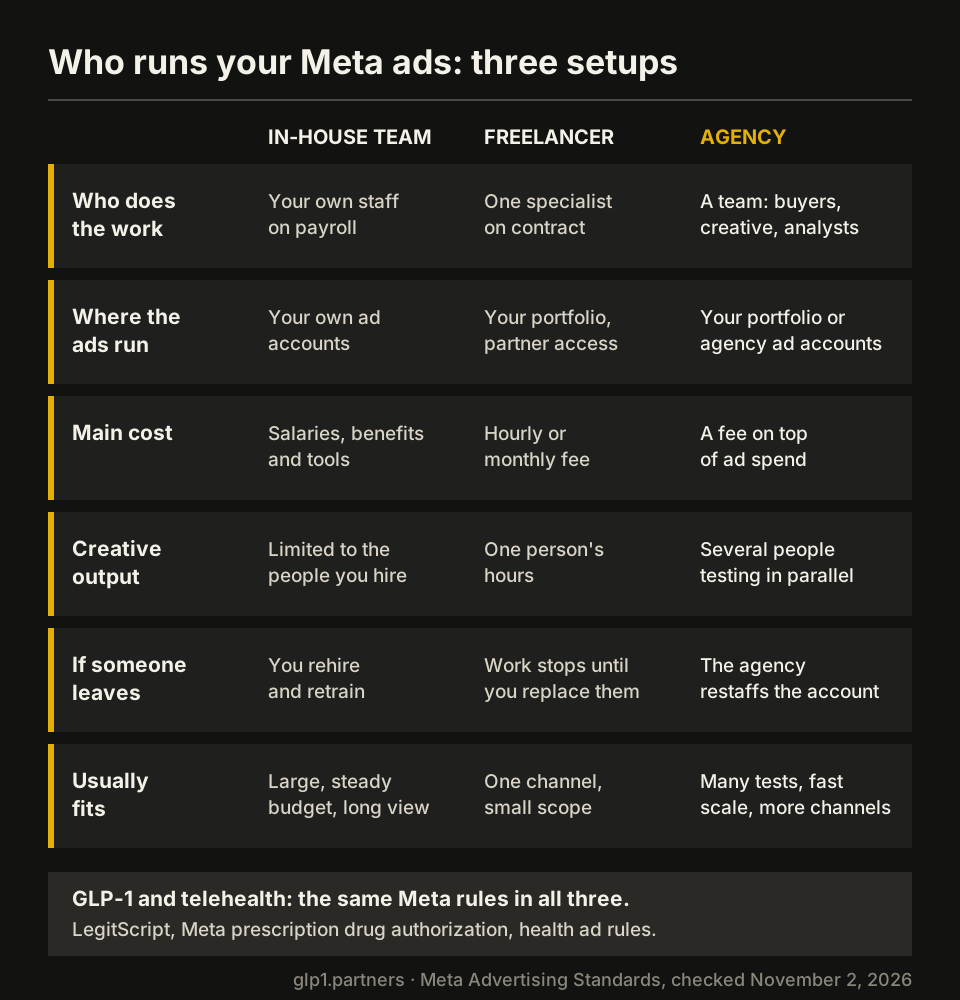
A Facebook ads agency, an in-house team and a freelancer can all run good Meta campaigns. They differ in who does the work, where the ads run, what you pay for and what happens when a person leaves.
| Question | In-house team | Freelancer | Facebook ads agency |
|---|---|---|---|
| Who does the work | Your own staff | One specialist on contract | A team: buyers, creative, analysts |
| Where the ads run | Your own ad accounts | Your business portfolio, through partner access | Your portfolio, or agency ad accounts |
| Main cost | Salaries, benefits, tools | Hourly or monthly fee | A fee on top of ad spend |
| Creative output | Limited to the people you hire | One person’s hours | Several people testing in parallel |
| If someone leaves | You rehire and retrain | Work stops until you replace them | The agency restaffs the account |
| Day-to-day control | Full | Brief and approvals | Targets, claims and approvals |
| Usually fits | Large, steady budget and a long horizon | One channel, small scope | Many tests, fast scale, more channels |
The in-house cost is easy to underestimate. The US Bureau of Labor Statistics put the median annual wage for marketing managers at $166,790 in May 2025, and for advertising and promotions managers at $133,660. That is one salary before benefits, software and creative production. A single senior buyer also can’t produce and test creative at the pace a team can.
A freelancer avoids that fixed cost. The risk is concentration: one person holds the account knowledge, so a holiday or a lost contract pauses the work.
A mixed setup is common. Some brands keep strategy and claims approval in-house and hand media buying and creative testing to an agency.
What a Facebook ads agency adds: ad accounts, a Meta contact, creative testing
A Facebook ads agency adds three things that a hire or a freelancer usually can’t bring on day one.
Agency ad accounts
An agency can run your ads in your own business portfolio through partner access, or in an agency ad account dedicated to your brand. Meta’s Advertising Standards set the rule for anyone managing ads for others: each advertiser or client “must be managed through separate ad accounts.” A real agency setup gives each brand its own ad account. Outside GLP-1, we also rent and run Meta agency accounts for any niche Meta’s ad rules allow.
To give an agency access to your own portfolio, Meta’s partner access page asks for the agency’s business portfolio ID and tells you to turn on two-factor authentication first. Our guide to Meta agency ad accounts for telehealth compares partner access with an agency-owned account and explains what Meta’s terms allow.
A contact at Meta
Some agencies work with a dedicated contact on Meta’s side. Ask what that contact actually does for your account (policy questions, account reviews, new formats), because the answer differs from agency to agency. For a GLP-1 brand, ask whether the agency already runs certified telehealth advertisers.
Creative testing at volume
Creative testing is where an agency’s team size shows. Meta’s A/B testing tool compares two versions of an ad strategy by changing one variable, such as creative, audience or placement, and shows each version to a separate part of the audience so nobody sees both. Meta also says leaving the learning phase “usually occurs after about 50 results in the week after the ad set’s last significant edit.” A good agency reads results after that point, not before.
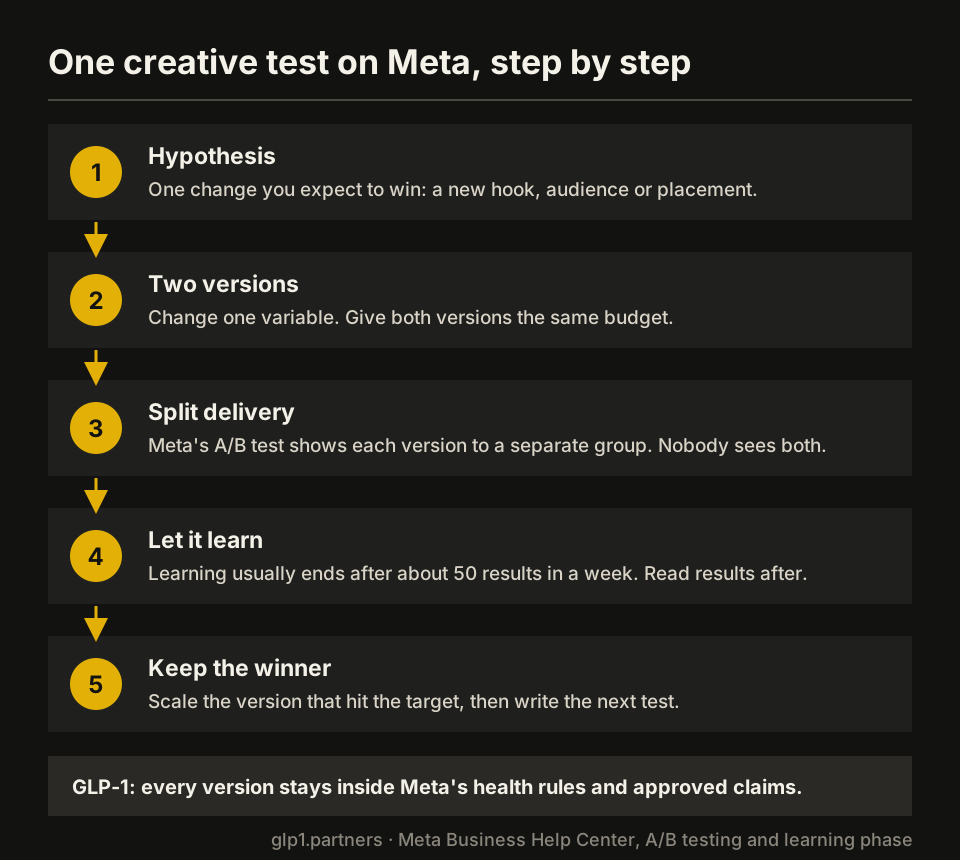
For GLP-1 ads the test pool is smaller than in most verticals, because some common weight loss hooks break Meta’s rules, such as statements of inferiority about physical appearance. Every version has to pass review and match the brand’s approved claims, so an agency that knows those limits wastes fewer tests on ads that get rejected.
Meta ad prices in 2026 and why testing volume matters
Meta’s price per ad rose faster than its ad volume in the third quarter of 2026. Meta’s third quarter 2026 results, released October 21, 2026, reported that ad impressions across its apps “increased by 10% year-over-year” and that average price per ad “increased by 14% year-over-year.”
When price per ad rises faster than impressions, each wasted ad costs more. That shifts the value of a Facebook ads agency toward:
- Fewer losing tests. One clear change per test, read after learning ends.
- Faster replacement. New creative ready before the current winner wears out.
- Clean measurement. Meta’s results checked against the brand’s own sales, so budget follows real buyers.
For a GLP-1 telehealth brand the same logic applies to rejected ads. An ad that fails review costs time and a slot in the test plan.
Meta rules that apply whoever runs GLP-1 ads
Meta’s rules for GLP-1 and telehealth ads apply the same way to an in-house team, a freelancer and a Facebook ads agency. Hiring an agency doesn’t change them. Policy checked on November 2, 2026:
| Rule | Meta wording | What it means for the setup |
|---|---|---|
| LegitScript for telehealth | “Meta requires online pharmacies and telehealth providers to be actively certified with LegitScript.” | The brand holds the certification; the agency runs ads on accounts tied to it |
| Authorization for Rx ads | Certified providers “must request authorization from Meta” | The ad accounts that run prescription drug ads must be authorized |
| General telehealth ads | No written authorization needed to “Promote telehealth services generally” | Service ads without drug claims follow the general health rules |
| Weight loss age limit | Ads “must be targeted to people at least 18 years or older” | 18+ in every ad set |
| Body image | No “statements of inferiority about physical appearance” | Rules out shame-based hooks in weight loss creative |
| Agency accounts | Separate ad accounts per advertiser | One ad account per brand |
The full authorization steps, including eligible countries, are in our guide to Meta prescription drug ads for GLP-1 telehealth.
Steps to decide between an agency, a hire and a freelancer
Deciding between a Facebook ads agency, an in-house hire and a freelancer comes down to eight checks. They work for any brand, and two are specific to GLP-1 and telehealth.
- Write down your target: cost per sale, monthly volume and the budget you can commit for at least three months.
- Count the creative you need. If you plan to test new ads every week, one person will struggle to keep up.
- Decide where the ads will run: your own business portfolio, or an agency ad account dedicated to your brand.
- GLP-1 and telehealth: confirm your LegitScript certification is active and plan which ad accounts Meta will authorize.
- Write a claims list your legal or medical side signs off. Whoever runs the ads works inside it.
- Ask each candidate how they test: one variable at a time, how long before they read results, and how they reconcile Meta’s numbers with your sales.
- GLP-1 and telehealth: ask how many certified telehealth advertisers they run today and what their contact at Meta helps with.
- Agree in writing who owns the ad account, the creative and the data if you part ways.
For contract terms and red flags in an agency pitch, use our checklist for choosing a GLP-1 marketing agency.
FAQ
How much does a Facebook ads agency cost?
Facebook ads agencies usually charge a monthly retainer, a percentage of ad spend, or a mix of both, on top of the ad spend itself. Fees vary with budget, creative volume and the number of channels. Compare the full monthly cost with an in-house salary, benefits and tools, not with ad spend alone.
Do GLP-1 brands need an agency to run Meta ads?
No. A GLP-1 telehealth brand can run Meta ads in-house if it holds an active LegitScript certification and Meta’s authorization for the ad accounts it uses. Brands hire an agency for creative volume, faster testing, agency ad accounts and experience with Meta’s health rules.
Who owns the ad account when a Facebook ads agency runs it?
It depends on the setup. With partner access, the ad account stays in the brand’s business portfolio and the brand can remove the agency. With an agency ad account, the account sits in the agency’s portfolio and is dedicated to one brand. Agree on ownership of the account, creative and data before launch.
Sources
- Meta Transparency Center, Introduction to the Advertising Standards (ads for other advertisers managed through separate ad accounts) · accessed
- Meta Transparency Center, Advertising Standards: Drugs and Pharmaceuticals (online pharmacies and telehealth providers actively certified with LegitScript; no written authorization needed to promote telehealth services generally) · accessed
- Meta Transparency Center, Advertising Standards: Health and Wellness (weight loss ads 18+; no statements of inferiority about physical appearance) · accessed
- Meta Platforms, Meta Reports Third Quarter 2026 Results, SEC Form 8-K Exhibit 99.1 (October 21, 2026; ad impressions +10% and average price per ad +14% year-over-year) · accessed
- US Bureau of Labor Statistics, Occupational Outlook Handbook: Advertising, Promotions, and Marketing Managers (median annual wage May 2025: marketing managers $166,790; advertising and promotions managers $133,660) · accessed
- Meta Business Help Center, About A/B testing (compare two versions by changing one variable such as creative, audience or placement; nobody sees both) · accessed
- Meta Business Help Center, About the learning phase (exit usually after about 50 results in the week after the last significant edit) · accessed
- Meta Business Help Center, Give a partner access to business assets in your business portfolio (partner business portfolio ID; two-factor authentication) · accessed