Med spa marketing for a GLP-1 weight-loss program works differently from marketing Botox or laser treatments. The ads promote a prescription drug, so Meta and Google approval rules apply. Compounded semaglutide claims are an FDA enforcement target. And the competitor is often a telehealth brand selling online in the same state.
Why GLP-1 programs changed med spa marketing
GLP-1 programs became one of the main services med spas market. Guidepoint Qsight reported on January 9, 2025 that 60% of US medspas offered GLP-1 treatments, against 35% of aesthetic physician offices. At practices offering them, GLP-1 drugs brought in about 15% of monthly revenue, and about 40% of 2024 GLP-1 patients were new to the practice. Erik Haines, managing director of Guidepoint Qsight, put it this way: “Our data indicates that practices embracing these innovations are outpacing their peers.”
A September 2026 review by Whelth Research of 14,748 US med spas found that 40.1% listed medical weight loss, ranking it sixth among listed services.
That new-patient share is the marketing point. A GLP-1 program brings in people who never booked an injectable, and a med spa has to find them in a market where telehealth brands advertise in the same feeds.
How GLP1.partners runs GLP-1 patient acquisition
GLP1.partners runs GLP-1 and telehealth traffic at scale with platform approvals on every network we buy. This is how we run acquisition for a GLP-1 program, and the part a med spa with a telehealth option can hand to us:
- Meta on agency accounts. We run campaigns on established agency accounts built for GLP-1 scale, with a dedicated Meta agency contact. The brand brings its own LegitScript certification.
- More than one paid channel. Outbrain and TikTok sit next to Meta, so one channel’s review queue doesn’t stop new patient flow.
- Owned and partner traffic. Our own comparison sites, an affiliate network we manage and Instagram influencers send visitors who are already comparing providers.
- One target across channels. Every source reports against the same number the clinic cares about, such as cost per started patient.
We help brands scale in other verticals too. Details are settled on a call with our team.
Local clinic vs telehealth reach for a GLP-1 program
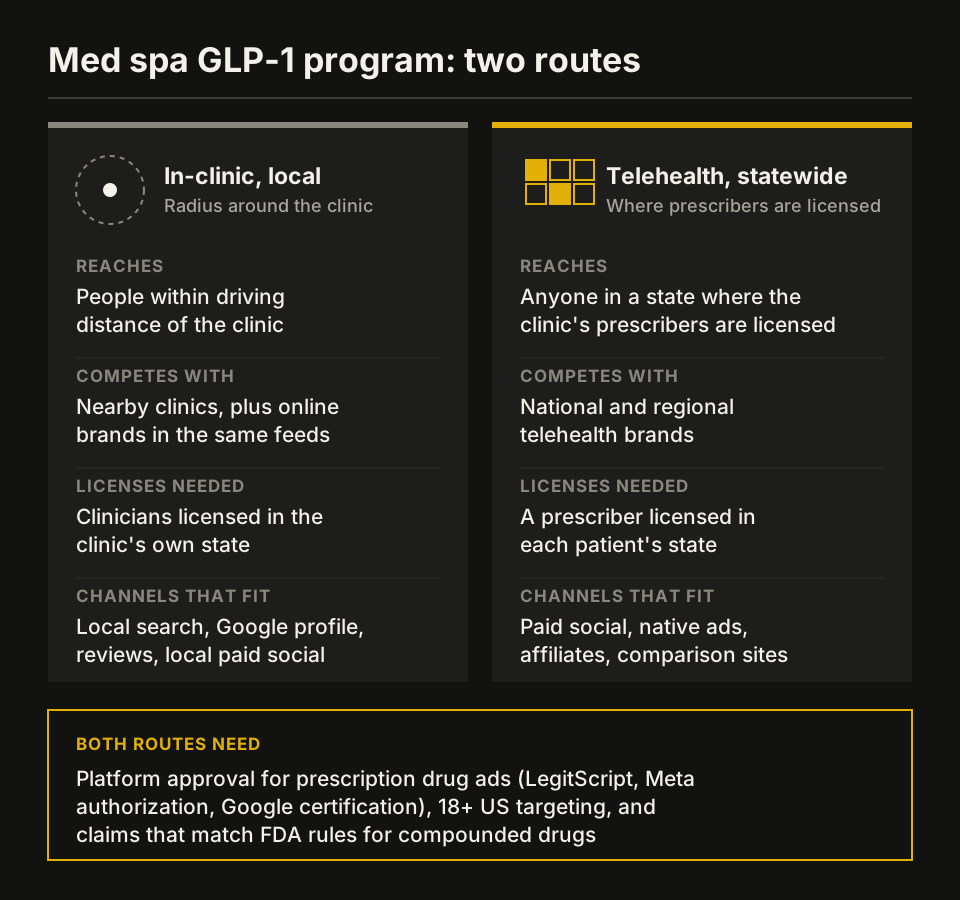
A med spa can sell its GLP-1 program in the clinic, through telehealth, or both, and the choice decides who it competes with and which channels work. HHS states that “A telehealth appointment occurs in the state where the patient is located at the time of the appointment,” so a virtual program can only reach states where its prescribers are licensed.
| Question | In-clinic program | Telehealth program |
|---|---|---|
| Who it reaches | People within driving distance | Anyone in states where the clinic’s prescribers are licensed |
| Main competitors | Nearby clinics, plus online brands in the same feeds | National and regional telehealth brands |
| Channels that fit | Local search, Google Business Profile, reviews, local paid social, referrals | Paid social, native ads, affiliates, comparison sites, influencers |
| What it sells on | In-person visits, body composition checks, add-on services | Convenience, price and speed to a consult |
| Main constraint | Small audience inside the radius | Prescriber licenses per state, platform approval |
Most med spas start local and add a virtual option for existing patients. The marketing changes when the virtual option opens to new patients across a state, because the clinic is then bidding against brands that do this full time.
Ad rules that apply to a med spa GLP-1 program
A med spa ad that promotes a prescription weight-loss drug falls under the platforms’ prescription drug rules, the same as a telehealth brand’s ad. Meta’s Health and Wellness policy sends prescription weight-loss products to its Drugs and Pharmaceuticals policy. Policy checked on November 2, 2026:
| Rule | What it says | What it means for a med spa |
|---|---|---|
| Meta Drugs and Pharmaceuticals | “Online pharmacies, telehealth providers, and pharmaceutical manufacturers” must show they are licensed; LegitScript certification plus Meta authorization | A clinic advertising GLP-1 drugs needs certification and Meta approval before Rx ads run |
| Meta targeting | “Only target people in eligible countries (United States, Canada or New Zealand)” and “Only target people 18 years or older” | Set 18+ and US targeting on every GLP-1 campaign |
| Google prescription drug services | Advertisers must get Google certification; some need third-party accreditation first “(for example, from LegitScript, NABP, or G2)” | Search ads for a GLP-1 program wait on certification |
| Google keywords | Advertisers “must be approved by Google Ads to bid on keywords containing prescription drug terms” | Bidding on “semaglutide near me” needs approval |
What each platform asks for, and where LegitScript fits, is in our guide to who needs LegitScript on each ad platform. The creative rules (before-and-after images, body-part close-ups, result claims) get their own page in medical spa advertising rules.
Compounded GLP-1 claims to keep out of med spa ads
Compounded GLP-1 claims are where med spa ads draw the most enforcement. FDA says “compounded drugs are not FDA approved. This means the agency does not review compounded drugs for safety, effectiveness or quality before they are marketed.” FDA also determined on February 21, 2025 that the semaglutide injection shortage “is resolved,” and the 503A enforcement period ended April 22, 2025.
On March 3, 2026, FDA sent warning letters to 30 telehealth companies over compounded GLP-1 marketing. The main problems named were “implying sameness with FDA-approved products” and selling compounded drugs under the firm’s own name without qualification. FDA Commissioner Marty Makary said: “We are paying close attention to misleading claims being made by telehealth and pharma companies.”
FDA’s guidance on promoting compounded drugs lists the claims to keep off ads and landing pages:
- Calling a compounded drug a generic version of an FDA-approved drug.
- Saying a compounded drug is FDA approved.
- Saying it is clinically proven to match an approved drug’s results.
- Saying it comes from an “FDA-approved” pharmacy or facility. FDA says it “does not approve or license any facility.”
- Branding that suggests the clinic is the compounder.
Brand names carry their own risk for med spas. NBC News reported on February 9, 2024 that Novo Nordisk settled with two Florida businesses, Cosmetic Laser Professionals Med Spa and Nuvida Rx Weight Loss. Both were barred from claiming their compounded drugs are “medicines approved by the Food and Drug Administration” and from using Novo Nordisk trademarks. The wording FDA has cited in letters is collected in our guide to compounded GLP-1 claims the FDA flags.
Channels in a med spa digital marketing mix for GLP-1
Med spa digital marketing for a GLP-1 program uses the same channels as any med spa, with different rules on each. The table shows what each channel is good for and the rule that matters most.
| Channel | Good for | Main rule for GLP-1 |
|---|---|---|
| Google Business Profile and local SEO | “Near me” searches, reviews | Program pages follow FDA claim rules |
| Google Search ads | High-intent searches | Prescription drug certification and keyword approval |
| Meta (Facebook and Instagram) | Reach, retargeting, lead forms | LegitScript plus Meta authorization, 18+, US only |
| Instagram influencers | Trust with local or niche audiences | FTC disclosure, no promised results |
| Email and SMS | Re-engaging past clients, refill reminders | Written consent for automated marketing texts and calls |
| Referrals | Existing clients | Program pages and offers follow FDA claim rules |
| Telehealth reach (native, affiliates, comparison sites) | New patients outside the radius | Prescriber licenses per state, same claim rules |
Existing clients are the easiest first audience. A med spa already has their consent and their trust, so email and in-clinic offers come before paid campaigns.
Handling GLP-1 leads at a med spa
A med spa’s GLP-1 leads need a fast reply and a consent record. A person filling a weight-loss form is often comparing a telehealth brand that answers in minutes, so the clinic needs someone or a system that replies the same day, including evenings.
Automated follow-up has a legal floor. Under 47 CFR 64.1200(a)(2), an advertising call “using an automatic telephone dialing system or an artificial or prerecorded voice” to a mobile number needs “prior express written consent.” Put a consent line on every form that names your clinic. Lead sources, response time and consent wording are covered in depth in med spa lead generation.
Track leads through to a started patient. A form fill that never books a consult isn’t a result, and cheap leads that don’t start cost more than they look.
A med spa marketing plan for a GLP-1 program
The plan below takes a med spa’s GLP-1 program from the first decision to a monthly review in eight steps:
- Decide the route. In-clinic only, telehealth for existing clients, or telehealth open to new patients. The route sets the channels.
- Write a claims sheet. Program name, what’s included, the drug type (branded or compounded) and the claims you can support. Leave out every claim on FDA’s list above.
- Get platform approval. LegitScript certification if you’ll run Rx ads, then Meta authorization and Google certification.
- Build one landing page per route. A local page for the clinic and a separate page for the virtual program, each with the consent line on the form.
- Start with existing clients. Email, in-clinic signs and front-desk mentions.
- Add local search and reviews. Google Business Profile with the weight-loss program listed, and a steady review request after visits.
- Add paid channels one at a time. Meta first, 18+ and US only, then Google Search when certified. Judge each on cost per started patient.
- Review monthly. Check ads and pages against the claims sheet, and cut any source that brings leads who don’t start.
Plan approvals before seasonal pushes such as January, because Rx ads don’t run until certification and authorization are in place.
Choosing a med spa marketing agency for GLP-1
An agency hired to market a med spa’s GLP-1 program should already know the prescription drug rules. Most top-ranking med spa marketing guides we read on November 2, 2026 covered injectables and local SEO, not prescription drug ad approval. Ask any agency:
- Have you run prescription weight-loss campaigns on Meta and Google, and which approvals did they need?
- How do you check ad copy against FDA’s compounded drug claim list?
- Which channels do you run beyond Meta and Google?
- What do you report on: leads, consults or started patients?
- Can you reach patients outside our radius if we add a telehealth program?
FAQ
Can a med spa advertise semaglutide on Facebook? Yes, with conditions. Meta requires LegitScript certification and Meta authorization for prescription drug ads, US targeting and an 18+ audience.
Can a med spa call compounded semaglutide “generic”? No. FDA lists calling a compounded drug a generic version of an approved drug as false or misleading.
Should a med spa use Ozempic or Wegovy in its ads? Treat brand names as legal risk. Novo Nordisk has sued med spas over trademark use and settled cases that bar the businesses from using its marks.
How is med spa marketing different from telehealth marketing? A med spa sells inside a driving radius and on in-person care. A telehealth program can reach a whole state but needs prescribers licensed there and competes with national brands.
Sources
- Guidepoint Qsight via GlobeNewswire, GLP-1 Medications Fuel Growth in Medical Aesthetics, with Weight Loss Accounting for 11% of Non-Surgical Spending in 2024 (January 9, 2025; 60% of US medspas offer GLP-1, ~15% of monthly revenue, ~40% of GLP-1 patients new to the practice) · accessed
- SpaKinect, New Research Maps Medical Services Across 14,748 U.S. Med Spas (Whelth Research, The State of America's Med Spas 2026, September 2026; 40.1% list medical weight loss) · accessed
- Meta Transparency Center, Advertising Standards: Drugs and Pharmaceuticals (online pharmacies, telehealth providers, manufacturers; LegitScript; US, Canada, New Zealand; 18+) · accessed
- Meta Transparency Center, Advertising Standards: Health and Wellness (weight loss 18+; change log July 22, 2026) · accessed
- Google Ads policy, Prescription drug services (certification; LegitScript, NABP or G2 accreditation; approval to bid on prescription drug terms) · accessed
- FDA, FDA Warns 30 Telehealth Companies Against Illegal Marketing of Compounded GLP-1s (March 3, 2026) · accessed
- FDA, FDA to Telehealth Companies: What to Know When Promoting Compounded Drugs (content current as of June 15, 2026) · accessed
- FDA, FDA's Concerns with Unapproved GLP-1 Drugs Used for Weight Loss (content current as of October 1, 2026) · accessed
- FDA, FDA clarifies policies for compounders as national GLP-1 supply begins to stabilize (semaglutide shortage resolved February 21, 2025; 503A period ended April 22, 2025) · accessed
- NBC News, Novo Nordisk settles two lawsuits against businesses selling copycat versions of Ozempic and Wegovy (February 9, 2024) · accessed
- 47 CFR 64.1200, Delivery restrictions (Cornell LII; (a)(2) prior express written consent) · accessed
- FTC, Disclosures 101 for Social Media Influencers · accessed
- HHS Telehealth, Licensure compacts · accessed