Weight loss lead generation for a GLP-1 telehealth brand means paying outside sources for form leads, phone calls or paid first orders. Judge every source on paid orders and refills, not lead counts. Accept a lead only with a TCPA consent record that names your brand, from a form that follows Meta’s and Google’s lead form health rules.
This guide is for national telehealth brands buying traffic. Local clinic SEO is a different job.
Leads, calls and paid orders: what you are buying
A GLP-1 brand can buy weight loss leads in six common ways, and each puts a different share of the quality risk on the brand. The closer to a paid order the source gets paid, the less of that risk you carry.
| Model | What you pay for | Where it fails for a GLP-1 brand | What to require | When it fits |
|---|---|---|---|---|
| Shared form leads | A contact sold to several buyers | Several brands call the same person; the consent may not name you | Consent text that names your brand | Rarely, and only with written return rules |
| Exclusive form leads | A contact sold to you only | You never see the ad or page that made the promise | Source URL, timestamp, consent text, a copy of the ad | When your team can call the same day |
| Aged leads | Older contacts, resold | The person forgot the form; consent may not cover your calls or texts | The original consent wording and date | Almost never for automated calls or texts |
| Pay-per-call | A live call that passes an agreed length | A long call is not intent, and a call-center script can overpromise | Call recordings and the ad behind each call | When intake staff answer during the hours the calls run |
| Your own Meta lead form | Ad spend for in-platform form fills | The form can’t ask health questions without Meta’s permission, so it can’t qualify | Your field list checked against Meta’s lead ads rules | Contact capture, with qualifying done in your own intake |
| Traffic paid on a paid first order | Visitors from affiliates or comparison sites who reach your site and pay | Partner ads and pages still reflect on you | A written definition of the result, plus review of partner ads | When you want the source to carry the lead-quality risk |
The last row matches how GLP-1 affiliate programs work: the partner is paid after an event the brand confirms.
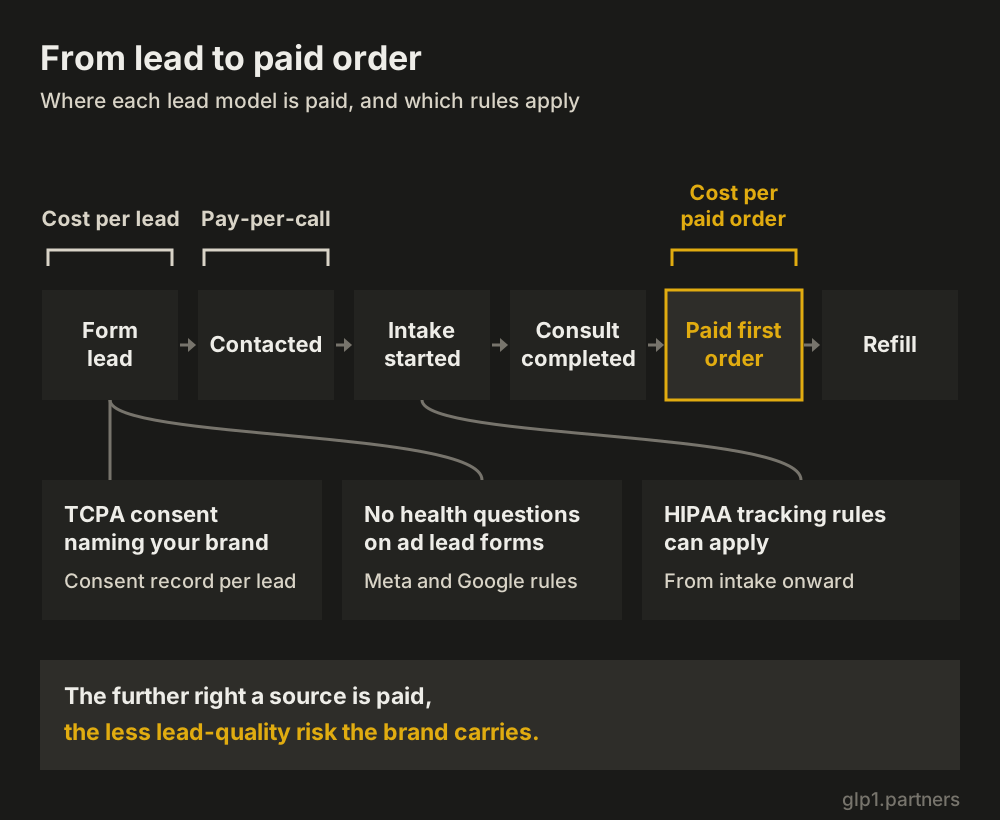
TCPA consent for weight loss leads in 2026
TCPA consent for a bought weight loss lead still means prior express written consent before any autodialed or prerecorded marketing call or text. Two federal changes since January 2025 altered the details. Rules checked on October 30, 2026.
The current definition in 47 CFR 64.1200(f) requires a signed agreement that “clearly authorizes the seller” to send those calls or messages, so the consent should name you. A list of “marketing partners” that never names your brand is the first thing to question.
The dates that matter:
- January 24, 2025: in Insurance Marketing Coalition v. FCC, the Eleventh Circuit vacated Part III.D of the FCC’s 2023 order. That part limited consent to one seller at a time, and to calls “logically and topically associated with the interaction that prompted the consent.”
- August 29, 2025: the FCC removed that paragraph from its rules (90 FR 42137), noting the court’s mandate of April 30, 2025.
- November 25, 2026: a new FCC revocation rule takes effect (91 FR 67214, published October 26, 2026). Its summary says callers may treat a revocation “as applying only to the specific category of informational robocalls to which the revocation was directed” and may “designate an exclusive means to revoke consent.”
Vendor blogs that still call one-to-one consent pending are out of date. How the revocation rule applies to your marketing texts is a question for your counsel, with the rule text in hand.
Meta and Google lead forms can’t collect health details
Meta lead ads can’t ask health questions unless Meta has given permission first, and Google doesn’t allow lead forms for healthcare content at all. Policy checked on October 30, 2026.
Meta’s Advertising Standards say: “Ads must not request health information, including physical health, mental health, medical treatments, medical conditions or disabilities without our prior permission.”
Google’s lead form requirements state: “Advertisements for healthcare-related content are not allowed for lead forms.” Google also sets entry bars for some lead form formats, including “More than $50,000 USD total spend in Google Ads” and completion of advertiser verification.
In practice the ad form collects contact details at most. Weight, medications and history belong in your own intake, and that is where qualifying happens. For pixels and events on those pages, see Meta health data restrictions for telehealth.
How GLP1.partners sends GLP-1 brands traffic
GLP1.partners works from the result the brand defines. Before launch we agree with you on the event we’re measured on and how you confirm it, and you see results by source.
We run GLP-1 and telehealth traffic at scale with platform approvals on every network we buy. The channels:
- Meta, on established agency accounts built for GLP-1 scale, with a dedicated Meta agency contact.
- Outbrain, on established accounts with a dedicated GLP-1 setup.
- TikTok.
- Instagram influencers.
- Our own comparison sites, where visitors are comparing providers.
- An affiliate network we manage, so you get traffic from our affiliate network and comparison sites without building a program yourself.
The visitor lands on your pages and goes through your intake, so your team qualifies them. The consent and form rules above still apply to everything that runs in your name.
A checklist before you accept bought leads
Before a GLP-1 brand pays for a lead batch, it should have these in writing. In August 2025 the FTC settled with MediaAlpha, a lead generator in health insurance (“MediaAlpha will pay $45 million”), and wrote that “A company can’t avoid responsibility for deception it facilitates by intentionally burying its head in the sand.”
- A consent record for each lead: the consent text, your brand named as the seller, source URL, timestamp and phone number.
- A copy of every ad and landing page that produced leads for you.
- Confirmation that no Meta lead form asked health questions (or proof of Meta’s permission), and that no Google lead form ran on healthcare ads.
- Exclusive or shared, stated in the contract, with the number of buyers if shared.
- Return rules: duplicates, wrong numbers, people outside the states you serve.
- Who calls the lead and how fast, staffed before the first batch arrives.
- Ad copy to these contacts that doesn’t hint you know their condition. Meta bars ads that “Imply knowledge of Medical information of a user or user’s family.”
- An opt-out process updated for the FCC revocation rule that takes effect November 25, 2026.
- Reporting from your own order system on paid first orders by source.
Have counsel review the contract and the consent wording.
Health data and tracking on lead pages
HHS guidance on tracking technologies still applies in part. Its page says that on June 20, 2024, a Texas federal court issued “an order declaring unlawful and vacating a portion of this guidance document,” and that “HHS is evaluating its next steps in light of that order.”
The section on user-authenticated pages remains, and HHS lists “a telehealth platform” as an example of one, so tracking on intake and patient pages is the part to review with counsel.
Measure lead sources on paid orders and refills
Compare lead sources on cost per paid first order and on refill rate, both pulled from your own order system. A source with cheap leads and few paid orders costs more than it looks.
Set the CPA target first. The method is in how to scale a GLP-1 telehealth brand, and the channel order is in our GLP-1 marketing strategy guide.
FAQ
Are bought weight loss leads worth it for a GLP-1 brand? Only if they arrive with consent that names your brand, a source you can inspect and return rules in writing. Judge them on paid first orders rather than lead volume.
Can a Meta lead form ask about weight or medications? Not without Meta’s prior permission, so ask those questions in your own intake.
Does the one-to-one consent rule still apply in 2026? No. The Eleventh Circuit vacated it on January 24, 2025, and the FCC removed it effective August 29, 2025.
Sources
- U.S. Court of Appeals for the Eleventh Circuit, Insurance Marketing Coalition Ltd. v. FCC, No. 24-10277 (filed January 24, 2025) · accessed
- Federal Register, FCC final rule 2025-16641, 90 FR 42137 (published and effective August 29, 2025) · accessed
- FCC, FCC Removes One-to-One Consent Rule Nullified by Court Decision · accessed
- Federal Register, FCC final rule 2026-21821, 91 FR 67214, Enhancing the Ability of Consumers To Control the Robocalls (published October 26, 2026; effective November 25, 2026) · accessed
- eCFR, 47 CFR 64.1200 Delivery restrictions (definition of prior express written consent) · accessed
- Meta Transparency Center, Advertising Standards (Lead Ads) · accessed
- Meta Transparency Center, Privacy Violations and Personal Attributes · accessed
- Google Ads Help, Lead form requirements · accessed
- HHS OCR, Use of Online Tracking Technologies by HIPAA Covered Entities and Business Associates · accessed
- FTC Business Blog, If you're deceiving consumers, the FTC means business: exploring the recent settlement with MediaAlpha (August 7, 2025) · accessed