Ozempic ads are Novo Nordisk’s branded commercials for its type 2 diabetes drug, built to FDA rules: approved claims, a spoken and on-screen risk statement, and no name-only reminder spots. FDA faulted Ozempic and Wegovy ads in February 2026. A GLP-1 telehealth brand should sell its own service and keep maker brand names out of its claims.
Facts checked on November 2, 2026.
Ozempic, Wegovy and Zepbound ad timeline
The maker ads for GLP-1 drugs have drawn FDA letters and a lawsuit between the two makers since 2025. Each row cites an agency record, a court report from a named reporter or the company’s own filing.
| Date | Event | Source |
|---|---|---|
| September 9, 2025 | FDA announces a crackdown on drug ads: “thousands of letters” and “approximately 100 cease-and-desist letters” | FDA |
| September 9, 2025 | FDA warning letters to Novo Nordisk and Eli Lilly treat a 2024 Oprah TV special, featuring company staff and paid consultants, as promotion for Wegovy, Ozempic, Zepbound and Mounjaro | FDA, Novo, FDA, Lilly |
| September 9, 2025 | FDA warning letter to Hims & Hers cites the website claim “Same active ingredient as Ozempic and Wegovy” for compounded semaglutide | FDA |
| January 28, 2026 | Reuters reports MediaRadar estimates for January to September 2025 US ad spend: Wegovy $316 million, Ozempic $169 million, Zepbound $131 million | Reuters |
| February 5, 2026 | FDA untitled letter says a Wegovy pill TV ad misbrands the drug | FDA |
| February 26, 2026 | FDA untitled letter says an Ozempic video from the “There’s Only One Ozempic” campaign is “false or misleading” | FDA |
| July 7, 2026 | Law firm alert: FDA’s proposed rule to end “adequate provision” for broadcast drug ads is expected in December 2026 | Foley Hoag |
| July 21, 2026 | Novo Nordisk sues Eli Lilly in federal court in New Jersey, alleging Zepbound and Mounjaro ads mislead on comparisons with Wegovy and Ozempic | CNBC |
| October 26, 2026 | A federal judge declines to block Lilly’s ads while the case continues | Reuters |
What telehealth brands can take from Ozempic ads
A GLP-1 telehealth brand can apply the lessons from Ozempic ads to its own copy. Each lesson below rests on a fact from the timeline.
| What happened | Rule or source | What to do |
|---|---|---|
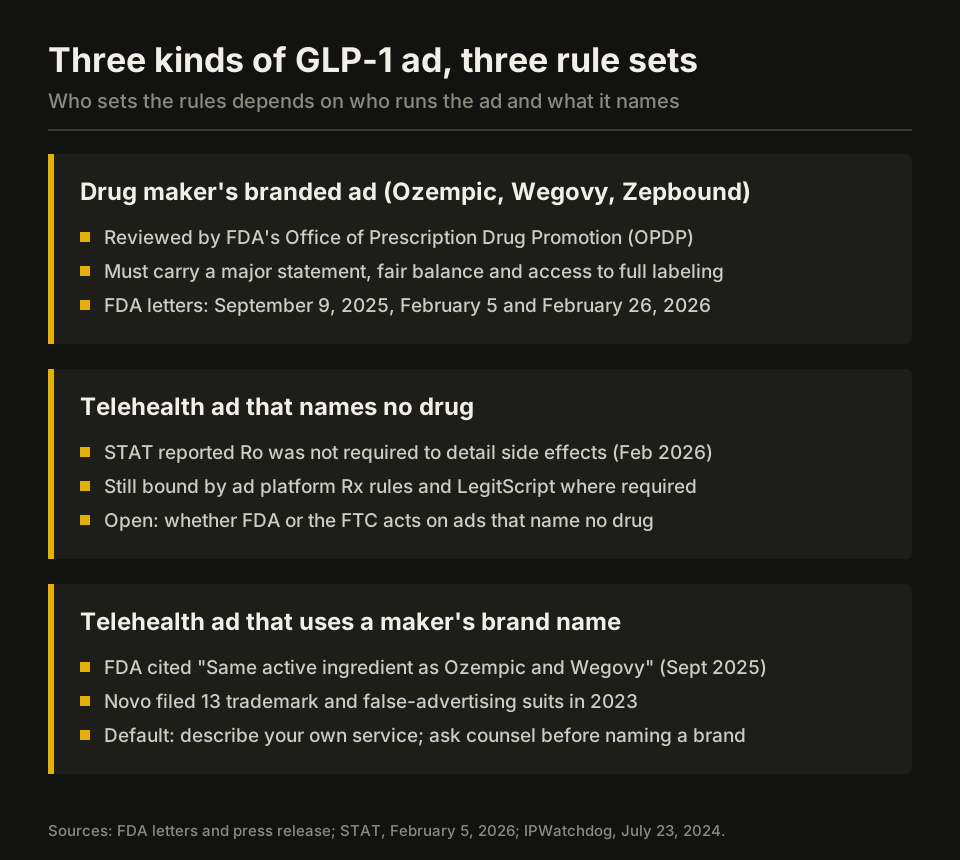
| FDA cited “Same active ingredient as Ozempic and Wegovy” on a telehealth site; Hims & Hers’ 10-K says about 50 companies marketing compounded GLP-1s got letters in September 2025 | FDCA 502(bb): a compounded drug is misbranded if its promotion is false or misleading | Never describe a compounded product with a maker’s brand name. Our list of compounded GLP-1 claims the FDA flags has the full set |
| Novo filed 13 trademark and false-advertising lawsuits in 2023, then more in 2024 against clinics, med spas and compounding pharmacies; most resolved cases ended in injunctions on consent | IPWatchdog, July 23, 2024 | Treat “Ozempic” and “Wegovy” in ad copy, hashtags and landing pages as legal exposure. Ask counsel before any brand name appears |
| FDA faulted the Ozempic and Wegovy pill ads for implying superiority over other GLP-1s without head-to-head data | FDA untitled letters, February 5 and 26, 2026 | Drop “better than” and “the only” framing unless a head-to-head source backs it, on ads and on comparison pages |
| FDA called “live lighter” and “a way forward” misleading because they implied extra weight loss and emotional benefits | FDA letter, February 5, 2026 | Keep lifestyle lines about the service (access, visits, delivery), never about drug outcomes |
| FDA treated a TV special with company staff and paid consultants as promotion | FDA warning letters, September 9, 2025 | Review podcasts, interviews and paid clinician content like ads, before they air |
| Novo sued Lilly over comparison ads; the judge let the ads run for now | CNBC, July 21, 2026; Reuters, October 26, 2026 | Expect competitors to read your comparisons. Date every number and keep the source on file |
| STAT reported Ro, which named no drug, “isn’t required to detail the drugs’ side effects and contraindications” | STAT, February 5, 2026 | An ad about the service still has to pass platform rules: see Meta’s prescription drug ad policy for GLP-1 and LegitScript by ad platform |
We run GLP-1 and telehealth traffic at scale with platform approvals on every network we buy, and our paid media for GLP-1 brands works from these same rules.
What FDA requires in an Ozempic, Wegovy or Zepbound ad
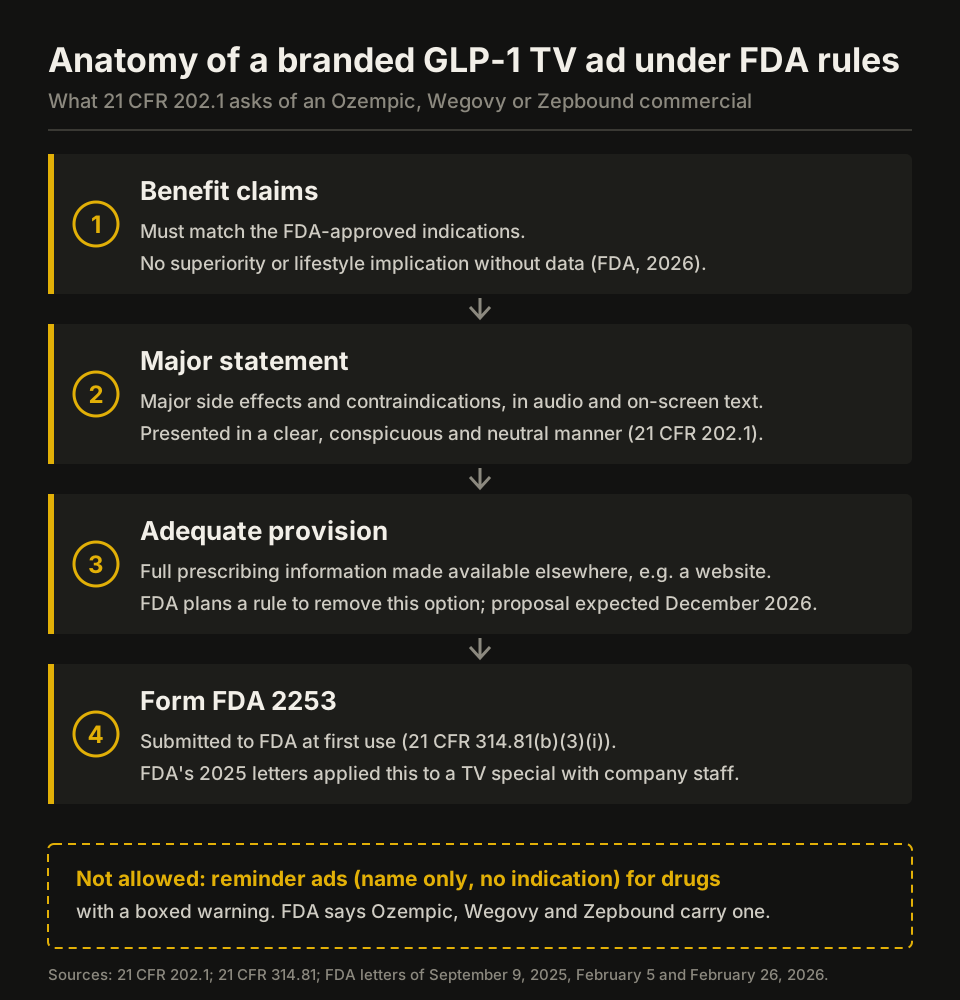
FDA’s rule for prescription drug ads, 21 CFR 202.1, sets what a branded GLP-1 ad must carry. Rules checked on November 2, 2026.
| Rule | What it says | What you see in the ad |
|---|---|---|
| 202.1(e)(1) | Ads must present “a true statement of information in brief summary relating to side effects, contraindications” | Print and web ads carry a risk summary next to the claims |
| 202.1(e)(1)(i)(A) | Broadcast ads must include “the major side effects and contraindications” (the “major statement”) | The spoken side-effect read in every Ozempic spot |
| 202.1(e)(1)(i)(B) | A brief summary is required “unless adequate provision is made” for the full labeling | “Visit Ozempic-pi.com” style lines, quoted in FDA’s February 2026 letter |
| 202.1(e)(1)(ii) | On TV the major statement must be “clear, conspicuous, and neutral,” in audio and text at once | Matching on-screen text; FDA faulted the Wegovy pill ad for text that didn’t match the audio |
| 202.1(e)(5)(ii) | An ad is false or misleading if it “fails to present a fair balance” between risk and effectiveness | Risk read at a pace that matches the benefit claims |
| 202.1(e)(2)(i) | Reminder ads “are not permitted for a prescription drug product whose labeling contains a boxed warning” | No name-only Ozempic spots; FDA’s 2025 letters say Wegovy, Ozempic and Zepbound carry a boxed warning for thyroid C-cell tumors |
| 21 CFR 314.81(b)(3)(i) | Promotional pieces go to FDA on Form 2253 at first use | FDA’s 2025 letter said the Oprah special “was not submitted” at first publication |
The celebrity and Super Bowl side of these campaigns is on our page about celebrity GLP-1 ads.
What FDA’s letters say about GLP-1 maker ads
FDA’s 2025 and 2026 letters on GLP-1 maker ads fault weak risk presentation and benefit claims broader than the label. The quotes below are from the letters.
- Ozempic video, February 26, 2026: The video’s line that Ozempic is “the GLP-1 with the most FDA-approved uses” for adults with type 2 diabetes is misleading, FDA wrote, because it “implies that all patients with type 2 diabetes are candidates for all the FDA-approved indications.” The letter adds that the comic bird-calling exchange “communicates to viewers that competitor GLP-1 products lack meaningful benefits,” and that the jingle before the risk read signals the end of the ad, which “misleadingly minimizes the risks.”
- Wegovy pill TV ad, February 5, 2026: The claims “live lighter” and “a way forward” “misleadingly imply additional weight loss compared to other currently approved GLP-1 treatments, when this has not been demonstrated.”
- Oprah special, September 9, 2025: The program “creates a misleading impression regarding the safety of Wegovy, Ozempic, and Victoza, which are drugs with multiple serious, potentially life-threatening risks.” Lilly’s letter says the same of Zepbound and Mounjaro.
FDA’s September 2025 announcement explains the timing. The agency said warning letters to drug companies “dropped to one in 2023 and zero in 2024,” and that it now uses “AI and other tech-enabled tools to proactively surveil and review drug ads.”
How Novo Nordisk, Eli Lilly and Hims & Hers responded
Each company answered in a statement or filing. A Novo Nordisk spokesperson told Reuters, on the Ozempic letter: “We take all regulatory feedback seriously and are in the process of responding to the FDA.” On the Oprah letters, a Lilly spokesperson said the interviews were independent media over which the company “had no editorial control,” as reported by PharmExec citing Reuters.
On the 2026 lawsuit, Lilly said it “stands firmly behind our advertising” and that “it is truthful, it is transparent, and it is grounded in the most direct scientific evidence available” (CNBC). After the October ruling, Novo said it “did not decide the question of whether Lilly’s advertising is false and misleading” (Reuters).
Hims & Hers wrote in its 10-K that it received two warning letters about compounded semaglutide products, “to which we timely responded.” We found no public Novo statement on the September 2025 or February 5, 2026 letters as of November 2, 2026.
What is still open
As of November 2, 2026, three questions are open. FDA’s proposed rule to remove adequate provision, which Foley Hoag reported as expected in December 2026, has not appeared in the Federal Register. Novo’s case against Lilly continues toward a decision on a permanent injunction. And no agency has acted on telehealth ads that name no drug, the gap STAT described.
FAQ
Why are Ozempic ads so weird?
Novo’s 2026 “There’s Only One Ozempic” ads used comedy, a jingle and a bird-calling bit. FDA’s February 26, 2026 letter said that comic setup made rival GLP-1s look unworthy of discussion and that the jingle signaled the end of the ad before the risk read.
Why are Ozempic ads everywhere?
Novo spends heavily on them. Reuters reported MediaRadar estimates of $169 million for Ozempic and $316 million for Wegovy in US advertising from January to September 2025.
Can a telehealth company advertise Ozempic by name?
FDA has cited telehealth claims that compare compounded drugs to Ozempic and Wegovy, and Novo has sued clinics and compounders over the names. A GLP-1 telehealth brand should describe its own service and ask counsel before any brand name appears in an ad.
Did FDA flag the Wegovy pill ads?
Yes. FDA’s February 5, 2026 untitled letter said a Wegovy pill TV ad implied extra weight loss over other GLP-1s without data, and that its on-screen risk text didn’t match the audio.
Changelog
November 2, 2026: page drafted and fact-checked.
Sources
- FDA untitled letter to Novo Nordisk, OZEMPIC video "Ozempic vs. – Random Guy OLV" (February 26, 2026) · accessed
- FDA untitled letter to Novo Nordisk, WEGOVY tablets TV ad (February 5, 2026) · accessed
- FDA warning letter, Novo Nordisk Inc., MARCS-CMS 716495 (September 9, 2025) · accessed
- FDA warning letter, Eli Lilly and Company, MARCS-CMS 716485 (September 9, 2025) · accessed
- FDA warning letter, Eli Lilly and Company, MARCS-CMS 716462 (September 9, 2025) · accessed
- FDA warning letter, Hims & Hers Health, Inc. dba Hims, MARCS-CMS 716567 (September 9, 2025) · accessed
- FDA, FDA Launches Crackdown on Deceptive Drug Advertising (September 9, 2025) · accessed
- 21 CFR 202.1, Prescription-drug advertisements, Cornell LII · accessed
- Reuters via Yahoo Finance, Harshita Mary Varghese and Patrick Wingrove, Novo's Wegovy and Ozempic US advertising spend doubles rival Eli Lilly (January 28, 2026) · accessed
- Reuters via PM360, Kamal Choudhury, US FDA warns Novo again about misleading drug advertising (March 3, 2026) · accessed
- PharmExec, Nicholas Jacobus, FDA Sends Warning Letters to Novo Nordisk, Eli Lilly, and Hims (September 17, 2025) · accessed
- CNBC, Annika Kim Constantino, Novo Nordisk sues Eli Lilly, alleging misleading GLP-1 advertising (July 21, 2026) · accessed
- Reuters via Investing.com, Jonathan Stempel, US judge won't block Eli Lilly ads for weight-loss drugs (October 26, 2026) · accessed
- IPWatchdog, Armin Ghiam and Maria Montenegro-Bernardo, A Review of Novo Nordisk's Ozempic and Wegovy Trademark Enforcement Campaign (July 23, 2024) · accessed
- STAT, Damian Garde, The FDA wants to rein in drug ads. On Super Bowl Sunday, it will be business as usual (February 5, 2026) · accessed
- Hims & Hers Health, Inc., Form 10-K for fiscal year 2025 (SEC) · accessed
- Foley Hoag, FDA Proposes to Eliminate 'Adequate Provision' for Broadcast Prescription Drug Advertising (July 7, 2026) · accessed