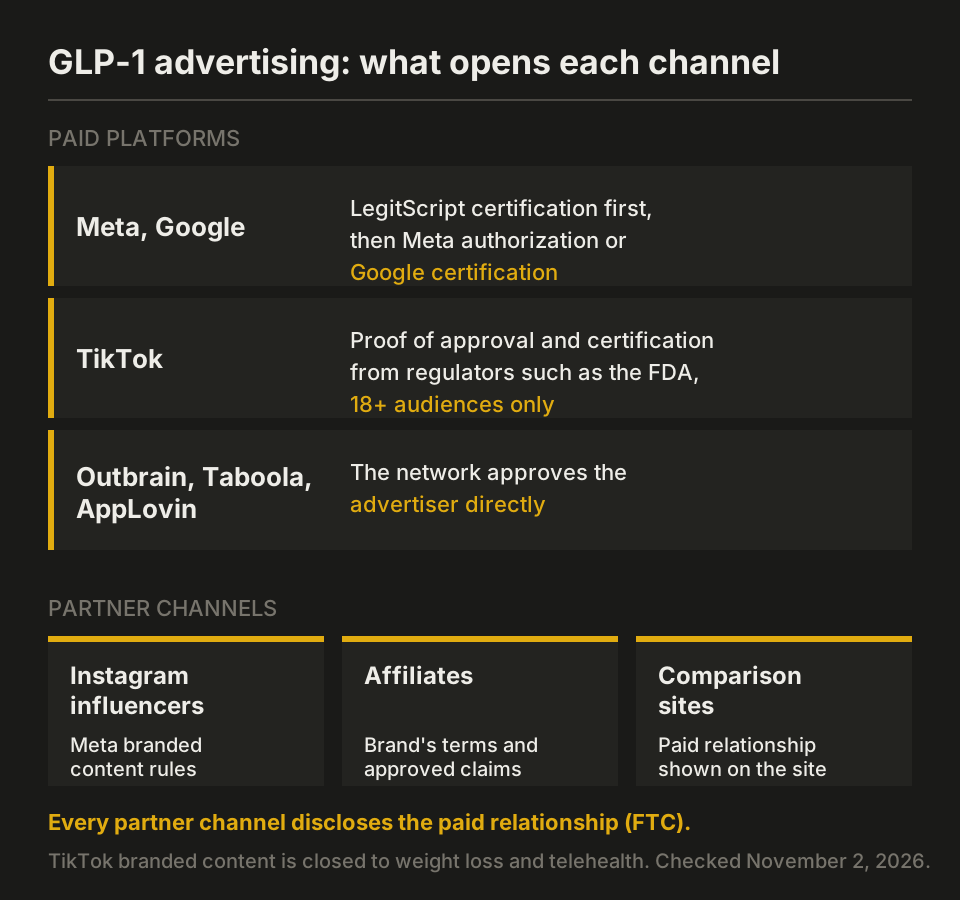
GLP-1 advertising in the US runs on two kinds of channels. Paid platforms (Meta, Google, TikTok, Outbrain, Taboola and AppLovin) open to a telehealth brand through LegitScript certification or the network’s own approval. Partner channels (Instagram influencers, affiliates and comparison sites) run on brand-approved claims and FTC disclosure. What your ad says decides which rules apply.
GLP-1 advertising in the US: the market and the scrutiny
GLP-1 advertising reaches a large, partly online buyer group, and regulators watch it closely. KFF’s poll published November 14, 2025 found that 12% of US adults were currently taking a GLP-1 drug. Among adults who had ever taken one, 17% got it “from an online provider or website,” the channel telehealth brands sell through.
Scrutiny and gatekeeping grew with the market:
- FDA’s announcement of September 9, 2025 said the agency was “sending thousands of letters warning pharmaceutical companies to remove misleading ads and issuing approximately 100 cease-and-desist letters to companies with deceptive ads.”
- LegitScript, the certifier Meta and Google name for telehealth, said on September 22, 2026 that telemedicine certification applications rose 101% in a year, as reported by PPC Land.
For a brand, that means each channel asks for proof before the first ad runs, and the proof differs by channel.
How GLP1.partners runs GLP-1 advertising
GLP1.partners runs GLP-1 and telehealth traffic at scale with platform approvals on every network we buy. The brand brings its own LegitScript certification where a platform requires it, and we plan and buy the media.
- Meta: established agency accounts built for GLP-1 scale, with a dedicated Meta agency contact.
- Outbrain: established Outbrain accounts with a dedicated setup for GLP-1.
- TikTok, Taboola and AppLovin: bought in-house under each network’s health rules.
- Partner channels: an Instagram influencer network, our own comparison sites and an affiliate network we manage.
Every channel reports against the one target the brand sets, in one weekly report. Our page on telehealth advertising for GLP-1 brands shows how the paid channels fit together.
Where a GLP-1 telehealth brand can advertise, channel by channel
A GLP-1 telehealth brand can advertise on every major US paid channel, but each one opens through a different gate. The table lists the gate as each platform states it, checked on November 2, 2026, with a link to our full guide for that channel.
| Channel | Gate for GLP-1 telehealth ads | Who decides | Full guide |
|---|---|---|---|
| Meta (Facebook, Instagram) | General telehealth service ads need no written authorization. Prescription drug ads need active LegitScript certification, 18+ targeting in the US, Canada or New Zealand, and authorization from Meta | LegitScript, then Meta | Meta prescription drug ads |
| Google Ads | US telemedicine providers accredited by LegitScript, and “Advertisers must also be certified with Google” | LegitScript, then Google | Google telemedicine certification |
| TikTok ads | In the US, prescription medicine “May be allowed” with proof of approval and certification from regulators “such as the US Food and Drug Administration (FDA),” 18+ only | TikTok | TikTok GLP-1 ads |
| Outbrain | Public guidelines say ads “must not promote the sale or use of illegal, prescription, or recreational drugs”; GLP-1 brands run through approval agreed with Outbrain | Outbrain | Outbrain GLP-1 ads |
| Taboola | Online pharmacy campaigns must “Have prior permission from Taboola”; US online pharmacies need NABP verification | Taboola | Taboola GLP-1 ads |
| AppLovin | Restricted health content may run “in AppLovin’s sole discretion,” within local licensing and certification rules | AppLovin | AppLovin GLP-1 ads |
| Instagram influencers | Meta’s branded content rules for health and prescription drug posts; FTC disclosure in each post | Meta and the brand | Influencer rules for GLP-1 |
| Affiliates | The brand’s program terms and approved claims; FTC disclosure by the affiliate | The brand or its network | Telehealth affiliate networks |
| Comparison sites | FTC disclosure of the paid relationship on the site | The site owner and the brand | This page, below |
TikTok’s Branded Content Policy lists “Weight loss products or services” and “telehealth providers” as prohibited, so paid creator posts for a GLP-1 program belong on Instagram. The platform-by-platform LegitScript wording, quoted in full, is in who needs LegitScript.
Service ads vs drug ads: the line that decides the rules
The first decision in GLP-1 advertising is whether an ad promotes the telehealth service or a prescription drug. On Meta the two follow different rules. Meta’s Drugs and Pharmaceuticals policy says advertisers don’t need written authorization to run ads that “Promote telehealth services generally.” For prescription drugs it says: “Meta requires online pharmacies and telehealth providers to be actively certified with LegitScript.”
| What the ad shows | Rule set on Meta | What the brand needs |
|---|---|---|
| Online visits with a licensed provider, program price, how ordering works | Telehealth services generally | Policy-compliant ad and landing page |
| A named prescription drug, such as semaglutide or tirzepatide | Prescription drug ads | LegitScript certification, Meta authorization, 18+ targeting, eligible countries |
A brand can run service ads on Meta while its LegitScript certification is in progress, then add drug ads once Meta authorizes it. Google draws its line around the provider instead: US telemedicine providers need LegitScript accreditation and Google certification.
Partner channels: influencers, affiliates and comparison sites
Partner channels carry GLP-1 advertising through other people’s audiences, and the FTC expects each paid relationship to be disclosed. For affiliate marketers, the FTC’s endorsement FAQ says: “You should disclose your relationship to the retailer clearly and conspicuously on your site.” It also warns that “Consumers might not understand that ‘affiliate link’ means that the person placing the link is getting paid.”
What each partner channel needs from the brand:
- Instagram influencers: a claims sheet the brand can prove, Meta’s paid partnership label, and a disclosure inside the post.
- Affiliates: written traffic rules, approved creative and the same claims limits as the brand’s own ads.
- Comparison sites: a visible statement that the site is paid by, or owned by, the brands it lists.
Claims regulators flag in GLP-1 advertising
The claims that draw regulators to GLP-1 ads apply on every channel: implying a compounded drug is FDA approved, calling it generic, and efficacy claims the approved labels don’t carry. A study of online GLP-1 sellers in JAMA Health Forum, published January 17, 2025, reviewed 79 websites selling compounded GLP-1 drugs. Of those, 36.7% said or implied the drugs were FDA approved, and 40.5% made efficacy claims not found in the labels of FDA-approved branded drugs.
Platform approval doesn’t cover these claims. A certified, authorized brand still answers to FDA and the FTC for what its ads say. The phrases FDA quoted in its letters to telehealth companies are listed in compounded GLP-1 advertising claims the FDA flags.
The route through platform approvals, step by step
The route through platform approvals runs in a fixed order: decide the ad type, certify, get each platform’s approval, then lock the claims before launch.
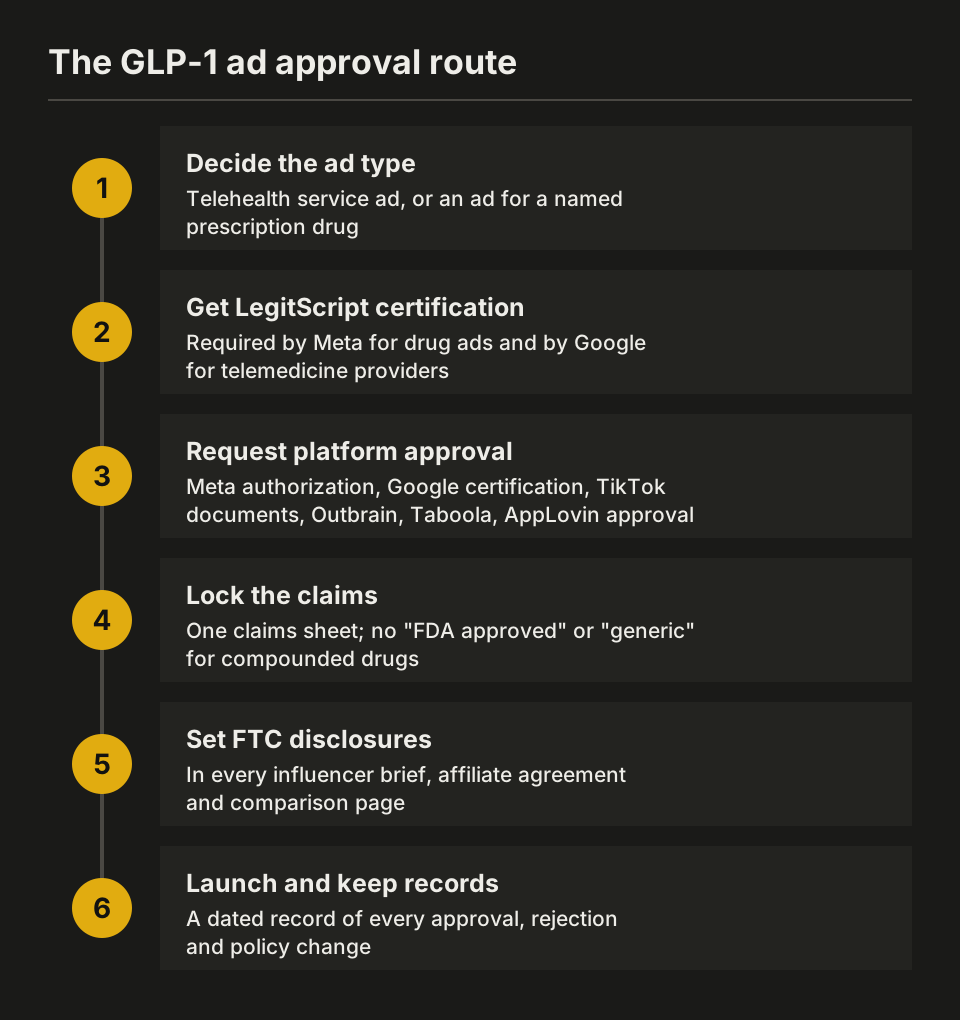
- List every planned ad by channel and mark it as a service ad or a drug ad.
- Apply for LegitScript telemedicine certification for each domain you advertise if you plan drug ads on Meta or any telehealth ads on Google. Start early: LegitScript reported a 101% rise in telemedicine applications in a year.
- Request each platform’s approval: Meta authorization, Google healthcare certification, TikTok’s documentation review, and direct approval from Outbrain, Taboola or AppLovin.
- Write one claims sheet: program price, what’s included, states served and the wording for approved and compounded drugs. Every ad and landing page uses it.
- Put the FTC disclosure into every influencer brief, affiliate agreement and comparison page.
- Launch, and keep a record of every approval, rejection and policy change by date, so an appeal or a new account review has the paper trail.
FAQ
Can GLP-1 telehealth brands advertise on Facebook and Instagram?
Yes. Meta lets telehealth brands promote their services generally without written authorization. Ads that promote a prescription drug need active LegitScript certification, authorization from Meta, 18+ targeting and eligible countries (US, Canada or New Zealand).
Do you need LegitScript to advertise GLP-1?
For drug ads on Meta and for telemedicine ads on Google, yes. TikTok asks for proof of approval and certification from regulators. Outbrain, Taboola and AppLovin decide through their own approval.
Can you advertise GLP-1 on TikTok?
TikTok ads for prescription medicine may be allowed in the US with proof of approval and certification and an 18+ audience. TikTok branded content, meaning paid creator posts, prohibits weight loss services and telehealth providers.
Sources
- Meta Transparency Center, Drugs and Pharmaceuticals (telehealth services generally without written authorization; LegitScript for online pharmacies and telehealth providers; US, Canada or New Zealand; 18+; authorization from Meta) · accessed
- Google Ads Help, Healthcare and medicines (US telemedicine providers accredited by LegitScript; advertisers must also be certified with Google) · accessed
- TikTok Business Help Center, Healthcare and pharmaceuticals ad policy (United States: prescription medicine may be allowed with proof of approval and certification, such as the FDA; 18+; last updated September 2026) · accessed
- TikTok, Branded Content Policy (prohibited: weight loss products or services; telehealth providers) · accessed
- Outbrain, Our Advertising Guidelines (ads must not promote the sale or use of prescription drugs) · accessed
- Taboola (Realize Help Center), Restricted content, products and services (online pharmacies: prior permission from Taboola; NABP for US online pharmacies) · accessed
- AppLovin, Policies for Demand Partners (restricted content permitted in AppLovin's sole discretion, subject to licensing and certification requirements) · accessed
- FTC, FTC's Endorsement Guides: What People Are Asking (affiliate marketers; affiliate links) · accessed
- FDA, FDA Launches Crackdown on Deceptive Drug Advertising (September 9, 2025) · accessed
- JAMA Health Forum, Chetty et al., Online Advertising of Compounded Glucagon-Like Peptide-1 Receptor Agonists (published January 17, 2025; 79 websites; 36.7% said or implied FDA approval; 40.5% efficacy claims not in branded labels) · accessed
- KFF Health Tracking Poll: Prescription Drug Costs, Views on Trump Administration Actions, and GLP-1 Use (November 14, 2025; 12% currently taking; 17% of users got it from an online provider or website) · accessed
- PPC Land, Telemedicine applications to ad certifier LegitScript jump 101% in a year (September 25, 2026; LegitScript announcement of September 22, 2026) · accessed