The GLP-1 patient journey for a telehealth brand runs in seven stages: ad and click, landing page and quiz, intake, provider review, first order, shipment and refill. Each stage loses people for its own reasons and needs its own metric. Most of those metrics live in your own systems, because ad platforms limit the health data they accept.
This guide is for brand owners and growth leads who already buy traffic and want to see where it leaks.
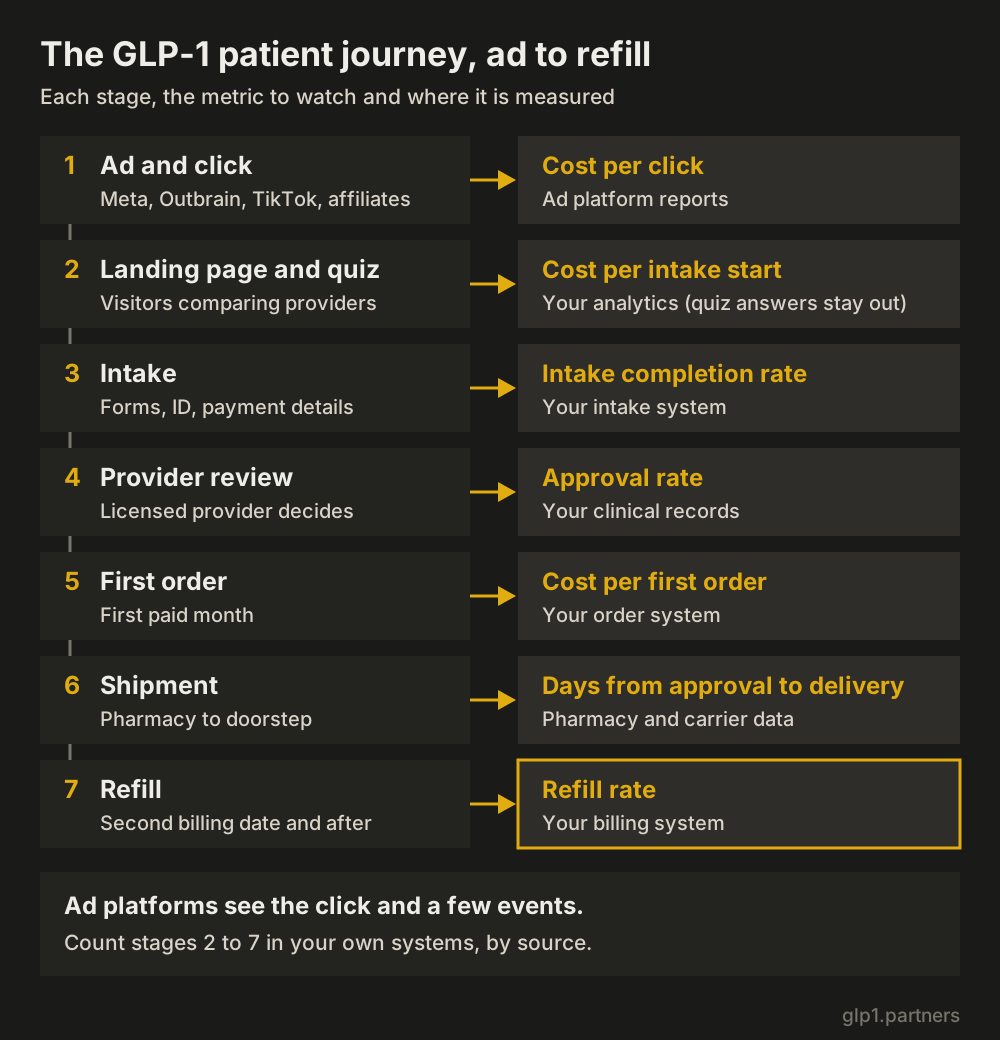
The seven stages of the GLP-1 patient journey
A GLP-1 telehealth patient journey has seven stages, and each needs an owner inside the brand: marketing for the first two, product for intake, the medical group for review, and operations for the order, the shipment and the refill flow.
| Stage | What happens | What usually breaks | Metric to watch | Where to count it |
|---|---|---|---|---|
| 1. Ad and click | A person clicks an ad, influencer post, comparison page or affiliate article | Ad promise doesn’t match the page; ads rejected or not delivering | Cost per click, click-through rate | Ad platform reports |
| 2. Landing page and quiz | Visitors comparing providers start the quiz | Slow page, price hidden, quiz too long before any value | Cost per intake start | Your analytics |
| 3. Intake | Health questions, ID, address, payment details | Drop-off at ID upload or payment; state not served | Intake completion rate | Your intake system |
| 4. Provider review | A licensed provider reviews the intake and decides | Missing information, slow review queue | Approval rate, time to decision | Your clinical records |
| 5. First order | The patient pays for the first month | Price shock at checkout; card declines | Cost per first order | Your order system |
| 6. Shipment | Pharmacy fills and ships | Delays, stock gaps, no tracking updates | Days from approval to delivery | Pharmacy and carrier data |
| 7. Refill | The second billing date and later ones | Silent cancellations, failed renewals, no follow-up | Refill rate by source | Your billing system |
The order matters for budget decisions. A channel can look strong at stage 1 and weak at stage 7, and the revenue arrives at stages 5 and 7.
How GLP1.partners works with a GLP-1 patient journey
GLP1.partners covers stage 1 and works to a result the brand picks further down the funnel. Before launch we agree on the event we are measured on and how the brand confirms it, and the brand sees results by source.
We run GLP-1 and telehealth traffic at scale with platform approvals on every network we buy. On Meta that means established agency accounts built for GLP-1 scale, with a dedicated Meta agency contact. On Outbrain it means established accounts with a dedicated setup for GLP-1. We also send traffic from TikTok, Instagram influencers, our own comparison sites and an affiliate network we manage.
Every visitor lands on the brand’s pages and goes through the brand’s intake, so the brand’s provider makes every medical decision. More on our weight loss telehealth marketing services.
Stages 1 and 2: from the ad to the intake start
The first two stages of the GLP-1 patient journey decide how many people reach your intake and at what cost. Cost per intake start is the first number that shows what you pay for a visitor who took a real step.
What breaks here:
- Mismatch between ad and page. An ad about a monthly price that lands on a page without the price loses the click. Carry one claim from ad to page to checkout.
- Rejected ads and ad sets with almost no spend. Our guide to Meta ads not delivering for telehealth covers the official routes.
- A quiz that asks too much before the visitor sees a plan or a price.
Count intake starts in your own analytics, with the traffic source attached, and keep quiz answers away from ad platforms. Meta’s prohibited information list names “Prescription medications, and over-the-counter (OTC) and supplements for specific medical conditions” and “Body specifications, bodily activities, and biological cycles”. Weight and BMI answers are body specifications.
Stages 3 and 4: intake completion and provider approval
Intake completion rate is the share of intake starts that reach submission. Approval rate is the share of submitted intakes that a provider approves. Together they show how many of the people you paid for finish the process and get a prescription decision in their favor.
A licensed provider makes that decision. LifeMD’s 10-Q for the quarter ended June 30, 2026 says it provides prescription and over-the-counter treatments “when medically appropriate.” That is why approval rate belongs in your reporting: a source can send many intakes that don’t lead to a prescription, and the media cost is spent either way.
What breaks here:
- ID and payment steps. Look at completion by step, since drop-off tends to cluster at document upload and card entry.
- States you don’t serve. Check your geo targeting against your provider coverage.
- Review time. People buy elsewhere while a slow queue makes them wait. Track time from submission to decision.
- Source quality. A low approval rate from one source usually points to the promise that source makes. Compare by source before you cut a channel.
Intake and review data sit behind a login. HHS’s guidance on tracking technologies, in the part a 2024 court order left in place, lists “a telehealth platform” as an example of a user-authenticated page. Meta’s prohibited information page says: “You shouldn’t send information about people from web pages where visitors may log in and provide potentially sensitive information, such as patient portals.” Count these stages in your intake and clinical systems.
Stages 5 and 6: the first order and the shipment
Cost per first order is your acquisition spend divided by the first paid orders from that spend. Most brands set their target on this event, and the method is in our guide to telehealth customer acquisition cost.
What breaks at the first order:
- Price shock. A plan price that first appears at checkout, or a first month that differs from the advertised one, loses approved patients.
- Card declines and failed payments. Count them separately, since they are an operations problem and the traffic source can’t fix them.
Shipment affects the refill, and it is often left out of marketing reports. Hims & Hers’ 10-Q for the quarter ended June 30, 2026 says: “Our Subscribers select an available cadence at which they wish to receive product shipments or a treatment term depending on the offering.” A first box that arrives late leaves less time before the next billing date. Track days from approval to delivery, and the share of orders with tracking updates sent.
Stage 7: refill rate and retention
Refill rate is the share of first-order patients who pay at the next billing date. It decides whether your cost per first order was worth paying, and ad platforms see it least.
Hims & Hers shows how one public telehealth company counts retention. Its 10-Q defines “Subscribers” as customers “automatically billed on a recurring basis at a defined cadence,” and Subscriptions “are excluded from our reporting when payment has not occurred at the contracted billing cadence.” A subscriber counts only while payments arrive on schedule. Hims reported approximately 2.9 million Subscribers on June 30, 2026, a count that includes its acquisition of Eucalyptus, and Monthly Revenue per Average Subscriber of $92 for the quarter.
The same filing explains why retention carries the economics: Hims expects “to retain a significant majority of revenue from Subscribers who maintain a Subscription for more than two years.” LifeMD reported approximately 356,000 active patient subscribers on June 30, 2026, and lists “a direct-to-patient marketing infrastructure for acquisition and retention” among its capabilities.
What breaks at refill:
- Cancellations before the second charge. Log the reason by source.
- Failed renewals. A card retry and a reminder belong in the retention flow.
- No contact between orders. Refill reminders, shipping updates and support response time belong to this stage.
Measure refill rate by acquisition source. A source with a cheap first order and a weak refill rate costs more than it looks.
How to measure the patient journey under health-data limits
Measuring a GLP-1 patient journey means joining your ad data to your own order and billing data, because platforms block most health data in between. Meta’s definition of Health and wellness names a “telemedicine platform” as an example, and a restricted category can trigger Meta’s restriction types, from core setup (“Restricts the sharing of custom parameters and parts of URLs following the domain”) to full restrictions. Policy checked on November 1, 2026.
| Data | Send to ad platforms? | Where it belongs |
|---|---|---|
| Click, landing page view | Yes, within each platform’s rules | Ad platform and your analytics |
| Quiz answers, weight, BMI, drug names | No | Your intake system only |
| Drug or condition names in URLs and UTMs | No; keep them out of URLs | Rename paths and UTM values |
| Intake submitted, provider approval | Not as health-named events | Your intake and clinical records |
| First order, refill | Only as events whose name and data carry no health information, and only if your dataset category allows it | Your order and billing system, joined to the source |
Capture a source field (UTM or partner ID) at stage 2 and store it with the patient record. Every later stage can then be reported by source without sending health data back to the ad platform. For what Meta allows under each restriction level, see Meta health data restrictions for telehealth. If you buy leads rather than traffic, the consent and lead-form rules are in weight loss lead generation.
A stage-by-stage plan you can run this month
- Write down the seven stages for your funnel, and the system that holds each count.
- Capture the traffic source at the first page view and store it with the intake and the order.
- Build one weekly report: intake starts, completion rate, approval rate, first orders, refill rate, all by source.
- Find the stage with the biggest drop for your largest source. Fix that stage before you add spend.
- Audit what your Pixel and Conversions API send. Remove quiz answers, drug names in URLs and health-named events.
- Set the media target on cost per first order and check each source again at the first refill date.
- Report shipping time and failed renewals as operations metrics.
FAQ
What is a GLP-1 patient journey?
A GLP-1 patient journey is the path a person takes from first seeing a GLP-1 telehealth ad to paying for a refill: click, landing page and quiz, intake, provider review, first order, shipment and refill. Each stage needs its own metric.
Can I track the GLP-1 patient journey with the Meta Pixel?
The Meta Pixel can track only part of the GLP-1 patient journey. Meta’s rules bar health information, including prescription medications and body specifications, and say not to send data from pages where visitors log in and provide sensitive information. Count the later stages in your own systems.
Sources
- Hims & Hers Health, Form 10-Q for the quarter ended June 30, 2026 (filed August 10, 2026) · accessed
- LifeMD, Form 10-Q for the quarter ended June 30, 2026 (filed August 5, 2026) · accessed
- HHS OCR, Use of Online Tracking Technologies by HIPAA Covered Entities and Business Associates · accessed
- Meta Business Help Center, About data source categories in Meta Events Manager · accessed
- Meta Business Help Center, Understand data sharing restrictions based on data source categories · accessed
- Meta Business Help Center, About prohibited information · accessed