A telehealth business needs a state business registration, a clinician licensed in every state a patient sits in, and often an MSO plus a physician-owned PC if the owner is not a physician. A licensed partner pharmacy fills the prescriptions. DEA registration only applies if a clinician prescribes an actual scheduled drug, and GLP-1 agonists are not scheduled. LegitScript is a separate certification, not a government license.
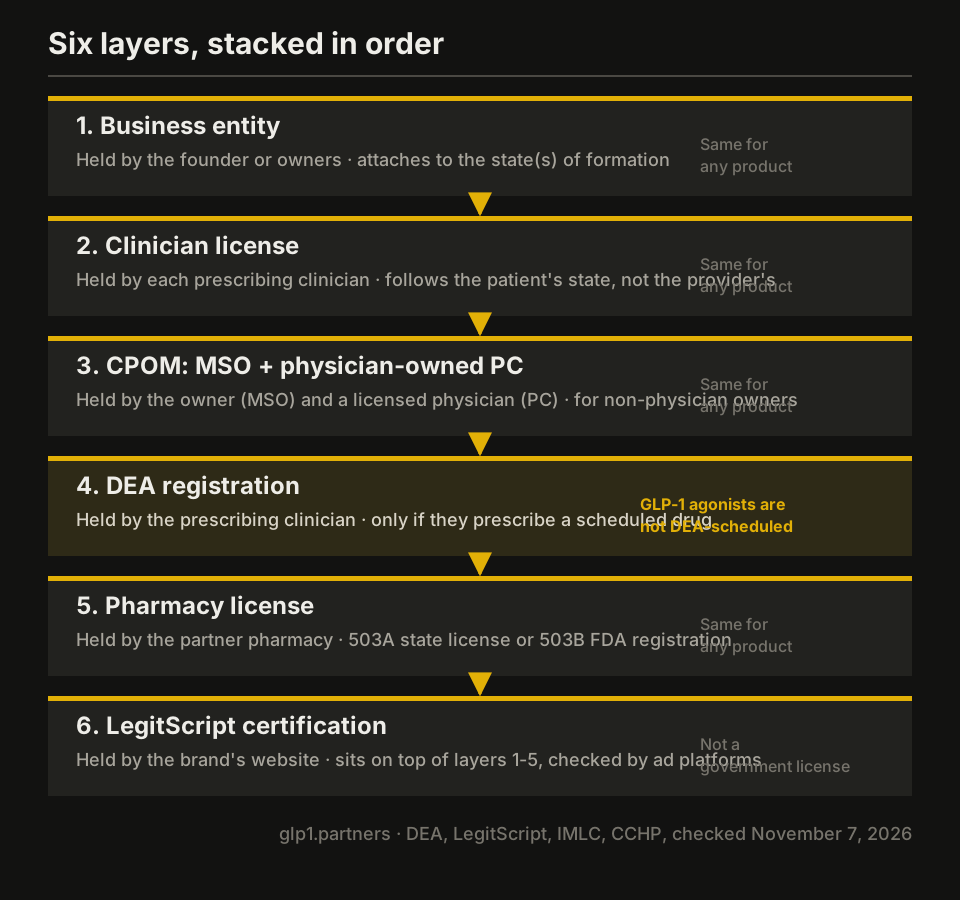
Most guides to starting a telehealth business cover one or two of these layers and stop there. A non-physician founder does not need a medical license personally, but the business still has requirements of its own. Six separate things get checked, by six separate parties, and none of them substitutes for another. This page lays out what each one is, who holds it, and where GLP-1 changes the answer.
The business entity: what the state registers, and what it does not
Registering an LLC or corporation with a state’s secretary of state creates the company. It does not give anyone inside that company permission to practice medicine or dispense a prescription drug. Those are separate licenses, covered below, and a state registration does not substitute for either one.
Some states layer a telehealth-specific registration on top of ordinary business registration. CCHP’s cross-state licensing tracker lists Alaska as one example: businesses delivering care at a distance to a patient physically located in Alaska must register separately with the state’s Telemedicine Business Registry, with one registration per business name. Arizona lets out-of-state providers without an Arizona license deliver telehealth there by registering with the applicable health care provider regulatory board. Check each of your launch states for the same split: a standard business filing, and sometimes a second, telehealth-specific registry for providers coming from out of state.
Clinician licensure: it follows the patient, not the provider
A telehealth business can only see a patient in a state where its treating clinician holds a license, because telehealth care is treated as happening where the patient is, not where the provider sits. CCHP’s tracker states the principle directly: when telehealth is used, the care is considered rendered at the patient’s physical location, so the provider typically needs to be licensed in that state.
That rule sets the sales map before marketing does. A brand with clinicians licensed in 12 states can legally see patients only in those 12 states, regardless of where its ads run. For how this plays out when the clinician is a nurse practitioner rather than a physician, including the ownership questions that come with it, see the NP-specific guide.
Interstate compacts, in one place: IMLC and the nursing compacts
Interstate licensure compacts speed up getting licensed in additional states. They do not replace the patient-location rule above. For physicians, the Interstate Medical Licensure Compact (IMLC) is the active one. FSMB’s snapshot, updated November 2, 2026 with information as of October 31, 2026, lists 44 member states plus 2 US territories and 246,359 licenses issued through the compact. A physician still needs a license covering each state a patient sits in. The compact just makes applying for additional states faster than filing from scratch in each one.
Nursing compacts are two different programs, and mixing them up matters for a GLP-1 brand led by a nurse practitioner. The Nurse Licensure Compact covers RNs and LPNs only. Vivian Health’s rundown of compact states is explicit that it does not extend to advanced practice. The APRN Compact is the one meant for nurse practitioners. NCSBN’s February 9, 2024 release on South Dakota’s enactment put the count at four states (Delaware, North Dakota, South Dakota, Utah), with implementation triggered once seven states enact it. The enactment count moves; check NCSBN’s APRN Compact page before assuming a state is covered.
Corporate practice of medicine: why a non-physician owner needs an MSO and a PC
A non-physician founder who wants to own a telehealth business, rather than fund one, runs into the corporate practice of medicine (CPOM) doctrine in states that enforce it. CPOM bars a lay-owned company from practicing medicine or controlling physicians’ clinical decisions. The common structure around it is two entities: a management services organization (MSO) the founder owns, and a professional corporation (PC) owned by a licensed physician, linked by a management services agreement.
The Medical Board of California draws the line clearly for one state that enforces CPOM strictly. Among the structures it lists as prohibited: “Non-physicians owning or operating a business that offers patient evaluation, diagnosis, care and/or treatment,” and “Management service organizations arranging for, advertising, or providing medical services rather than only providing administrative staff and services for a physician’s medical practice.” The MSO runs the business side, and the PC employs the clinicians and holds clinical decisions. CPOM rules vary by state and by clinician type, and they apply the same way regardless of what drug the brand prescribes. For the full launch sequence this fits into, including when to form each entity, see how to start a GLP-1 telehealth company.
Decision table: who needs what, by layer
The table below lines up every layer side by side: who holds it, where it attaches, and whether GLP-1 changes the answer.
| Layer | Who holds it | Where it attaches | Does GLP-1 change this? |
|---|---|---|---|
| Business entity | The founder or owners | The state(s) of formation, plus any state telehealth registry | No, same for any product the brand sells |
| Clinician license | Each prescribing clinician | The state where the patient sits at the time of the visit | No, same for every prescription drug |
| Interstate compact (IMLC; APRN Compact where enacted) | The individual clinician | Speeds up licensing in additional compact states; does not replace per-state licensure | No |
| CPOM: MSO + physician-owned PC | The owner (MSO) and a licensed physician (PC) | States that bar non-physician ownership or control of a medical practice | No, it is about who owns the practice, not what is prescribed |
| DEA registration | The individual prescribing clinician | Only attaches if that clinician prescribes an actual DEA-scheduled drug | Yes: semaglutide and tirzepatide are not DEA-scheduled, so prescribing them alone does not trigger it |
| Pharmacy license | The partner pharmacy | The pharmacy’s own licensed state(s) under 503A, or FDA registration under 503B | No, but GLP-1 compounding carries its own FDA rules |
| LegitScript certification | The brand’s website | Ad platforms such as Meta, once the layers above are in place | No, it is a certification layer on top, not a license |
DEA registration: when it actually applies to a GLP-1 brand
DEA registration applies only to a clinician who prescribes an actual controlled substance. It does not apply to a GLP-1 brand by default. The DEA’s own schedules page, which sets out what belongs in Schedule I through V, does not name semaglutide or tirzepatide in any of them. GLP-1 receptor agonists are not DEA-scheduled drugs.
That means prescribing semaglutide or tirzepatide by itself does not require the prescribing clinician to hold DEA registration. One nuance matters for a GLP-1 operator. If the same clinician also prescribes something that is scheduled, such as certain adjunct medications some weight-loss protocols add, DEA registration attaches to that clinician for that prescription, in that state, regardless of whether the GLP-1 drug itself required it. Check the schedule status of every drug on your formulary, not just the GLP-1 agonist.
The partner pharmacy’s own licensing
The pharmacy that fills a GLP-1 prescription carries its own license, separate from everything above it. It is either a state-licensed 503A pharmacy or a 503B outsourcing facility registered with the FDA, and that status, plus which states it is licensed to ship into, sets where the brand can actually deliver product. A brand with clinicians licensed in 20 states but a pharmacy licensed to ship to 10 of them can fulfill in only those 10. The full breakdown of 503A versus 503B and what to check in a pharmacy partner is in how to start a GLP-1 telehealth company. This page flags the licensing fact so it does not get skipped.
What LegitScript is, and is not: a certification, not a license
LegitScript certification is a private, platform-facing credential. It comes after the layers above, not instead of them. LegitScript’s own certification page states that merchants “must be adequately licensed for the services they offer and in the jurisdictions they serve,” as part of its Licensure & Business Registration standard. Certification checks that the licenses above already exist. It does not create them, and it does not replace a state’s own licensing requirement.
A telehealth business can be fully, legally licensed under every layer above and still not be LegitScript certified, because certification is a separate review on top of licensing. The reverse does not work: LegitScript’s own standard requires the licensing to already be in place, so a business cannot get certified while skipping a layer above. The full certification process, fees and timeline live on our LegitScript hub.
How GLP1.partners fits once the licensing layers are in place
This is where the GLP1.partners media team comes in, once the layers above are settled. Getting licensed and certified is the brand’s own work, done with its own counsel. What comes after that is ours: we bring the brand new patients. We have managed $38M of GLP-1 media and scaled 27 GLP-1 brands.
Our Meta setup is established agency accounts built for GLP-1 scale, with a dedicated Meta agency contact. The brand keeps its own LegitScript certification on file, and our accounts are set up to run campaigns that require it. On Outbrain and TikTok, we run established accounts with a dedicated setup for GLP-1. Beyond paid social and native, we bring brands traffic through our own comparison sites, a network of affiliates we manage, and Instagram influencers. The brand sets one target, such as cost per paid first order, and every channel reports against it.
None of that replaces the work in the sections above. A brand without its clinician licenses, its pharmacy partner or its LegitScript certification cannot run Meta prescription drug ads, regardless of who buys the media. Meta’s Drugs and Pharmaceuticals policy states that “Meta requires online pharmacies and telehealth providers to be actively certified with LegitScript,” and only then can they request authorization from Meta. Licensing and certification come first, and acquisition scales after that. A founder researching whether they need a license to start a telehealth business is usually asking before any of the acquisition work starts, and wants a straight answer on the licensing layers alone before thinking about channels.
A short step-by-step order
The full launch sequence, with the reasoning behind each step, is in how to start a GLP-1 telehealth company. In short, the licensing layers above tend to fall in this order:
- Register the business entity in your state(s) of formation, and check whether any launch state adds its own telehealth registry.
- Form the MSO and, if the owner is not a physician, recruit a physician for the PC. Have a healthcare attorney draft the management services agreement.
- Recruit and license clinicians in your first launch states. Use an interstate compact to speed up additional states where your clinician type qualifies.
- Confirm DEA registration status per clinician, based on your actual formulary, not just the GLP-1 drug.
- Sign a pharmacy partner and confirm its license type and shipping states.
- Build a compliant website and apply for LegitScript certification once steps 1 through 5 are final.
- Request ad-platform authorization and start acquisition once certification is in place.
FAQ
Do you need a license to start a telehealth business?
The business itself needs a standard state entity registration, and in some states a telehealth-specific registry on top. Beyond that, the licenses that matter are held by individuals and partners, not the company: each prescribing clinician needs a license in the patient’s state, and the partner pharmacy needs its own 503A or 503B status.
Can a non-physician own a telehealth company?
Yes, in most states, but how depends on whether that state enforces the corporate practice of medicine doctrine. In states that do, such as California, the common structure is an MSO the founder owns paired with a professional corporation owned by a licensed physician, with the MSO limited to business and administrative services.
Does a GLP-1 telehealth brand need DEA registration?
Not because it prescribes GLP-1 drugs. The DEA’s schedules do not list semaglutide or tirzepatide, so prescribing them alone does not trigger registration. A clinician who also prescribes an actual scheduled drug needs DEA registration for that prescription, regardless of the GLP-1 side of the practice.
Is LegitScript a government license?
No. LegitScript is a private certification that ad platforms such as Meta require for prescription drug ads. Its own standards require a merchant to already hold the licenses that apply to its services and states before it can be certified, so it sits on top of licensing rather than replacing any part of it.
Sources
- DEA, Diversion Control Division, Controlled Substance Schedules · accessed
- FSMB, Interstate Medical Licensure Compact, snapshot statistics (updated November 2, 2026; information as of October 31, 2026: 44 member states + 2 US territories, 246,359 licenses issued) · accessed
- NCSBN, South Dakota Enacts APRN Compact (February 9, 2024) · accessed
- NCSBN, APRN Compact home page · accessed
- CCHP (Center for Connected Health Policy), State Telehealth Policies for Cross-State Licensing · accessed
- LegitScript, Healthcare Certification · accessed
- Medical Board of California, Physicians and Surgeons Practice Information (corporate practice of medicine; management service organizations) · accessed
- Meta Transparency Center, Advertising Standards: Drugs and Pharmaceuticals · accessed
- Vivian Health, What Are the Nurse Licensure Compact States? · accessed