A patient acquisition strategy for a GLP-1 telehealth brand sets one target (cost per first order), picks the event each campaign optimizes for, funds each test for about 50 of those events a week, opens channels in an order the ad rules allow, and keeps or cuts each channel on cost per first order and refill rate.
Most guides to patient acquisition are written for local clinics. This one is for national, cash-pay GLP-1 programs, where half of the usual clinic tactics don’t apply.
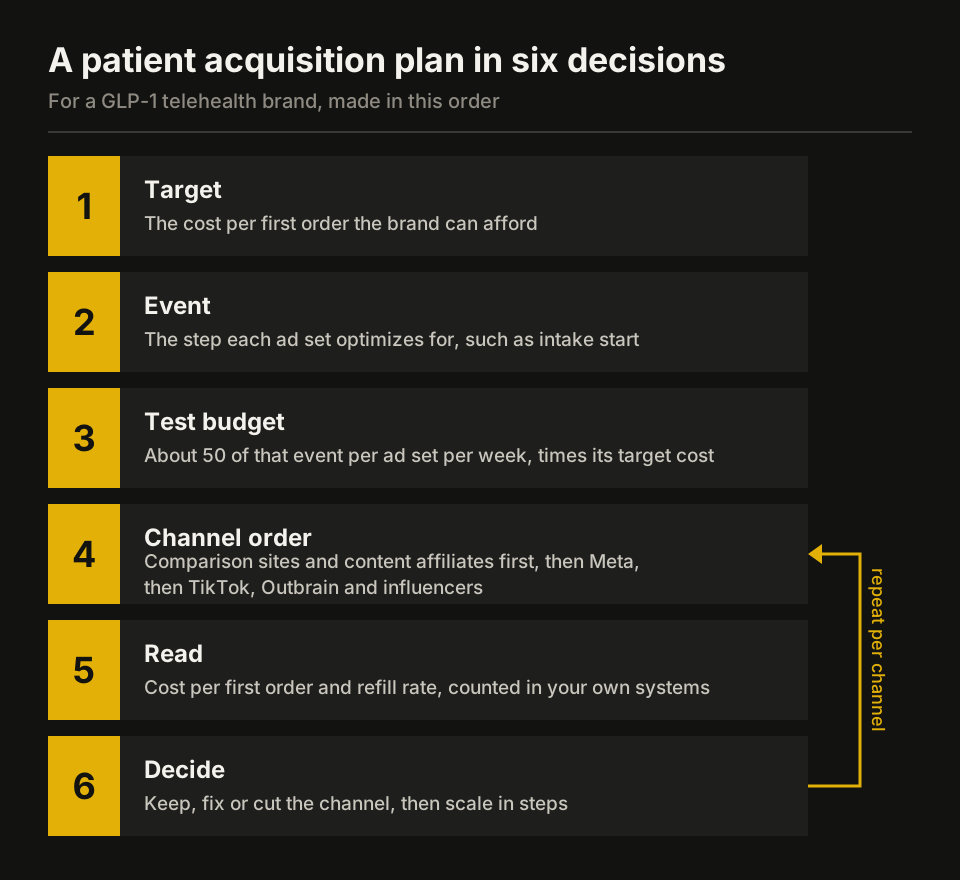
What a patient acquisition strategy covers for a telehealth brand
A patient acquisition strategy for a telehealth brand is the written plan for how new patients will reach the brand, what each one may cost and how each channel is judged. Retention is a separate plan, but it feeds this one, because refills decide how much a new patient is worth.
The demand is there. KFF’s poll published November 14, 2025 found that 18% of US adults had ever used a GLP-1 drug and 12% were using one at the time. About one in six users (17%) “got them from an online provider or website.”
The plan has to answer five questions:
- What is the most we can pay for a first order and still profit after refills?
- Which event will each campaign optimize for?
- How much does a fair test of one channel cost?
- Which channels can we open now, and which wait for certification?
- What result makes us keep, fix or cut a channel?
Which practice tactics work for GLP-1 telehealth
The patient acquisition tactics on most top-ranking lists (Google Business Profile, local SEO, referrals, reviews, community events) were built for a practice with a door and a street address. A GLP-1 telehealth brand sells online across the states where its providers are licensed, so each tactic needs a check.
| Practice tactic | Works for GLP-1 telehealth? | Why |
|---|---|---|
| Google Business Profile and map listings | Rarely | Google lists businesses that have “a physical location that customers can visit” or travel to customers. A virtual office “isn’t eligible.” |
| Local SEO by city | Partly | Visitors search nationally; city pages help only where the brand serves that state |
| Content and SEO | Yes | Explainers and comparison content reach people researching treatment, with claims kept inside FDA and FTC limits |
| Paid social (Meta, TikTok) | Yes, after gates | Prescription drug ads need LegitScript certification and platform approval |
| Paid search (Google) | Yes, after gates | Telemedicine providers need LegitScript and Google certification |
| Native (Outbrain, Taboola) | Yes, with platform approval | Public policies restrict prescription drug ads; the route is approval from the platform |
| Affiliates and comparison sites | Yes | Pay on a tracked result; partners need written claim rules |
| Influencers | Yes, on Instagram | Meta allows branded content for telehealth with conditions |
| Patient referral programs | With care | Keep incentives inside the platform and state rules your counsel approves |
| Reviews and ratings | Yes | Real reviews on the brand’s site and review platforms support every channel |
| Community events and print | Rarely | Local reach for a national online program |
| Online booking | Built in | Intake is the booking; the work is making it short |
Most clinic lists also leave out a step telehealth can’t skip, matching targeting to licensure. Clinicians “must be licensed/authorized to practice in the state where the patient is physically located at the time of service,” as the Mid-Atlantic Telehealth Resource Center puts it. Every ad set, partner and influencer audience should match the states your providers cover.
How the GLP1.partners media team plans patient acquisition
We run GLP-1 and telehealth traffic at scale with platform approvals on every network we buy. On Meta that means established agency accounts built for GLP-1 scale, with a dedicated Meta agency contact. On Outbrain it means established accounts with a dedicated setup for GLP-1. We also send traffic from TikTok, Instagram influencers, our own comparison sites and an affiliate network we manage.
How the plan works with a brand:
- The brand sets the target. We agree on the event we are judged on, usually a first order, and how the brand confirms it in its own systems.
- Every channel answers to the same target. Paid media, influencers, comparison sites and affiliates are compared on one number.
- Every visitor goes through the brand’s intake. The brand’s licensed provider makes every medical decision.
Brands that want this run for them can talk to our team about weight loss telehealth marketing. The rest of this guide is the plan you can run yourself.
Rules that shape a GLP-1 acquisition plan
Four rule sets decide which channels a GLP-1 telehealth brand can open first. Rules checked on November 2, 2026:
| Rule | What it says | Effect on the plan |
|---|---|---|
| Meta, Drugs and Pharmaceuticals | “Meta requires online pharmacies and telehealth providers to be actively certified with LegitScript.” Meta “doesn’t allow targeting for prescription drugs to people under the age of 18.” | Meta prescription ads wait for certification and Meta authorization; audiences 18+ |
| Google Ads, Healthcare and medicines (US) | “Google allows telemedicine providers if they’re accredited by LegitScript’s Healthcare Merchant Certification Program.” “Advertisers must also be certified with Google.” | Search waits for both certifications |
| Meta conversion tracking | “Beginning September 2, 2025, we will start to roll out more proactive restrictions on custom conversions” that suggest health conditions | Name custom conversions neutrally (“intake_complete”, not a condition name) |
| State licensure | Clinicians must be licensed where the patient is at the time of service | Geo targeting follows provider coverage |
Certification takes time, and more brands are in the queue. LegitScript reported on September 22, 2026 “a 101% increase in telemedicine applications specifically” over the past year. Plan the first weeks around channels that don’t need it.
Channel order for a new GLP-1 brand
Channel order for a new GLP-1 telehealth brand follows the gates: start what needs no prescription ad approval, then open paid channels one at a time.
- While LegitScript review runs: content, comparison sites and a small group of content affiliates, all sending visitors to the brand’s own pages.
- After certification and Meta authorization: Meta, with few ad sets and one optimization event.
- Once Meta holds the target: TikTok, Outbrain and Instagram influencers, each with creative built for that channel.
- Once orders track per partner: more affiliates and comparison traffic, with written claim rules and monitoring.
Opening one paid channel at a time keeps the test readable. If two channels launch the same week and first orders rise, you can’t tell which one did it. The full channel-by-stage map is in our GLP-1 marketing strategy.
How to size a testing budget for a GLP-1 channel
A testing budget for a GLP-1 channel should buy enough of the optimization event for the platform’s costs to settle. Meta’s guidance is to wait until an ad set “has generated about 50 optimization events since your last significant edit, which indicates that your current costs are more stable.” That gives a working formula:
Weekly test budget per ad set ≈ 50 × target cost of the chosen event.
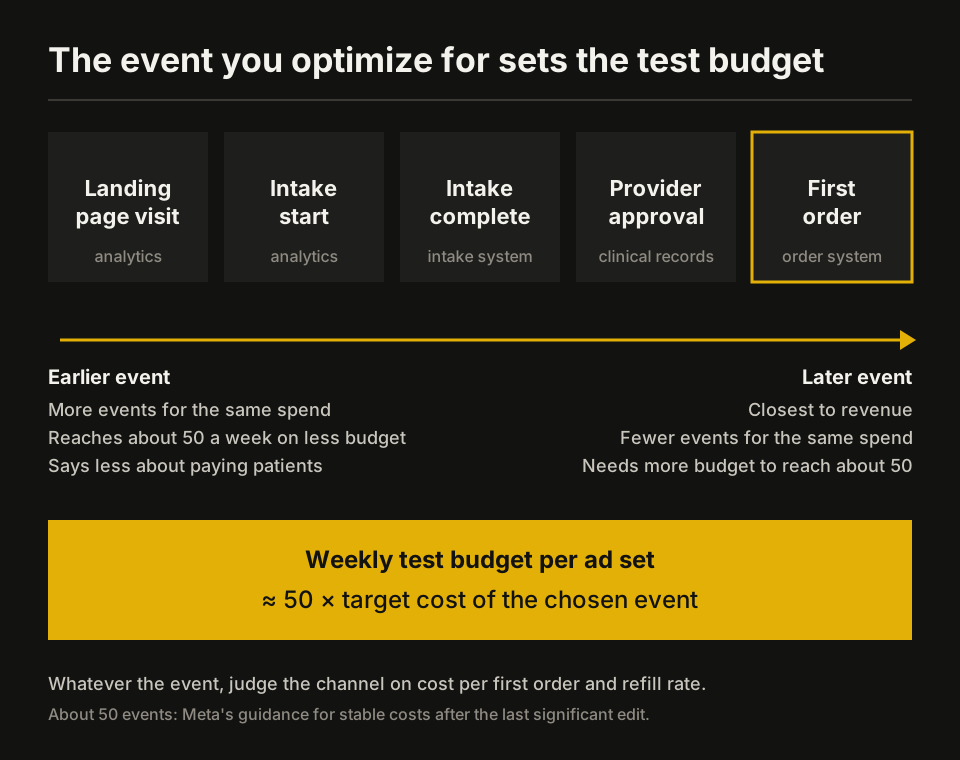
The choice of event is the real budget decision:
- First order is the event closest to revenue. If 50 first orders a week cost more than you can spend on one ad set, the test will run for weeks without settling.
- Intake start or intake complete happens more often, so the same budget reaches 50 sooner. The risk is that the platform finds people who start forms and never pay.
- Whatever you optimize for, judge on cost per first order. An ad set optimized to intake starts that misses the first-order target is a failed test.
Two rules keep the test clean. Meta counts a pause or a change to the optimization event, audience or creative as a significant edit, and large budget or bid changes can count too. Each one restarts the count. Fund fewer ad sets properly rather than many ad sets thinly.
For what real acquisition costs look like in public filings, see our guide to telehealth customer acquisition cost.
KPIs for each funnel stage
The KPIs in a GLP-1 patient acquisition strategy follow the funnel from visit to refill, and most of them are counted in the brand’s own systems, not the ad platform:
- Visit: cost per click and landing page speed (ad platform and analytics).
- Intake: cost per intake start and intake completion rate (analytics and intake system).
- Consult: provider approval rate and time to decision (clinical records).
- Prescription and first order: cost per first order, the main target (order system).
- Refill: refill rate by source (billing system).
Report every KPI by source. A channel can win on intake starts and lose on refills. Each stage’s failure points and fixes are in our GLP-1 patient journey guide.
When to keep, fix or cut a channel
A GLP-1 acquisition channel is kept, fixed or cut by comparing two numbers from your own systems with the target: cost per first order and refill rate. Decide once the test has reached about 50 optimization events since its last significant edit, not after a good or bad day.
| Result after the test | Decision | Next step |
|---|---|---|
| Cost per first order at or under target, refill rate in line with other channels | Keep | Scale in steps, one budget change at a time |
| Cost per first order over target, intake completion low | Fix the page or intake | Test one landing page or intake change, then re-read |
| Cost per first order over target, approval rate low | Fix the audience | Check geo against licensed states and the audience the creative attracts |
| Cost per first order at target, refill rate well below other channels | Fix or cut | Check what the creative promised; a mismatch shows up at refill |
| Under 50 events after several weeks of budget | Change the event or cut | Move the optimization event earlier, or stop the test |
Once one channel holds the target, the question becomes what to add next. That is covered in how to scale a GLP-1 telehealth brand.
A one-page patient acquisition strategy you can write this week
A one-page patient acquisition strategy for a GLP-1 telehealth brand fits on a single document and gets reviewed every month:
- Target. Write the cost per first order you can pay, based on your price and how many patients reach a second and third refill.
- Event. Pick the optimization event for each channel, and write down that every channel is judged on cost per first order.
- Budget. For each test, multiply 50 by the target cost of its event. If the number is more than you can spend weekly on one ad set, move the event earlier.
- Gates. List what each channel needs before launch: LegitScript, Meta authorization, Google certification, platform approvals.
- Order. Write the launch order: what starts during certification, what starts after, what waits for tracking per partner.
- States. Copy the list of states your providers cover into every targeting setup and partner brief.
- Claims. Keep one approved claims list for ads, influencers and affiliates.
- Tracking. Count intake, approval, first order and refill in your own systems by source, with neutral event names.
- Decision rules. Paste the keep, fix or cut table above and agree it with whoever controls the budget.
FAQ
What is a patient acquisition strategy?
A patient acquisition strategy is the plan a healthcare business uses to bring in new patients: which channels it uses, what it can pay per new patient and how it measures each channel. For a telehealth brand it also covers ad platform certification and state licensure.
How do telehealth companies get patients?
Telehealth companies get patients through paid social and search ads (after LegitScript and platform certification), native ads, content and SEO, comparison sites, affiliates and influencers. Local tactics such as map listings play a smaller role because the program is online.
How much should a GLP-1 brand spend to test a channel?
Enough for about 50 optimization events per ad set per week, which is the point Meta says costs become more stable. Multiply 50 by the target cost of your chosen event. If that is too much, optimize for an earlier event and still judge on cost per first order.
What KPIs matter most for telehealth patient acquisition?
Cost per first order is the main KPI. Refill rate by source is the second, because a cheap first order that never refills costs more than it looks. Intake completion and approval rate explain why a channel misses.
Sources
- Meta Business Help Center, Last significant edit (about 50 optimization events since the last significant edit before costs are more stable; what counts as a significant edit) · accessed
- Meta for Developers, Conversion Tracking (from September 2, 2025, restrictions on custom conversions that suggest health conditions) · accessed
- Meta Business Help Center, About the learning phase (ad sets exit learning after about 50 results in the week after the last significant edit) · accessed
- Meta Business Help Center, Branded Content Policies (prescription drugs: business partner must apply; telehealth providers eligible; 18+) · accessed
- Meta Transparency Center, Advertising Standards: Drugs and Pharmaceuticals · accessed
- Google Ads Help, Healthcare and medicines policy (United States, telemedicine) · accessed
- Google Business Profile Help, Guidelines for representing your business on Google · accessed
- Mid-Atlantic Telehealth Resource Center, Licensure and Telehealth · accessed
- KFF Health Tracking Poll: Prescription Drug Costs, Views on Trump Administration Actions, and GLP-1 Use (published November 14, 2025; fielded October 27 to November 2, 2025; 18% ever used, 12% currently using, 17% of users got it from an online provider or website) · accessed
- LegitScript, release of September 22, 2026 (101% increase in telemedicine applications over the past year) · accessed