A telehealth affiliate program pays you when a visitor you send to an online clinic completes one defined event, usually a first order, sometimes a lead or a repeat purchase. Programs run in GLP-1 weight loss, ED and sexual health, hair loss, testosterone and women’s health. Each vertical pays on its own event and carries its own ad rules.
The demand behind these programs is measurable. KFF’s poll published November 14, 2025 found 12% of US adults currently taking a GLP-1 drug, and 17% of people who had taken one got it from an online provider or website.
What a telehealth affiliate program pays on
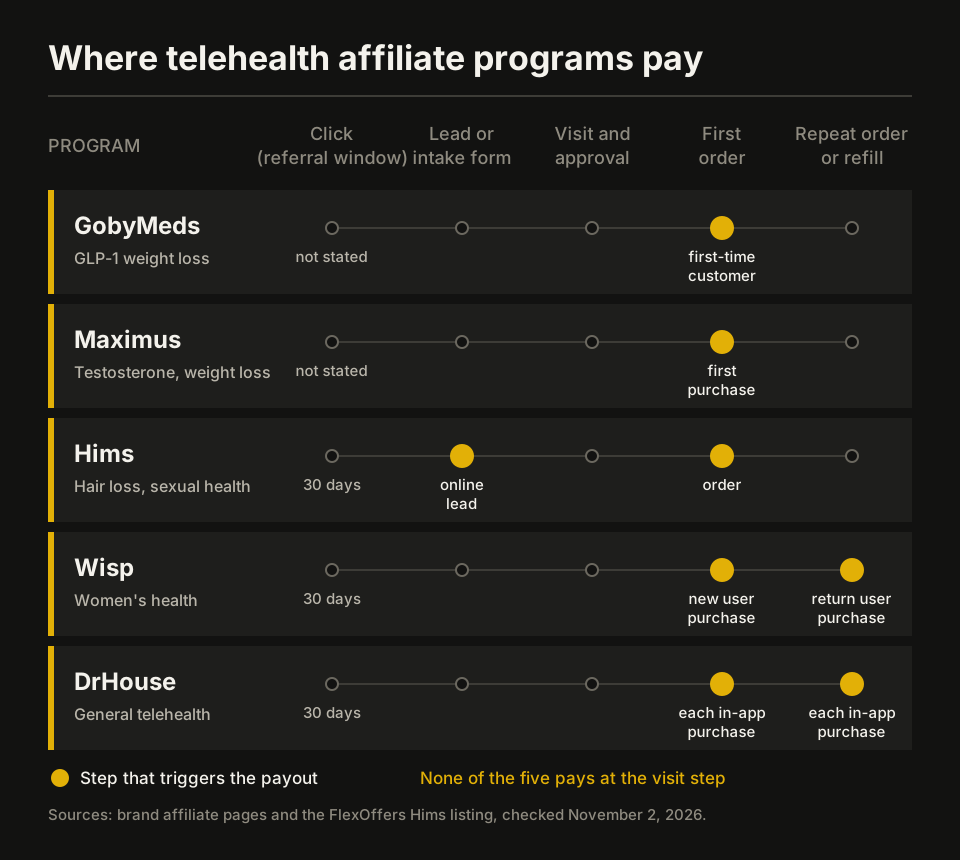
A telehealth affiliate program pays on one event the brand defines, and that event decides your real earnings more than the headline rate. The five programs below publish theirs (checked November 2, 2026).
| Program | Vertical | Payout event, in the program’s words | Window | Where it runs |
|---|---|---|---|---|
| GobyMeds | GLP-1 weight loss | “flat-rate for each first-time customer,” paid net-30 | Not stated | Own portal |
| Maximus | Testosterone, weight loss | “Compensation for first purchase from your channels” | Not stated | Own partner page |
| Hims (FlexOffers listing) | Hair loss, sexual health | Per online lead and per order | 30 days | FlexOffers |
| Wisp | Women’s sexual and reproductive health | New user purchases, plus a smaller amount on return users | 30 days post-click | Impact |
| DrHouse | General telehealth | “each in-app purchase” | 30 days | Awin |
Telehealth programs use four payout models:
- Flat amount per first order: pays after a clinician approves the visit and the order is paid.
- Per lead: pays on a submitted intake form, before any treatment decision. On the Hims listing, the lead payout is smaller than the order payout.
- Repeat: pays again on a later purchase, as Wisp does for return users.
- Percentage of the order: earnings move with plan price and length.
For GLP-1 holds, clawbacks and what reverses a payout, see how GLP-1 affiliate programs work.
Telehealth affiliate programs by vertical
Telehealth affiliate programs differ by vertical in what the brand sells and which ad rule bites first. Meta rules quoted below were checked on November 2, 2026.
| Vertical | What the brand sells | The rule that limits ads | Main claim risk |
|---|---|---|---|
| GLP-1 weight loss | Plans with a provider visit and branded or compounded GLP-1 | Meta: weight loss ads target 18+, no close-ups of pinching body fat; drug ads need LegitScript and Meta authorization | Calling a compounded drug the same as an FDA-approved one |
| ED and sexual health | Prescription treatment after an online visit | Meta: 18+, focus on health and efficacy, “not on the sexual pleasure or enhancement” | Performance or pleasure framing |
| Hair loss | Prescription and topical plans | Drug ad rules once a prescription product is promoted | Promised regrowth |
| Testosterone and hormones | Lab test plus a prescribed protocol | Drug ad rules; 18+ | Effect claims in your own words |
| Women’s health and menopause | Visits and prescriptions for sexual, reproductive and menopause care | Meta lists “The effects of menopause” under sexual and reproductive health, 18+ | Pleasure framing; results claims |
| General or urgent care | Visit fees and subscriptions | Meta lets advertisers promote telehealth services in general without written authorization | Low |
GLP-1 also has a recent FDA enforcement record. The FDA warned 30 telehealth companies on March 3, 2026, citing “claims implying sameness with FDA-approved products.” The claim rules are in misleading GLP-1 ad claims and the FDA.
Meta and Google rules for telehealth affiliate ads
Meta and Google both tie prescription telehealth ads to the brand’s LegitScript certification. Meta’s policy says: “Meta requires online pharmacies and telehealth providers to be actively certified with LegitScript.” Google’s says: “Google allows telemedicine providers if they’re accredited by LegitScript’s Healthcare Merchant Certification Program,” and “Advertisers must also be certified with Google.” Policy checked on November 2, 2026.
The certification belongs to the brand, so ask the program in writing if paid ads are allowed at all, and from whose account.
Which traffic telehealth affiliate programs accept
Telehealth affiliate programs publish clearer rules for content and creator traffic than for paid traffic. The table uses the five programs’ published terms; where none publishes a rule, ask first.
| Traffic source | Status | Why |
|---|---|---|
| Review, comparison and SEO content | Allowed with conditions | GobyMeds asks comparison and coupon sites for “appropriate disclaimers, a clean and easy-to-use interface, and a clear value to the visitor” |
| Coupon and deal sites | Allowed with conditions | Wisp offers a “Custom Promo Code as needed”; the GobyMeds conditions above apply |
| Creators and coaches with an audience | Allowed with disclosure | GobyMeds wants an engaged audience in health or wellness; Maximus recruits people who have “built a community” |
| Paid social (Meta) | Ask first | Ads that promote a prescription drug fall under Meta’s drug policy |
| Paid search and brand-term bidding | Ask first | None of the five pages publishes a brand-bidding rule |
| Mostly AI-generated accounts | Usually declined | GobyMeds says it generally doesn’t approve accounts that are “primarily AI-based” |
| Push and pop | Not accepted on our GLP-1 offers | Our program’s rule |
Compliance rules for telehealth affiliates
Telehealth affiliates follow the FTC’s disclosure rule plus each vertical’s claim limits. The FTC’s guidance for influencers says: “Disclose when you have any financial, employment, personal, or family relationship with a brand.”
Our rules for publishers on GLP-1 offers:
- Disclose the paid relationship in the post or on the page, near the link.
- Sell the program. The provider decides the prescription.
- Don’t call a compounded product by a brand name or call it the same as one.
- Make no weight-loss promises and use no before-and-after images.
- Match the landing page. Don’t name a drug or price the page doesn’t show.
How to join a telehealth affiliate program
Joining a telehealth affiliate program takes five steps.
- Find the program. Check the brand’s footer for “Affiliates” or “Partners,” or its network: Wisp runs through Impact, DrHouse through Awin. See telehealth affiliate networks.
- Apply with your site or audience. GobyMeds reviews each application and may ask for more information.
- Get the terms in writing: payout event, window, payment timing, allowed traffic, creative approval.
- Get your links. GobyMeds sends a referral link and a QR code after approval.
- Add disclosures, then launch on one traffic source and check that conversions track.
How to compare telehealth affiliate programs
The best telehealth affiliate program for you is the one whose payout event matches your traffic. A lead payout suits wide, cold traffic. A first-order payout suits readers already comparing providers. Ask each program:
- What exact event pays, and after how many days?
- Is there a payment on repeat orders?
- Which traffic sources are banned, and is brand bidding allowed?
- Does the brand approve creative before it runs?
GLP-1 weight loss is where we work. In our GLP-1 program a conversion is a sale, and we accept coupon and deal sites. How it runs is on our GLP-1 affiliate program page.
FAQ
What is telehealth affiliate marketing?
Telehealth affiliate marketing is promoting online clinics’ plans for a commission on a defined event, such as a first order. GLP-1 weight loss is one vertical inside it, with its own claim rules. The overview is in GLP-1 affiliate marketing.
Is a telemedicine affiliate program different from a telehealth affiliate program?
No, brands use both words. A separate B2B type exists: TelehealthCash pays for referring entrepreneurs who want their own white-label telehealth brand.
Do telehealth affiliate programs pay recurring commissions?
Some do. Wisp pays on return users, and Maximus offers a partner tier with “compensation for new clients for longer terms.” GobyMeds pays per first-time customer.
Sources
- GobyMeds, Affiliates (flat rate per first-time customer; net-30; disclosure and FTC rules; application steps) · accessed
- Maximus, Partner Program (affiliate tier: compensation for first purchase; partner tier for longer terms) · accessed
- FlexOffers, Hims, Inc. Affiliate Program (last update September 8, 2026; per online lead and per order; 30-day cookie) · accessed
- Wisp, Affiliate Program (new user and return user purchases; 30-day post-click window; Impact) · accessed
- Wisp, homepage (Online Sexual, Reproductive, and Women's Health Care) · accessed
- DrHouse, Telehealth Affiliate Program (each in-app purchase; 30-day cookie; Awin) · accessed
- TelehealthCash, Affiliate Program (B2B referrals of white-label partners) · accessed
- Meta Transparency Center, Drugs and pharmaceuticals · accessed
- Meta Transparency Center, Health and wellness (updated July 22, 2026) · accessed
- Google Ads Help, Healthcare and medicines · accessed
- FTC, Disclosures 101 for Social Media Influencers · accessed
- FDA, FDA Warns 30 Telehealth Companies Against Illegal Marketing of Compounded GLP-1s (March 3, 2026) · accessed
- KFF Health Tracking Poll: Prescription Drug Costs, Views on Trump Administration Actions, and GLP-1 Use (November 14, 2025; 12% of adults currently taking; 17% of users got it from an online provider or website) · accessed