An incentive CPA network runs offers where the affiliate may reward the visitor for completing an action, with points, cash, gift cards or access to locked content. GLP-1 telehealth offers don’t accept that traffic. Every GLP-1 and telehealth listing we checked on November 2, 2026 bans it, while content, email, social, native and brand-issued coupon codes are allowed with conditions.
What an incentive CPA network is
An incentive CPA network is an affiliate network whose offers are marked “Incent,” so the publisher may reward users for completing them. AppsFlyer describes rewarded ads as offering “a benefit to the end user in exchange for an engagement with the ad.” Incent traffic usually comes from these sources:
- Offerwalls. Apps and games list offers and pay users in points or virtual currency for each one they complete.
- Content and link lockers. A download, video or page stays locked until the visitor completes an offer.
- Rewards and get-paid-to sites. Members earn points or gift cards for sign-ups, surveys and trials.
- Cashback and rebate portals. The visitor gets part of the purchase back after buying.
- Survey walls. A survey or quiz leads into an offer as the price of finishing it.
These offers suit app installs, email submits, trials and sweepstakes, where one action is the whole conversion. An offer that is not marked Incent doesn’t allow rewards, even when its traffic field says “all.”
What GLP-1 telehealth offers say about incentivized traffic
GLP-1 telehealth offers ban incentivized traffic in their own listing terms. This is what each public listing said when we checked on November 2, 2026:
| Offer (listing) | Incent rule, verbatim | Other rule on the same listing |
|---|---|---|
| Triad Media “GLP1 - US” (OfferVault, updated November 1, 2026) | “No Incent” | “Converts on Purchase”; “All invalid/bot/proxy leads will be reversed.” |
| SmashLoud “DirectMeds GLP1 SS - US (No PPC)” (OfferVault, updated November 1, 2026) | “No PPC, No Incent, No Survey, No Celebrity Pages” | Bans branded drug names and money-back guarantee language |
| MaxBounty “Marek Health, Premier Telehealth - CPA (US)” (mThink) | “No incentive traffic or Brand Bidding is permitted.” | “Converts on sale and lead submit.” |
| Trimi Health (Katalys, July 2, 2026) | “Incentivized Traffic” listed under prohibited methods | Also prohibits cookie stuffing and website cloaking |
| Gala Health (Katalys, July 13, 2026) | “Incentivized Traffic” listed under prohibited methods | Accepted types include “Coupon” and “Loyalty/Reward Program” |
| FindMyDirectDoctor (Awin) | “No incentivized or cashback traffic.” | “Coupon and deal sites not accepted.” |
The networks above run their GLP-1 and telehealth offers as non-incent, so these offers don’t belong on an incent site’s offerwall. The Gala listing also shows why the label alone isn’t enough. One program can ban “incentivized traffic” and still accept a loyalty program, so read the full terms of each offer.
Why GLP-1 programs reject incentivized traffic
GLP-1 programs reject incentivized traffic because they pay for a sale, and a visitor who came for points rarely buys a prescription program. The reasons below come from the offer terms above and the data on rewarded traffic.
- The conversion is a purchase after a clinician visit. Triad Media’s GLP-1 offer “Converts on Purchase.” At GLP1.partners a conversion is a sale too. The visitor has to fill in an intake, see a licensed clinician and pay, and a reward for clicking doesn’t create that intent.
- Retention drives the brand’s numbers. GLP-1 programs earn on refills month after month. In AppsFlyer’s data (2017, in a post last updated June 2, 2026), “the average 30-day retention for Gaming apps ranges between 2.4% and 4.4%,” while “for incent-heavy networks it’s 1.1%.” Those are app figures, and GLP-1 brands also pay for customers who stay.
- Bad leads get reversed. Triad Media says “All invalid/bot/proxy leads will be reversed.” Incent traffic on a No Incent offer breaks the offer’s own terms, so it lands in the same reversal pile.
- The buyer is real and searching. KFF’s poll published November 14, 2025 found 18% of US adults had used a GLP-1 drug, and 17% of them got it “from an online provider or website.” Brands pay affiliates to reach that group, people comparing telehealth providers.
- Paid reviews carry legal risk. The FTC’s rule on fake reviews, announced August 14, 2024, bans “providing compensation or other incentives conditioned on the writing of consumer reviews” with a particular sentiment. Rewarding users for positive GLP-1 reviews or testimonials is a separate risk on top of the offer terms.
What counts as incentivized traffic in GLP-1 programs
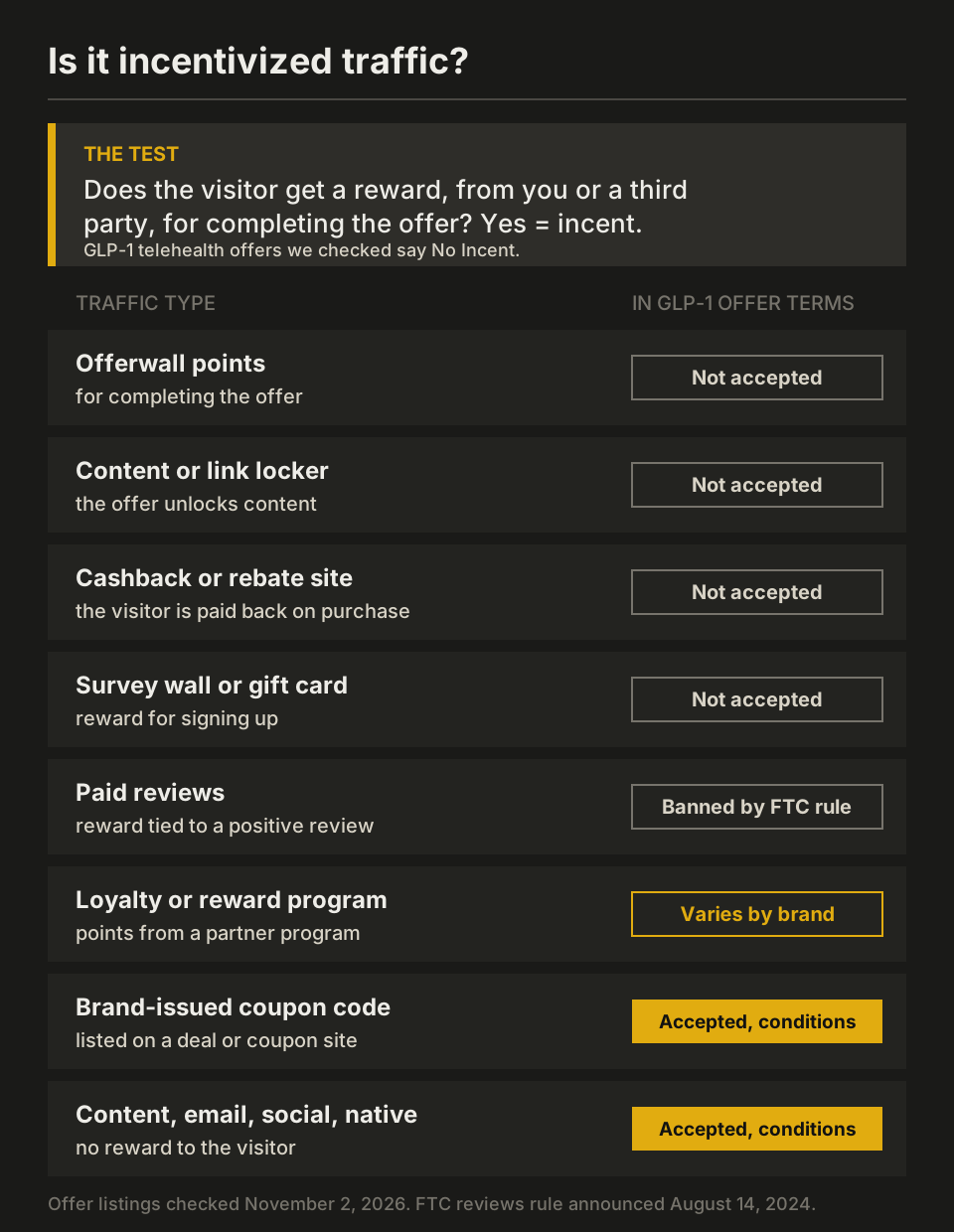
Incentivized traffic in GLP-1 programs is any visitor who gets a reward from the affiliate or a third party for completing the offer. A discount the brand itself gives every buyer counts as part of the price. This table sorts the common cases.
| Practice | Incent? | Status in the GLP-1 terms above |
|---|---|---|
| Offerwall points or virtual currency for signing up | Yes | Not accepted (“No Incent”) |
| Content or link locker that opens after the offer | Yes | Not accepted |
| Cashback or rebate on the purchase | Yes | Not accepted (“No incentivized or cashback traffic,” FindMyDirectDoctor) |
| Survey wall or gift card for signing up | Yes | Not accepted (“No Survey,” SmashLoud) |
| Reward for a positive review or testimonial | Yes | Banned by the FTC reviews rule |
| Loyalty or reward program points | Depends on the program | Accepted at Gala on Katalys; ask everywhere else |
| Brand-issued coupon code on a deal site | No, the discount is the brand’s | Allowed by some programs, banned by others |
| Content, email, social or native with no reward | No | Allowed with conditions |
Coupon traffic has its own rules on codes, brand bidding and disclosure. Program-by-program detail is in our guide to coupon and deal sites in GLP-1 affiliate programs.
Traffic GLP-1 offers accept instead
GLP-1 offers accept traffic where the visitor arrives with their own interest: content, email, social, native, display and, at some programs, paid search and coupons. The allowed lists on the same listings:
| Traffic source | Allowed? | From the listings |
|---|---|---|
| Content and SEO pages | Allowed with conditions | Listed as accepted at Trimi Health and Gala Health |
| Email to your own opt-in list | Allowed with conditions | “Email” on Triad Media, Trimi and Gala |
| Social and native | Allowed with conditions | “Social” and “Native” on Triad Media; creative rules apply |
| SMS | Allowed on some offers | Listed on Triad Media; needs consent |
| Paid search | Varies | Accepted at Trimi; “No PPC” at SmashLoud |
| Coupon and deal sites | Varies | Accepted at Gala; banned at FindMyDirectDoctor |
| Incentivized, cashback, surveys | Not allowed | Incent banned on every listing above; cashback named by FindMyDirectDoctor, surveys by SmashLoud |
GLP1.partners accepts coupon and deal sites on its GLP-1 offers. Incentivized, cashback, push and pop traffic are not accepted. How programs track and credit each source is covered in how GLP-1 affiliate programs work.
Compliance rules for GLP-1 affiliates
GLP-1 affiliates follow claim and disclosure rules on every source, incent or not. These come from the offer terms and the regulators:
- No sameness claims. The FDA announced 30 warning letters to telehealth companies on March 3, 2026, over “claims implying sameness with FDA-approved products.” Don’t call a compounded drug the same as a branded one. See GLP-1 ad claims the FDA flags.
- No branded drug names where the offer bans them. SmashLoud’s DirectMeds listing bans “ANY branded drug names (Ozempic, Wegovy, Mounjaro, Zepbound, etc.).”
- No promised results and no before-and-after images. Use the brand’s approved claims only.
- Prices as the brand states them. Don’t add discounts or savings figures of your own.
- Disclose the affiliate link next to the link or code.
- No brand bidding unless the brand approves it in writing. Marek Health bans it in the same sentence as incent traffic.
- No personal or health data in sub-IDs or URLs.
How payouts work on GLP-1 CPA offers
GLP-1 CPA offers pay a fixed amount per conversion, and the conversion is usually a purchase, a completed consult or both. This is how the industry works in general:
- Offer types. Telehealth weight-loss subscriptions, consult or membership offers, and programs built on branded or compounded medication. Each defines its own conversion.
- Conversion event. Triad Media converts on purchase; Marek Health “on sale and lead submit.” Get the event in writing.
- Holds and reversals. Conversions sit in a hold while the brand checks them. Invalid, bot, proxy or incent leads are reversed.
- Payment terms. Weekly or monthly depending on the network and the deal.
Typical commission levels by brand are on GLP-1 affiliate commissions.
Moving from incent traffic to GLP-1 offers
Affiliates who run incent traffic can move to GLP-1 offers by keeping their audience skills and dropping the reward. A short checklist:
- Keep the audience, lose the reward. An email list, a content site or a social following built on rewards can still work as non-incent traffic, once the reward is gone from the path to the offer.
- Rebuild the page around the decision. Visitors are comparing telehealth providers, so price, what’s included and how the visit works matter more than speed to the click.
- Ask before you test. Tell the affiliate manager exactly how traffic reaches the offer, and get the yes in writing.
- Expect a hold. Budget for conversions to be paid after the hold, not on the day of the sale.
FAQ
What does “No Incent” mean on a CPA offer?
“No Incent” means you may not reward visitors for completing the offer, with points, cash, gift cards, locked content or cashback. Every GLP-1 telehealth listing we checked carries this rule or an equivalent.
What happens if you send incent traffic to an offer that doesn’t allow incent?
The traffic breaks the offer’s terms, so expect the conversions to be reversed and your place on the offer to be at risk. Check the network’s agreement for what it does with pending commissions.
Is a coupon code incentivized traffic?
No, as long as the code is the brand’s own discount and not a reward from you. Programs still decide whether coupon sites are allowed. Gala Health on Katalys accepts coupon traffic and FindMyDirectDoctor on Awin bans it.
Sources
- OfferVault, Triad Media: GLP1 - US (listing updated Nov 01, 2026) · accessed
- OfferVault, SmashLoud: DirectMeds GLP1 SS - US (No PPC) (listing updated Nov 01, 2026) · accessed
- mThink, MaxBounty: Marek Health - Guided Optimization and Premier Telehealth - CPA (US) · accessed
- Katalys, Trimi Health Affiliate Program (July 2, 2026) · accessed
- Katalys, Gala Health Affiliate Program (July 13, 2026) · accessed
- Awin, FindMyDirectDoctor merchant profile · accessed
- AppsFlyer, Rewarded advertising: the good, bad and ugly (last updated June 2, 2026; 2017 retention data) · accessed
- FTC, Federal Trade Commission Announces Final Rule Banning Fake Reviews and Testimonials (August 14, 2024) · accessed
- KFF Health Tracking Poll: Prescription Drug Costs, Views on Trump Administration Actions, and GLP-1 Use (November 14, 2025; 18% ever, 12% current, 17% from an online provider or website) · accessed
- FDA, FDA warns 30 telehealth companies against illegal marketing of compounded GLP-1s (March 3, 2026) · accessed