A CPA network is a company that holds deals with advertisers and pays affiliates a set amount each time a visitor completes an agreed action, such as a sale or a sign-up. You get one account, many offers and one payment. On GLP-1 telehealth offers, the action is usually a first paid order, and the brand approves your creative.
How a CPA network works
A CPA network sits between advertisers and affiliates and earns the gap between what the advertiser pays per action and what it pays you. CPA stands for cost per action (some say cost per acquisition). The network runs the tracking, the offer list, fraud checks and payments.
The three parties:
| Party | What it does | What it wants |
|---|---|---|
| Advertiser (the brand) | Sets the action it pays for, the rate and the rules | Real customers at a known cost |
| CPA network | Signs the brand, recruits affiliates, tracks, pays | Volume and a margin on each action |
| Affiliate (you) | Sends visitors through a tracking link | A good rate, paid on time |
The network’s margin is why the same offer can pay you less through a network than direct with the brand. It’s also why a network that buys an offer from another network (a sub-network) usually pays less again. We compare the routes GLP-1 offers take in telehealth affiliate networks.
What a CPA payment is
A CPA payment is a fixed amount paid for one completed action. The offer page names the action, and only that action pays. Common models on a CPA marketing network:
- CPA or CPS (per sale) pays on a purchase. GLP-1 telehealth offers often pay here, on a first paid order or a paid consult.
- CPL (per lead) pays on a form or sign-up. Telehealth offers sometimes pay on a completed intake instead of a sale.
- CPI (per install) pays on an app install.
- Rev share pays a share of what the brand earns, sometimes on refills too.
What GLP-1 brands publish about these models is in GLP-1 affiliate commissions.
The three approvals in a CPA network
A CPA network has three approval steps, and for GLP-1 offers the last one belongs to the brand. Traffic you send before all three are in place may not pay.
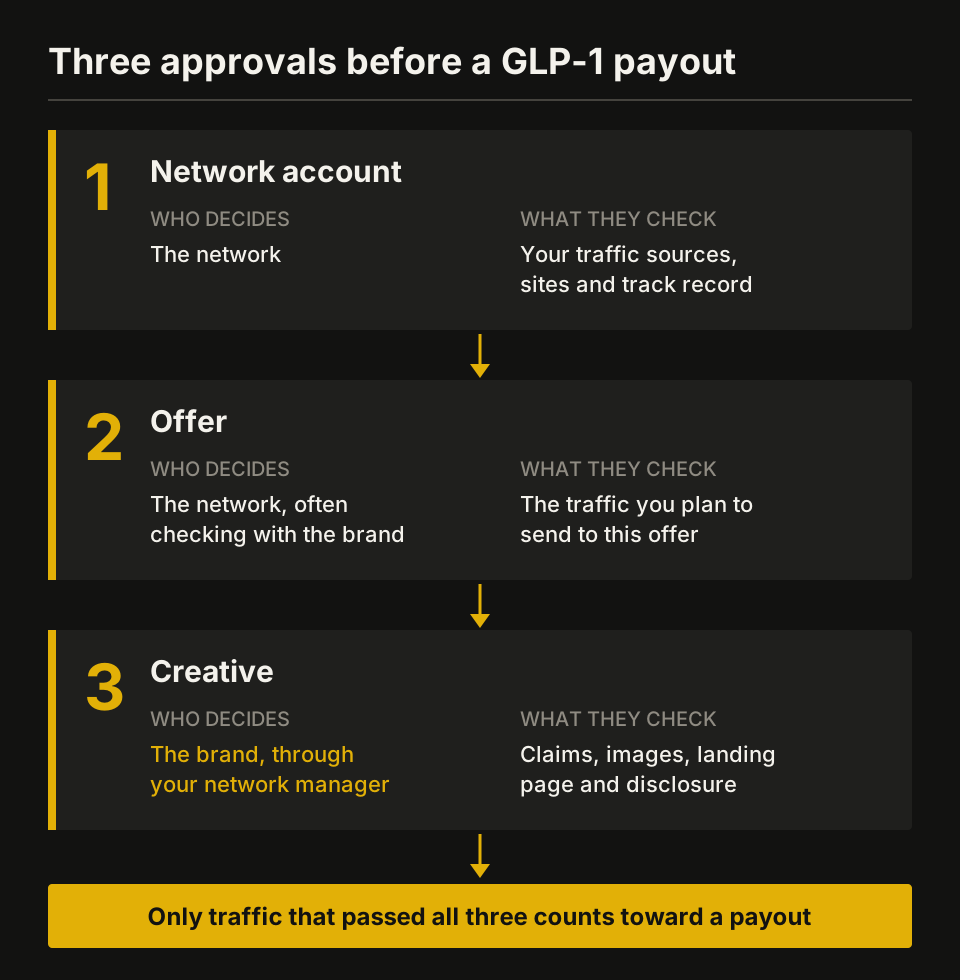
| Approval | Who decides | What helps you pass |
|---|---|---|
| Network account | The network, often after a call with an affiliate manager | Named traffic sources, live sites or ad accounts, past results you can show |
| Offer | The network, often checking with the brand on regulated offers | A clear plan: which traffic, which states, which angle |
| Creative | On GLP-1 offers, the brand, through your manager | Brand-approved claims, a disclosure, a landing page the brand has seen |
The brand holds the creative step on GLP-1 offers because the ad platforms certify the brand, not you. Meta’s policy says: “Meta requires online pharmacies and telehealth providers to be actively certified with LegitScript.” Demand for that certification is rising. LegitScript reported a 101% increase in telemedicine certification applications over the past year in its September 22, 2026 release.
CPA network payment terms: hold, net terms and minimums
CPA network payment terms decide when an approved action turns into money in your account. Five terms matter, and you should get each one in writing before you send traffic.
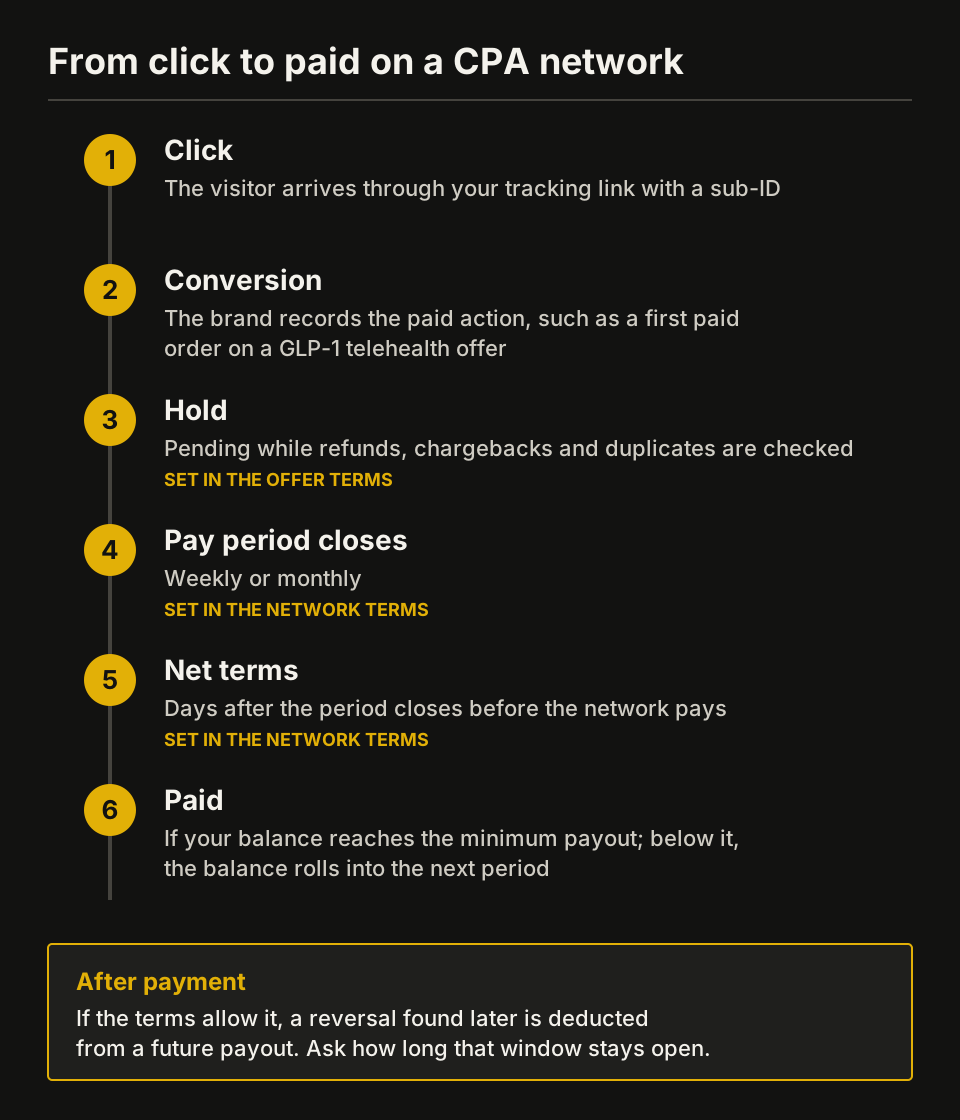
| Term | What it means | Question to ask |
|---|---|---|
| Hold (validation) | Days a conversion stays pending while the brand checks it | How long, and what gets a conversion rejected? |
| Pay period | How often the network closes your balance: weekly, twice a month, monthly | When does the period close? |
| Net terms | Days after the period closes before payment (“net 15” means 15 days) | Is it net from period close or from brand payment? |
| Minimum payout | The balance you need before the network pays | What happens to a balance below it? |
| Reversals | Conversions taken back after a refund or chargeback | Can a reversal hit money already paid, and for how long? |
Tax paperwork is part of the terms too. A US network usually asks US affiliates for a Form W-9. For tax years beginning after 2025, the IRS instructions for Form 1099-NEC set the reporting line at “$2,000 or more” in nonemployee compensation, up from $600.
On GLP-1 offers, ask how the brand’s refund policy passes down to you. Each telehealth brand sets its own refund rules, and a refunded first order can come back to you as a reversal. When an offer stops, pending conversions are a separate question, covered in why GLP-1 offers get paused.
GLP-1 telehealth offers on a CPA network
GLP-1 telehealth offers on a CPA network pay on a brand’s sale, not on a drug sale, because a licensed clinician at the brand decides on any prescription. You send visitors, and the brand handles everything after the click. Offer categories you’ll see:
- Monthly or multi-month telehealth weight-loss plans
- Paid consultations
- Branded medication programs
- Compounded medication programs, which carry their own claim rules
The audience is large. KFF’s poll published November 14, 2025 found that 18% of US adults had ever taken a GLP-1 drug and 12% were taking one. Among people who had taken one, 17% got it from an online provider or website, the channel these offers sell.
Which traffic a CPA network allows on GLP-1 offers
A CPA network passes the brand’s traffic rules to you, so the allowed list on a GLP-1 offer starts with the brand. This is how we run it for GLP-1 offers:
| Traffic source | Allowed? | Why |
|---|---|---|
| SEO and content sites | Allowed with conditions | Disclosure next to every link; no made-up ratings or reviews |
| Meta (Facebook, Instagram) | Allowed with conditions | Brand-approved creative only; no before-and-after images |
| Instagram influencers | Allowed with conditions | Your own account and audience; brand-approved claims only |
| Google and Microsoft search | Allowed with conditions | Generic terms only |
| Search ads on the brand’s name | Not allowed without written approval | Competes with the brand’s own search ads |
| Allowed with conditions | Your own opt-in list, CAN-SPAM compliant, copy reviewed first | |
| Native | Allowed with conditions | Pre-landers reviewed first; no fake news layouts |
| Coupon and deal sites | Allowed with conditions | Codes and discounts the brand approves |
| Incentivized or cashback traffic | Not allowed | Visitors with no intent to buy |
| Push, pop and bot traffic | Not allowed | Low intent and fraud risk |
Our rules for publishers on GLP-1 offers
Our rules for publishers on GLP-1 offers follow the brand’s rules and the FTC’s. The FTC’s Endorsement Guides FAQ tells affiliates: “You should disclose your relationship to the retailer clearly and conspicuously on your site.” In short:
- Affiliate disclosure next to every link, in plain words.
- Brand-approved claims only. No weight-loss results, no before-and-after images, no prescription promises.
- Prices and plan details exactly as they appear on the brand’s current landing page.
How brands watch for claims that break these rules is in monitoring GLP-1 affiliate ads.
How to check a CPA network before you join
The best CPA network for you is the one with a direct deal with the brand, clear terms and fair rules on reversals, so check those before you look at the rate. Networks also carry legal weight. On October 4, 2016, the FTC announced a federal appeals court ruling that held the operator of an affiliate network liable for deceptive claims its affiliates made for a weight-loss supplement, with $11.9 million to pay. The FTC wrote: “The decision is the first by a court of appeals holding the operator of an affiliate marketing network liable for deception by third-party marketers.”
Read a CPA network’s sign-up page and terms against this table before you send a click:
| What to check | Good sign | Red flag |
|---|---|---|
| Fees | Free to join; the network earns from the advertiser | A sign-up, “activation” or training fee |
| Source of the offer | Direct from the brand, named on request | Can’t or won’t say where the offer comes from |
| Creative approval | A named person and a stated turnaround | “Run it and we’ll see” on a GLP-1 offer |
| Hold and rejections | Hold length and rejection reasons in writing | Conversions rejected with no reason given |
| Reversals after payment | A fixed window, tied to the brand’s refund rules | Open-ended clawbacks on paid balances |
| Payment | Pay period, net terms, minimum and method in the terms | Terms only “discussed with your manager” and never written |
| Tracking | Postbacks to your own tracker; sub-IDs for traffic labels only | Asks you to pass names, emails or health details in sub-IDs |
| Compliance help | Brand claim rules and disclosure rules sent before launch | No rules until after a complaint |
FAQ
What’s the difference between a CPA network and an affiliate network?
A CPA network is a type of affiliate network that pays per action. Many affiliate networks also run rev share or hybrid deals, and people use the two terms for the same thing.
What is a CPA program?
A CPA program is one advertiser’s offer that pays a fixed amount per action. A CPA network carries many such programs in one account.
Can you promote GLP-1 offers through a CPA network?
Yes, if the network carries prescription telehealth offers and you follow the brand’s rules. Some large affiliate programs exclude prescription drugs. Amazon Associates, for one, lists “prescription drugs, or any other product sold by Amazon Pharmacy” among its excluded products. Check that the “GLP-1” offers are telehealth plans and not supplements.
Sources
- FTC, U.S. Circuit Court Finds Operator of Affiliate Marketing Network Responsible for Deceptive Third-Party Claims Made for LeanSpa Weight-loss Supplement (October 4, 2016) · accessed
- FTC, FTC's Endorsement Guides: What People Are Asking · accessed
- IRS, Instructions for Forms 1099-MISC and 1099-NEC (Rev. December 2026; $2,000 threshold for tax years beginning after 2025) · accessed
- KFF Health Tracking Poll: Prescription Drug Costs, Views on Trump Administration Actions, and GLP-1 Use (November 14, 2025; 18% ever, 12% current, 17% of users from an online provider or website) · accessed
- LegitScript, Certification Applications Rise 59%, Led by 101% Growth in Telemedicine (September 22, 2026) · accessed
- Meta Transparency Center, Drugs and pharmaceuticals · accessed
- Amazon Associates, Program Policies (Excluded Products) · accessed