A telehealth Facebook ads agency plans, builds and runs a telehealth brand’s Meta campaigns: account structure, ads written to Meta’s health rules, adult targeting without health data, tracking inside Meta’s data limits, and weekly reports against a target cost per acquisition. The brand keeps its LegitScript certification, its offer, its claims sign-off and every clinical decision.
Policy checked on November 1, 2026.
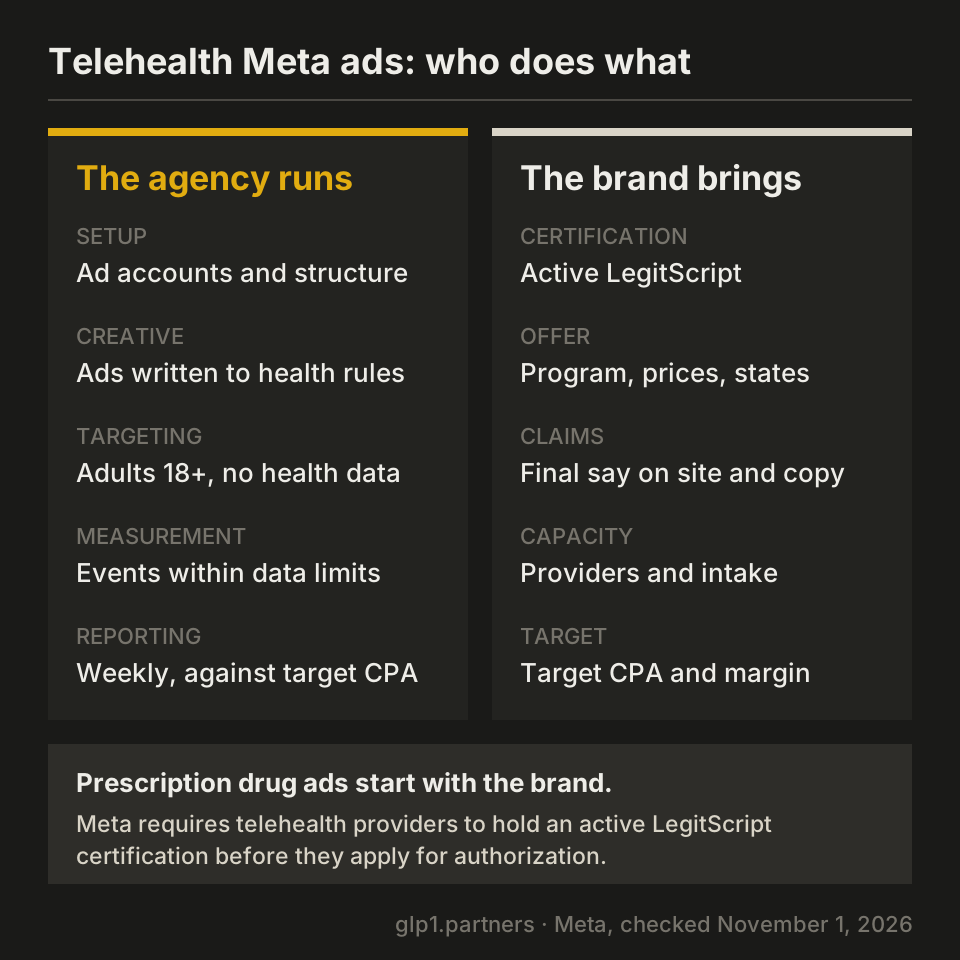
Who does what: agency vs telehealth brand on Meta
A telehealth Facebook ads agency owns the media work, and the brand owns everything Meta and the law tie to the provider itself. Get this split in writing before the first campaign, because several Meta steps can only be done by the brand.
| Task | Usually owned by | Meta rule behind it |
|---|---|---|
| LegitScript certification | Brand | Meta “requires telehealth providers to be actively certified with LegitScript before submitting an application” |
| Prescription drug ad authorization | Brand applies; agency checks the right ad accounts are selected | The application asks you to “select the ad accounts that you want to authorize to advertise” |
| Ad account and campaign structure | Agency | One advertiser per ad account when an agency runs ads for others |
| Creative and ad copy | Agency writes; brand approves claims | Health and Wellness and Drugs and Pharmaceuticals standards |
| Targeting | Agency | Adults 18+, eligible countries, no health-condition audiences |
| Pixel, Conversions API, event plan | Agency sets up with the brand’s developer | Data source categories may restrict events |
| Landing pages and checkout | Brand owns; agency reviews | Brand’s signed-off claims list applies |
| Prescribing, intake, patient care | Brand and its licensed providers | Outside the ad account |
| Budget and target CPA | Brand sets; agency plans spend against it | Ad sets usually leave learning after about 50 results in a week |
The authorization row needs the most care. Authorized advertisers can request to “extend their authorization to run prescription drug ads to other ad accounts within their same business portfolio,” Meta’s prescription drug help page says, so where the ad account lives decides how authorization is handled. Our guide to Meta agency ad accounts for telehealth covers the two setups (partner access vs an agency-owned account) and what Meta’s terms allow.
Week 0: paperwork a telehealth brand brings to its Meta agency
Before a telehealth Facebook ads agency launches a single ad, the brand hands over the documents and access that only the provider can produce.
- Active LegitScript certification for the website the ads will send traffic to. On Meta’s LegitScript route, “If the URL you provide has not been certified or is not in good standing with LegitScript, you will not be able to proceed with the next step.”
- Prescription drug ad authorization in Meta Business Suite, under Authorizations and verifications. On the LegitScript route Meta says “you’ll be notified of your application status right away.” Meta’s 48-business-hour review applies to pharmaceutical manufacturers on Meta’s internal route, not to telehealth.
- Business portfolio access. If the agency works inside the brand’s own portfolio, someone with full control adds the agency as a partner. Meta’s partner access page asks for the agency’s business portfolio ID and tells you to turn on two-factor authentication first.
- The offer in plain terms: the program, monthly price, states served, and whether the menu is branded, compounded or both.
- A claims list the brand’s legal or medical side has signed off. The agency writes ads inside it.
Meta’s eligibility limits apply whoever runs the account. Prescription drug ads may “Only target people in eligible countries (United States, Canada or New Zealand),” “Only target people in the countries in which they are certified,” and “Only target people 18 years or older.” The full steps are in our guide to Meta prescription drug ads for GLP-1 telehealth.
Week 1: account structure and first creative
In week 1 a telehealth Facebook ads agency builds the account and writes the first ads. The account rule comes from Meta’s Advertising Standards: when you manage ads for other advertisers, “each advertiser or client must be managed through separate ad accounts.” So the brand gets its own ad account.
Week 1 work usually covers:
- Campaign structure: few campaigns, few ad sets, enough budget per ad set to reach Meta’s learning threshold. Meta says leaving the learning phase “usually occurs after about 50 results in the week after the ad set’s last significant edit.”
- First creative batch: ads that describe the program, the provider visit and access, written to Meta’s Health and Wellness standard. That standard bans “statements of inferiority about physical appearance,” which rules out the body-shaming hooks common in older weight loss ads.
- Landing page review: the agency checks that the page matches the ad and the brand’s claims list before anything goes to review.
Week 2: targeting a telehealth audience inside Meta’s limits
Telehealth targeting on Meta is narrow by design, so a Facebook ads agency spends week 2 on broad, compliant audiences instead of interest stacks. Three Meta changes set the limits:
| Date | Meta change | What the agency does |
|---|---|---|
| January 19, 2022 | Removed detailed targeting options “that relate to health” | No condition interests in any ad set |
| March 31, 2025 | Started removing detailed targeting exclusions from Ads Manager | Uses other exclusion tools; rebuilds old saved audiences |
| Ongoing | Custom and lookalike audiences with “references to specific health conditions” are flagged and can’t be used | Builds audiences from data that holds no health-condition details |
Meta says an advertiser test found “the median cost per conversion was 22.6% lower when not using detailed targeting exclusions.” That test covered advertisers in general, not GLP-1. In practice the creative and the offer do most of the audience selection. More detail is in our guide to Meta targeting for GLP-1 ads.
Weeks 2 to 4: measurement when Meta restricts health data
Measurement for a telehealth brand on Meta depends on the category Meta assigns to the brand’s website. Meta’s help page on data source categories lists three levels of restriction:
- Core setup: “Restricts the sharing of custom parameters and parts of URLs following the domain.”
- Restriction on certain standard events: “Restricts the sharing of specific mid and lower funnel events.”
- Full restrictions: Meta Business Tools “cannot be used for ads purposes where restrictions are in place.”
A telehealth Facebook ads agency checks the category in Events Manager in week 1, then picks the optimization event from what Meta still accepts. If lower-funnel events are blocked, Meta itself suggests “more upper-funnel events to maintain effective audience targeting and campaign optimization.” The agency then reconciles Meta’s reported results with the brand’s own backend numbers, because the brand’s system is the record of real sales. Our guide to Meta health data restrictions and core setup walks through the Events Manager settings.
Month 2 onward: reporting on target CPA
From month 2 a telehealth Facebook ads agency reports against the target CPA the brand set, usually weekly. A useful weekly report answers five questions:
- What did we spend, and how many sales did the brand’s backend record?
- What was the cost per sale against target, by campaign?
- Which ads were rejected or limited in review, and what changed?
- Which new creative launched, and which was paused?
- What is the spend plan for next week, given intake capacity?
In telehealth, provider capacity caps useful spend. If providers can’t see new patients quickly, more spend only builds a backlog, so the brand should share intake capacity with the agency every week.
What stays with the telehealth brand
Some work never moves to a Facebook ads agency, whatever the contract says. The brand keeps:
- The certification and the authorization. LegitScript certifies the brand’s site, and Meta says “To maintain your authorization to run prescription drug ads, you must maintain an active LegitScript Certification.”
- Clinical decisions. Ads sell access to a licensed provider and a program. Whether a patient gets a prescription is the provider’s call.
- Claims sign-off. The agency writes; the brand decides what it can stand behind.
- Its own business portfolio and Page security. Only someone with full control can add a partner.
- Ownership terms. Who owns creative and data is agreed in writing before launch.
How GLP1.partners runs Meta for telehealth brands
GLP1.partners is a telehealth Facebook agency for GLP-1 brands: we run Facebook and Instagram campaigns on established agency accounts built for GLP-1 scale, with a dedicated Meta agency contact. It is managed media. Our team runs the campaigns end to end, and each brand runs in its own ad account.
“We run GLP-1 and telehealth traffic at scale with platform approvals on every network we buy.” The GLP1.partners media team
What that covers on Meta:
- campaign structure and an audience plan built for Meta’s health limits
- ad creative and copy written to Meta’s health and weight loss rules
- landing page review before launch
- tracking set up in line with Meta’s health data limits
- weekly reporting against the target we agree with you
The brand brings its LegitScript certification, and our agency accounts are suited to run certified telehealth brands. The GLP1.partners media team has managed $38M in GLP-1 media and scaled 27 GLP-1 brands. Meta is one channel; we also run Outbrain, TikTok, Instagram influencers, our own comparison sites and an affiliate network we manage. See how we work as a telehealth Facebook agency.
Hiring a telehealth Facebook ads agency
Hiring a telehealth Facebook ads agency starts with the questions above: what paperwork they expect from you, how they handle Meta’s health-data limits, and what they report weekly. Our checklist for choosing a GLP-1 marketing agency covers the contract terms and red flags.
FAQ
What does a telehealth Facebook ads agency do?
A telehealth Facebook ads agency builds and runs a telehealth brand’s Meta campaigns: account structure, creative written to Meta’s health rules, compliant targeting, tracking and weekly reporting against a target CPA. The brand keeps its LegitScript certification, claims sign-off and all clinical decisions.
Can a telehealth Facebook agency target people interested in weight loss?
Not through health interests. From January 19, 2022 Meta removed detailed targeting options “that relate to health,” and it flags custom audiences that include references to specific health conditions. Weight loss ads must target people 18 or older. Agencies use broad adult audiences and let the creative do the selecting.
How long before a telehealth agency’s Meta campaigns are stable?
Meta says ad sets leave the learning phase “as soon as they can deliver stably,” which “usually occurs after about 50 results in the week after the ad set’s last significant edit.” How fast that happens depends on budget, cost per result and how often the ad set is edited.
Sources
- Meta Business Help Center, About Meta's Prescription Drugs advertising policy (eligible countries, 18+, LegitScript before applying, ad accounts selected at application, status right away on the LegitScript route, sharing authorization within the same business portfolio) · accessed
- Meta Transparency Center, Introduction to the Advertising Standards (separate ad accounts per advertiser) · accessed
- Meta Transparency Center, Advertising Standards: Drugs and Pharmaceuticals · accessed
- Meta Transparency Center, Advertising Standards: Health and Wellness (18+ for weight loss ads; statements of inferiority; change log Jul 22, 2026) · accessed
- Meta for Business, Removing Certain Ad Targeting Options and Expanding Our Ad Controls (health-related detailed targeting removed from January 19, 2022) · accessed
- Meta Business Help Center, Updates to detailed targeting (exclusions removed from March 31, 2025; 22.6% lower median cost per conversion without exclusions in an advertiser test) · accessed
- Meta Business Help Center, Understand restrictions on certain custom audiences · accessed
- Meta Business Help Center, Understand data sharing restrictions based on data source categories (core setup, restricted mid and lower funnel events, full restrictions) · accessed
- Meta Business Help Center, About the learning phase (exit usually after about 50 results in the week after the last significant edit) · accessed
- Meta Business Help Center, Give a partner access to business assets in your business portfolio · accessed
- GLP1.partners, own figures on the About page ($38M in GLP-1 media managed; 27 GLP-1 brands scaled) · accessed