A healthcare branding agency builds the name, tagline, visual identity, trust signals and brand book a GLP-1 telehealth brand launches with. For GLP-1 brands specifically, FDA has cited a company’s own name on its pictured product labels, not just its ad copy, in misbranding findings against compounded-GLP-1 telehealth marketing. A branding agency sets that risk; it doesn’t buy the traffic that follows.
Healthcare branding agency vs. marketing agency: which does a GLP-1 brand need, and when
A healthcare branding agency and a healthcare marketing agency do different jobs on a different clock. Branding builds the name, identity and promise a GLP-1 telehealth brand launches with. Marketing, specifically paid media, buys the traffic that turns that promise into patients. Our healthcare marketing agency types guide maps all six agency types a telehealth brand might hire; this page covers the first one in depth.
A GLP-1 brand needs branding first, before its first ad runs, because paid media needs an offer that looks different from every other compounded-semaglutide program on the market. It needs a performance marketing agency once that offer is set and the brand wants volume at a known cost. Our healthcare advertising agencies guide covers that paid-media hire directly.
Running both jobs at once, without agreeing who owns which claim, is how a tagline written for a brand book ends up disapproved as an ad.
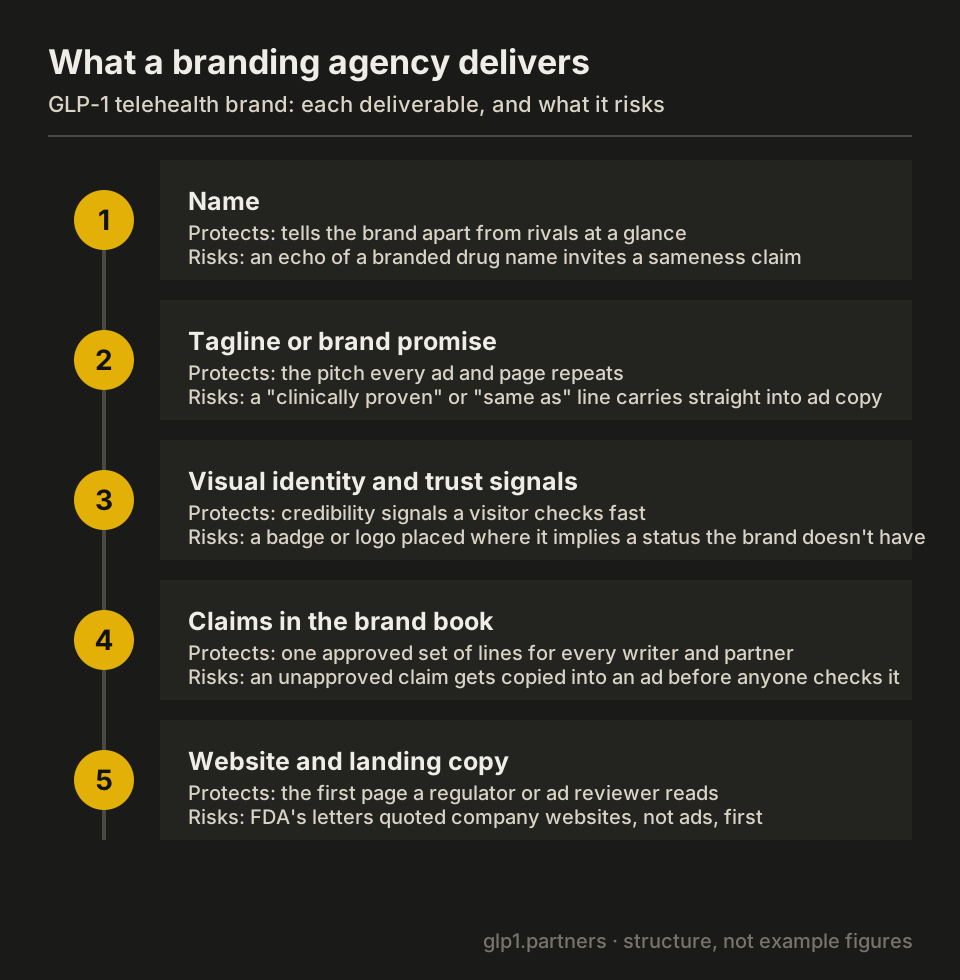
What a healthcare branding agency delivers
A healthcare branding agency’s deliverables aren’t interchangeable. Each one protects something different for a GLP-1 telehealth brand, and each carries a different risk if nobody checks it against FDA’s and the platforms’ rules before launch.
| Deliverable | What it protects | What it risks | Stage |
|---|---|---|---|
| Name | How visitors tell the brand apart from rivals | An echo of a branded drug name invites an FDA sameness claim | Before launch |
| Tagline or brand promise | The pitch every ad and page repeats | A “clinically proven” or “same as” line carries straight into ad copy | Before launch |
| Visual identity and trust signals | At-a-glance credibility: badges, price clarity, design quality | A badge or logo used where it implies a certification status the brand doesn’t have | Before launch, revisited at scale |
| Claims in the brand book | One approved set of lines for every writer and partner | An unapproved claim gets copied into an ad before anyone checks it | Before launch, enforced every stage after |
| Website and landing copy | The first page a regulator or ad reviewer reads | FDA’s June 2026 letters cited what companies displayed on their own websites | Before launch, checked every stage after |
FDA’s June 8, 2026 letters to altRx and Momentum Health cited products and claims “displayed on your website.” Ad copy for a GLP-1 brand usually borrows from the landing page a branding agency wrote, so a line that never touches a platform’s ad review can still sit in front of a regulator.
Naming and visual identity choices that can trigger an FDA misbranding finding
FDA’s warning letters to telehealth companies don’t stop at ad copy. On March 3, 2026 and June 8, 2026, FDA cited products “branded with the telehealth firm’s name or trademark without qualification” and labels that made a brand look like the compounder “when in fact it is not.” Both are naming and packaging decisions, not copywriting ones.
The March 3, 2026 release covered 30 telehealth companies at once over claims “implying sameness with FDA-approved products.” The two June 8, 2026 letters, to Trinity HealthCare Supply LLC dba altRx and Momentum Health 360 dba Momentum Health, spelled out the labeling finding: a brand’s own name on a pictured product label, “suggesting [the company] is the compounder of those drugs when in fact it is not.”
| Naming or visual-identity choice | What FDA flagged | Letter date | Check before your brand book locks it in |
|---|---|---|---|
| Brand name or trademark used without qualifying it isn’t the manufacturer | Products “branded with the telehealth firm’s name or trademark without qualification” | March 3, 2026 | Does your brand book require a compounder-identification line near the logo? |
| Brand name on the pictured product label | Labeling “suggesting [the company] is the compounder of those drugs when in fact it is not” | June 8, 2026 | Whose name appears on the pictured vial or box in your creative? |
| Name or tagline that pairs the brand with an approved drug’s name | Claims “implying sameness with FDA-approved products” | March 3, 2026 | Does any name element or tagline reference a brand-name drug, directly or by implication? |
A branding agency owns this decision. It gets made once, in the naming and packaging phase, and it is expensive to unwind after launch creative is built around it. The full phrase-by-phrase table, including the ad-copy claims FDA has flagged alongside these naming findings, is on our compounded GLP-1 advertising claims page.
Letters and policy checked on November 2, 2026.
How trust-signal and brand-book choices feed paid-media performance
A healthcare branding agency’s choices don’t stop mattering once paid media starts buying traffic. They show up again in two numbers a GLP-1 brand tracks every week: ad approval rate and cost per patient.
The claims link is direct. FDA’s June 2026 letters cited what companies showed on their own websites, and that matters here because ad copy for a GLP-1 brand usually gets drafted from the landing page a branding agency wrote. A tagline cleared for the brand book but never checked against a platform’s health-ad rules becomes the exact line a reviewer catches once it’s running as a paid ad, and a rejected ad doesn’t spend.
The trust-signal link runs through certification. Meta’s Drugs and Pharmaceuticals policy states: “Meta requires online pharmacies and telehealth providers to be actively certified with LegitScript.” LegitScript reported “a 101% increase in telemedicine applications specifically” in its September 22, 2026 release, so more telehealth brands are in the application queue at once. A trust signal the brand book promises has to match what the brand actually holds by the time paid media runs, or the claim gets caught in review instead of helping the ad convert.
The liability runs wider than the brand. The FTC’s Health Products Compliance Guidance states: “Anyone participating in deceptive marketing is potentially liable under FTC law.” A branding agency that writes the brand book carries that exposure too, which is one more reason the claims check belongs before launch, not after the first rejected ad.
How GLP1.partners fits
GLP1.partners is not a branding agency; a GLP-1 telehealth brand still needs one before its first ad can run. We run the paid media and partner traffic that follows, once branding and LegitScript certification are in place.
- Meta: established agency accounts built for GLP-1 scale, with a dedicated Meta agency contact. The brand brings its LegitScript certification.
- Outbrain: established Outbrain accounts with a dedicated setup for GLP-1.
- TikTok: brands run on our TikTok agency accounts suited for GLP-1, through us.
- Partners: Instagram influencers, our own comparison sites and an affiliate network we manage.
- One target: every channel reports against the brand’s KPIs.
See how this works on our telehealth marketing agency page.
Claims-safe brand-book checklist before you brief a branding agency
A GLP-1 founder can run this checklist before the first naming or logo concept is approved, without hiring anyone yet.
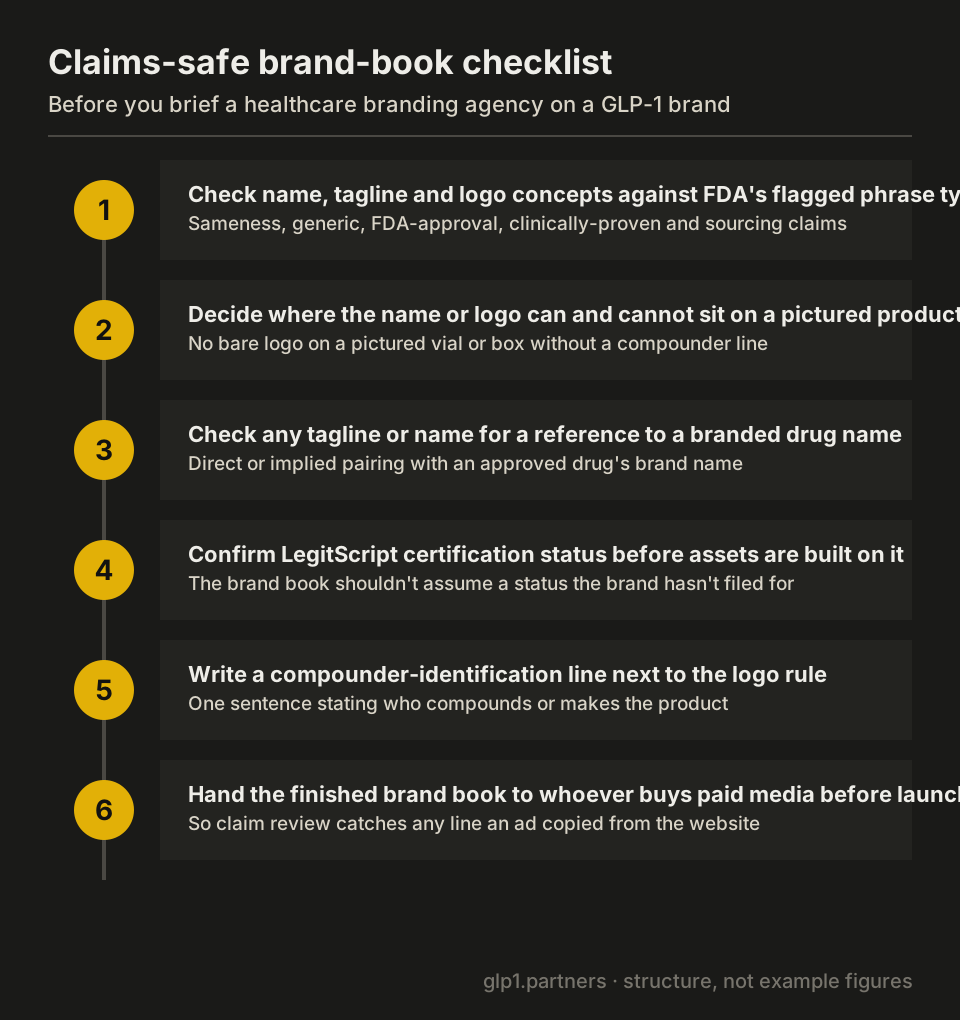
- List every name, tagline and logo concept against FDA’s flagged phrase types: sameness claims, “generic,” FDA approval, “clinically proven,” FDA-licensed sourcing, and labeling that makes the brand look like the compounder.
- Decide where the name or logo can and cannot appear. Set a rule now: no bare logo on a pictured vial, box or label without a line identifying who actually compounds or makes the product.
- Check any tagline or name for a reference to a branded drug, direct or implied. If it pairs your brand with an approved drug’s name, it stays out of the brand book.
- Confirm your LegitScript certification status, or where the application stands, before the brand book is built around a badge or claim the brand hasn’t earned yet.
- Write the compounder-identification line into the brand book itself, next to the logo-placement rule, so every designer and photographer sees it before a product shot goes out.
- Hand the finished brand book to whoever will buy paid media before launch creative starts, so claim review catches any line an ad borrowed from the website before it runs, not after.
- Re-check the brand book after each new FDA warning-letter wave. Our compounded GLP-1 advertising claims page tracks new phrases as FDA cites them.
FAQ
What does a healthcare branding agency do?
A healthcare branding agency builds a company’s name, visual identity, messaging and brand guidelines. For a GLP-1 telehealth brand, that work also sets what later becomes an FDA misbranding risk or a paid-media approval problem, so the brand book needs a claims check before it ships.
How much does a healthcare branding agency cost?
Costs vary widely by scope. One agency, Ramotion, puts its own healthcare branding projects at “$30,000 to $100,000+, depending on the depth of services and organization size,” with timelines from 4 to 6 weeks for basic branding and 8 to 16 weeks or more for comprehensive branding. That is one agency’s own range, not a market average. Get quotes from a few agencies with telehealth experience before setting a budget.
What is the difference between a healthcare branding agency and a healthcare marketing agency?
Branding builds the name and trust signals a GLP-1 brand launches with. Marketing, specifically paid media, buys the traffic that turns those signals into new patients. Our healthcare marketing agency types guide covers both, along with the other four agency types a telehealth brand might hire.
Sources
- FDA, FDA Warns 30 Telehealth Companies Against Illegal Marketing of Compounded GLP-1s (March 3, 2026) · accessed
- FDA, FDA to Telehealth Companies: What to Know When Promoting Compounded Drugs (content current as of June 15, 2026) · accessed
- FDA warning letter, Trinity HealthCare Supply LLC dba altRx, MARCS-CMS 728236 (June 8, 2026) · accessed
- FDA warning letter, Momentum Health 360 dba Momentum Health, MARCS-CMS 728286 (June 8, 2026) · accessed
- FTC, Health Products Compliance Guidance · accessed
- LegitScript, Certification Applications Rise 59%, Led by 101% Growth in Telemedicine (September 22, 2026) · accessed
- Meta Transparency Center, Advertising Standards: Drugs and Pharmaceuticals · accessed
- Ramotion, Healthcare Branding (cost range, one agency's own example) · accessed