A performance marketing agency buys paid media and manages partner traffic against a number you can count, such as cost per first paid order, and is judged on that number. For a GLP-1 telehealth brand, the agency also works inside platform approvals, LegitScript certification and claim rules that a general agency rarely meets.
What a performance marketing agency does
A performance marketing agency plans, buys and tunes campaigns where each dollar is tied to a measured action. The work is the same across verticals. In GLP-1 telehealth each task carries an extra layer:
| Agency task | What it means in general | What it adds for a GLP-1 telehealth brand |
|---|---|---|
| Channel plan | Which networks get budget first | Only channels that accept the brand’s offer and certification |
| Media buying | Bids, budgets, audiences, pacing | Health targeting limits and Rx ad rules shape every audience |
| Creative testing | New ads every week, losers cut fast | Every ad passes claim review before it runs |
| Tracking | Pixels, conversion events, attribution | Events stay inside each platform’s health data rules |
| Partner traffic | Affiliates, influencers, publishers | Partners follow the brand’s claims sheet too |
| Reporting | Spend and results against the target | Results checked against the brand’s own order data |
Spend is moving this way. IAB’s Internet Advertising Revenue Report, conducted by PwC and released April 16, 2026, put 2025 digital ad revenue at $294.6 billion, up 13.9% from 2024. Social media grew fastest, up 32.6% to $117.7 billion. IAB CEO David Cohen said: “This revenue growth reflects a market that has reoriented around performance channels.”
How the GLP1.partners media team runs performance marketing
GLP1.partners is a performance network for US GLP-1 telehealth brands, and we also run performance campaigns for brands in other verticals. We run GLP-1 and telehealth traffic at scale with platform approvals on every network we buy. For a GLP-1 brand that looks like this:
- Meta: established agency accounts built for GLP-1 scale, with a dedicated Meta agency contact. The brand brings its LegitScript certification.
- Outbrain: established Outbrain accounts with a dedicated setup for GLP-1.
- TikTok: creative made for the format and its ad rules.
- Partners: Instagram influencers, our own comparison sites and an affiliate network we manage.
- One target: the brand sets it, approves every ad, and gets a weekly report by channel against it.
We agree the conversion event with the brand before the budget, because a report only works when both sides count the same thing. See what this looks like on our GLP-1 performance marketing page.
Performance marketing agency vs brand agency
A performance marketing agency is paid to produce counted actions now. A brand agency builds how people see the company over time: name, identity, positioning, awareness. A telehealth brand usually needs both, at different stages.
| Performance marketing agency | Brand agency | |
|---|---|---|
| Main job | New customers at a target cost | Identity, positioning, awareness |
| Typical work | Paid social, native, search, affiliates, influencers | Naming, visual identity, messaging, campaigns |
| Measured by | Cost per event, return on spend, volume | Awareness, recall, sentiment |
| Time to signal | Days to weeks | Months to quarters |
| In GLP-1 telehealth | Runs inside platform approvals and claim rules | Sets the brand promise the ads must stay within |
| Risk if used alone | Efficient spend on an offer that looks like every rival | A strong brand with no steady patient flow |
GLP-1 telehealth brands often sell close variations of the same service, so price, speed and trust decide who wins the click. A brand agency helps when the offer can’t be told apart from rivals. A performance agency helps once the offer is set and the brand needs volume at a known cost.
Channels a performance marketing agency runs for GLP-1 brands
A performance marketing agency for a GLP-1 brand picks channels by what each network accepts, then by cost. The platform gates come first:
- Meta. Meta’s Drugs and Pharmaceuticals policy says “Meta requires online pharmacies and telehealth providers to be actively certified with LegitScript.” After certification, the brand requests authorization from Meta. The policy lists the United States, Canada and New Zealand as eligible countries.
- Google. Google Partner status rates how an agency manages accounts. It says nothing about healthcare eligibility. A Google Partner needs a 70% optimization score, $10,000 in ad spend across managed accounts over 90 days, and at least 50% of account strategists certified. Premier Partner status goes to the top 3% of participating companies in a country. The brand’s own healthcare certification still applies.
- Native and other networks. Outbrain, Taboola, TikTok and AppLovin each publish their own health rules. Our GLP-1 media buying guide covers what each channel needs before spend starts.
- Partners. Affiliates, comparison sites and influencers add volume, and the brand still answers for what they say.
Policy checked on November 2, 2026.
How KPIs are agreed with a performance marketing agency
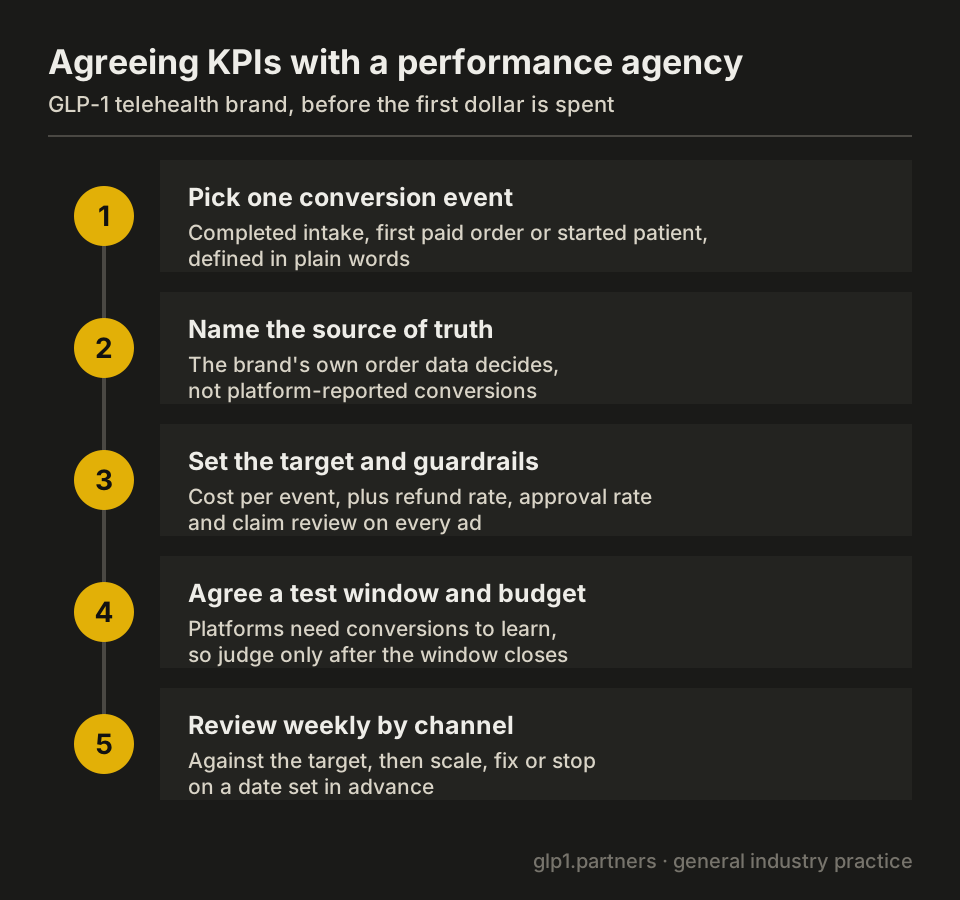
KPIs with a performance marketing agency are agreed in five steps, shown in the diagram above: one conversion event, one source of truth, a target with guardrails, a test window, and a fixed review. For a telehealth brand the event choice matters most, because the funnel has several paid steps.
| Conversion event | What it measures | Upside | Watch out for |
|---|---|---|---|
| Completed intake | A visitor finished the medical questionnaire | Fast signal, high volume | Many intakes never become paying patients |
| First paid order | The patient paid for the first month or consult | Ties spend to revenue | Refunds and declined cases lag by days |
| Started patient | The prescription was approved and shipped | Closest to real value | Slow signal, low volume for platform learning |
| Refill or month 2 | The patient stayed on the program | Shows quality of traffic | Weeks of delay before you can judge |
Points to write into the agreement:
- The event and its definition in plain words, such as “first paid order, net of refunds within 14 days.”
- The source of truth. The brand’s order data decides, not platform-reported conversions.
- Guardrails next to the cost target: refund rate, approval rate, and no ad running without claim review.
- The test window and budget before anyone judges the result. Platforms need conversions to learn.
- The review rhythm. A weekly report by channel, and a set date to scale, fix or stop.
The full GLP-1 funnel is mapped in our GLP-1 patient journey guide. How public telehealth companies report acquisition cost is in our telehealth customer acquisition cost guide.
Common fee models for performance marketing agencies
Performance marketing agencies charge in a few standard ways. These are general industry models, and each suits a different stage:
| Fee model | How it works | Good fit when | Trade-off |
|---|---|---|---|
| Flat retainer | A fixed monthly fee for a defined scope | Scope and spend are steady | Fee doesn’t move with results |
| Percentage of ad spend | The fee rises with the media budget | Spend is growing across channels | Can reward spending more over spending better |
| Performance-based (per event or revenue share) | The agency earns per counted event or a share of revenue | The conversion event is clean and trusted by both sides | Disputes over what counted; agency may avoid slow-learning channels |
| Hybrid | A lower base plus a bonus tied to the target | Both sides want shared risk | More terms to define and audit |
In telehealth, a performance-based fee only works if both sides trust the event. A brand that counts started patients and an agency that counts intakes will argue every invoice. Settle the KPI table above before the fee model.
Compliance a performance agency shares with a telehealth brand
A performance agency that writes or runs GLP-1 ads shares the legal risk of those ads. The FTC’s Health Products Compliance Guidance says: “Anyone participating in deceptive marketing is potentially liable under FTC law.” The same guidance lists ad agencies among the parties the FTC has acted against.
FDA is active in this category. On March 3, 2026, FDA announced 30 warning letters to telehealth companies over false or misleading claims about compounded GLP-1 drugs on their websites. An agency that writes “same as Ozempic” or calls a compounded drug FDA approved puts the brand’s whole account at risk.
What to expect from a performance agency on compliance:
- A claims sheet from the brand, used for every ad and partner.
- Review of each new ad before it goes live.
- Partner rules that match the brand’s, with monitoring after launch.
- Tracking set up within each platform’s health data limits.
Step-by-step: hiring a performance marketing agency
Hiring a performance marketing agency for a GLP-1 telehealth brand works best in this order, so the target is fixed before the fee:
- Decide the stage. If the offer looks like every rival’s, fix positioning first. If the offer is set and you need volume, hire for performance.
- Write down your numbers: current cost per first paid order, refund rate and monthly volume.
- Confirm your LegitScript certification and platform authorizations, since they decide which channels can start.
- Ask each agency which event it would optimize to and which data decides.
- Ask for its claim review process and its rules for partners.
- Agree the KPI table, guardrails and test window in writing.
- Choose the fee model last, once the event is trusted by both sides.
- Start with a test budget and judge it on your own order data.
Questions to ask on the first call are in our GLP-1 marketing agency checklist.
FAQ
What does a performance marketing agency do?
A performance marketing agency buys and tunes paid media and partner traffic against a counted goal, such as cost per order. For a telehealth brand it also handles platform approvals, claim review and tracking that respects health data rules.
What is the difference between performance marketing and brand marketing?
Performance marketing is judged on counted actions in days or weeks. Brand marketing is judged on awareness and how people see the company over months. Most telehealth brands use both.
Are the best performance marketing companies the ones that rank themselves first?
Many “best performance marketing companies” lists are written by agencies that put themselves at the top. Judge an agency on how it defines the conversion event, how it reviews claims and how it reports against your own data.
How much does a performance marketing agency cost?
Agencies charge a flat retainer, a percentage of ad spend, a performance-based fee or a hybrid. The right model depends on how clean your conversion event is. Terms vary by agency and are set case by case.
Sources
- IAB, Digital Ad Revenue Climbs to Nearly $300B as IAB Celebrates 30 Year Anniversary (April 16, 2026; IAB/PwC Internet Advertising Revenue Report, full year 2025) · accessed
- Google Ads Help, Google Partners program requirements (70% optimization score, $10,000 90-day spend, 50% of strategists certified, Premier = top 3%) · accessed
- Meta Transparency Center, Advertising Standards: Drugs and Pharmaceuticals · accessed
- FTC, Health Products Compliance Guidance · accessed
- FDA, FDA Warns 30 Telehealth Companies Against Illegal Marketing of Compounded GLP-1s (March 3, 2026) · accessed