GLP-1 stands for glucagon-like peptide-1. It is a hormone made in the gut, named because its amino-acid chain resembles the hormone glucagon, and the “1” marks it as the first of two such peptides coded by the same gene. The name GLP-1 was first used in 1983, and today GLP-1 also names a class of prescription drugs.
GLP-1 at a glance
| Question | Answer |
|---|---|
| Full form of GLP-1 | Glucagon-like peptide-1 |
| Pronunciation | “jee-el-pee-WUN” (Merriam-Webster) |
| Part of speech | Abbreviation or noun; plural GLP-1s |
| First known use of “GLP” | 1983 (Merriam-Webster) |
| First known use of “glucagon-like peptide” | 1973 (Merriam-Webster) |
| Paper that introduced the GLP-1 name | Bell, Santerre and Mullenbach, Nature, 1983 |
| What GLP-1 means today | The gut hormone, and in everyday use the drugs that act on its receptor |
| Sister terms | GLP-2, GLP-1 receptor agonist (GLP-1 RA), GIP |
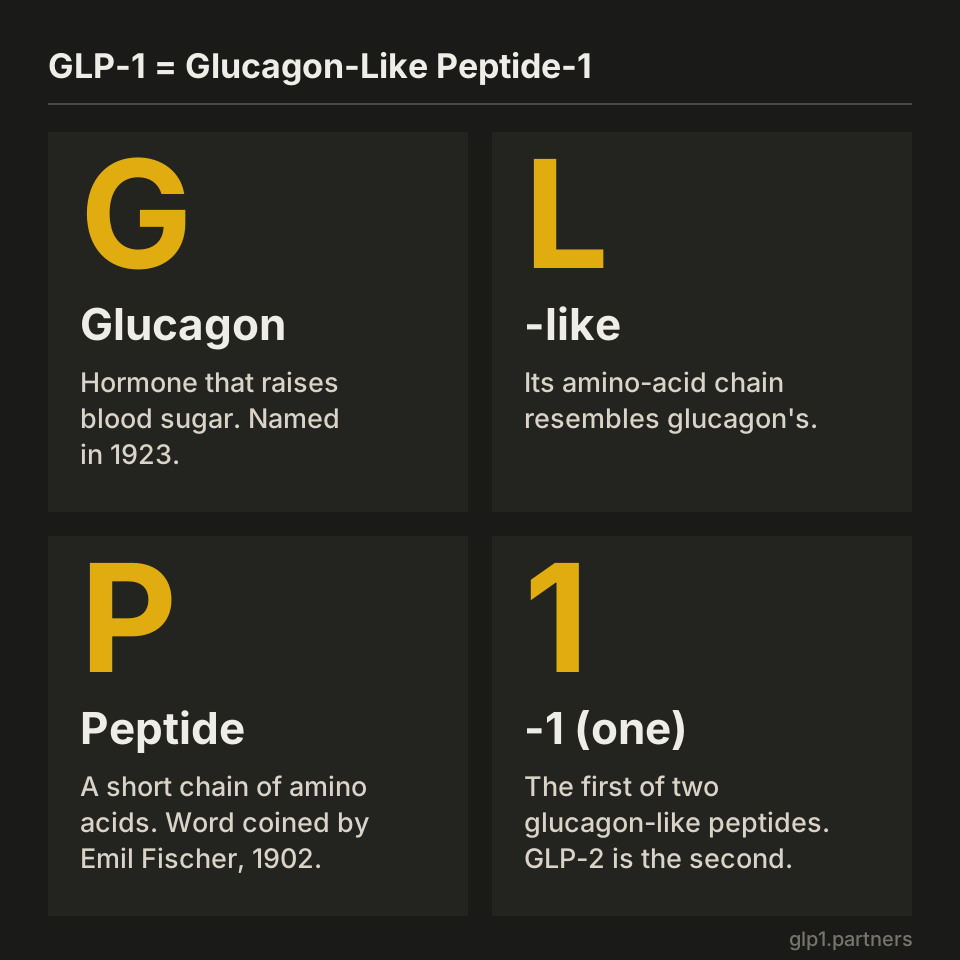
What GLP-1 stands for, word by word
Each part of the name glucagon-like peptide-1 has its own history. Three of the four parts are older than GLP-1 itself by decades.
Glucagon: the “G” in GLP-1
Glucagon is the pancreatic hormone that raises blood sugar. The word was introduced in 1923 by John R. Murlin and his student Charles P. Kimball at the University of Rochester, in a Journal of Biological Chemistry paper on extracts of the pancreas. They were trying to purify insulin and found a fraction that pushed blood sugar up instead of down.
Two explanations of the word glucagon exist:
- The popular one: “glucagon” is short for “glucose agonist,” a substance that pushes glucose up. The Journal of Endocrinology repeats this in its 2023 piece marking 100 years of glucagon.
- The dictionary one: Merriam-Webster traces glucagon to “gluc-” plus the Greek ágōn, a form of ágein, “to bring, lead.” Read that way, glucagon is “the thing that brings glucose.”
Both readings land on the same meaning: a hormone that raises glucose. GLP-1 borrows the name because it looks like glucagon on paper, even though it does a very different job.
“-like”: the “L” in GLP-1
“Like” is the oldest and plainest part of the name. Since the 1960s, researchers had measured material in gut extracts that reacted with glucagon antibodies but was not pancreatic glucagon. Roger Unger’s lab called it “glucagon-like immunoreactivity,” or GLI. “Glucagon-like” became the label for any peptide that shared part of glucagon’s amino-acid sequence. GLP-1 earned it because its chain lines up closely with glucagon’s.
Peptide: the “P” in GLP-1
A peptide is a short chain of amino acids, smaller than a protein. The German chemist Emil Fischer coined Peptid in 1902. He built it from “peptone,” a product of protein digestion, which comes from the Greek peptós, “digested” (the stomach enzyme pepsin shares the root). Merriam-Webster dates the first known English use of “peptide” to 1906 and lists its origin as “from peptone.”
The number 1 in GLP-1
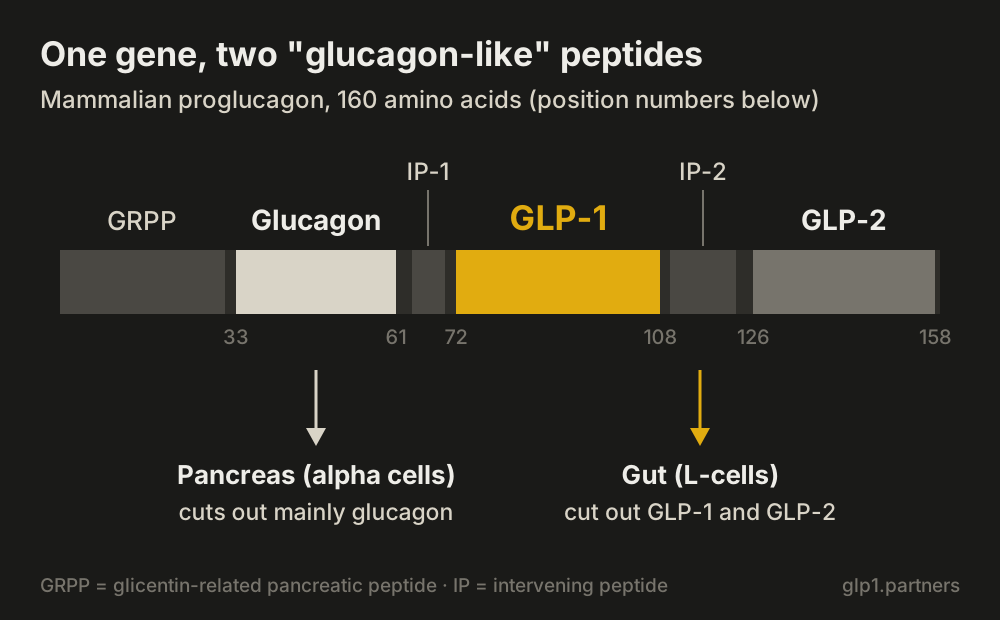
The “1” is a counter, not a version number. When scientists read the glucagon gene, they found two glucagon-like sequences in a row after glucagon itself. The first became GLP-1 and the second GLP-2. GLP-2 acts mainly on the lining of the intestine and has little effect on insulin.
The dictionary definition of GLP-1
Merriam-Webster lists GLP as an “abbreviation or noun” with two senses. Sense “a,” GLP-1, is the hormone that “stimulates insulin secretion, inhibits glucagon secretion, slows the movement of stomach contents into the small intestine, and promotes feelings of satiety.” Sense “b,” GLP-2, stimulates cell growth in the intestinal lining.
The same dictionary keeps a separate entry for the spelled-out phrase “glucagon-like peptide,” with the same two senses. Its date for that phrase, 1973, is ten years earlier than its date for the abbreviation GLP, 1983. The gap makes sense. Researchers wrote about “glucagon-like” peptides in the gut long before anyone knew their exact sequences, and the short form GLP-1 only appeared once the gene was read.
In plain words, the literal meaning of GLP-1 is “the first peptide that looks like glucagon.” The working meaning is “the gut hormone released after a meal that tells the pancreas to release insulin and tells the brain you are full.”
When the term GLP-1 was first used
GLP-1 was first named in 1983, in a Nature paper by Graeme Bell, R. F. Santerre and G. T. Mullenbach. They cloned the hamster glucagon gene and found that it held glucagon plus “two related peptides.” The name went through several versions before GLP-1 settled.
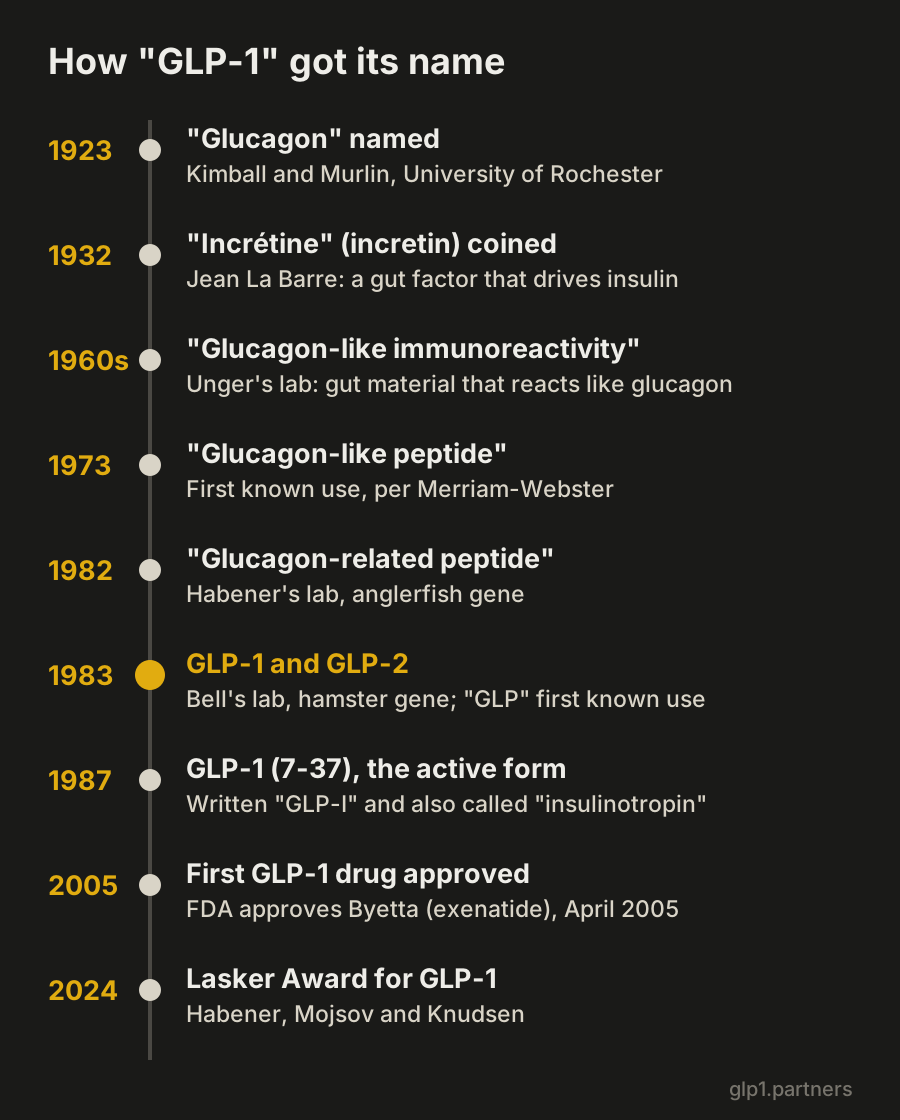
| Year | Term in use | What happened |
|---|---|---|
| 1923 | Glucagon | Kimball and Murlin name the blood-sugar-raising factor in pancreas extracts |
| 1932 | Incrétine (incretin) | Belgian physiologist Jean La Barre names a gut factor that lowers blood sugar through the pancreas |
| 1960s | Glucagon-like immunoreactivity (GLI) | Unger’s lab detects glucagon-like material in the gut |
| 1973 | Glucagon-like peptide | First known use of the phrase, per Merriam-Webster |
| 1982 | Glucagon-related peptide | Joel Habener’s lab reads the anglerfish glucagon gene and finds an extra 34-amino-acid peptide |
| 1983 | GLP-1, GLP-2 | Bell’s lab reads the hamster gene; the peptide is renamed glucagon-like peptide 1 |
| 1986 | GLP-1 (7-37) | Svetlana Mojsov and Habener’s group find the shorter, active form made in the intestine |
| 1987 | GLP-I, “insulinotropin” | Papers write the name with a Roman numeral; one calls the hormone “insulinotropin” |
| 2005 | GLP-1 receptor agonist | FDA approves Byetta (exenatide), the first GLP-1 drug in the US |
| 2024 | GLP-1 | Habener, Mojsov and Lotte Bjerre Knudsen share the Lasker Award for GLP-1 drugs |
Two details in the timeline explain spellings you still see. The 1987 papers by Mojsov, Habener and Jens Juul Holst wrote “glucagon-like peptide I,” with a Roman numeral, and Mojsov, Weir and Habener’s paper title used the name “insulinotropin.” The Arabic “1” won, and “insulinotropin” dropped out of use.
The peptide named in 1983 also turned out not to be the active hormone. As the 2024 PNAS account of the Lasker Award puts it, the 1986 paper’s key finding was that the 37-amino-acid GLP-1 “may be a ‘prohormone’” for GLP-1 (7-37). The numbers in brackets give the positions in the chain, so GLP-1 (7-37) is the full peptide minus its first six amino acids.
How the meaning of GLP-1 changed: hormone, drug class, everyday word
For its first 20 years, GLP-1 meant one thing: a hormone that researchers studied. Since 2005 the term has stretched in three steps.
- The hormone (1983 onward). GLP-1 is the natural peptide your gut releases after eating. Its half-life in the blood is 1 to 2 minutes, according to the PNAS account, because enzymes and the kidneys clear it fast.
- The drug class (2005 onward). Drugs built to act on the GLP-1 receptor for much longer are “GLP-1 receptor agonists,” shortened to GLP-1 RAs or GLP-1 agonists. The first, exenatide (Byetta), is based on exendin-4, a peptide found in Gila monster saliva. Liraglutide followed in 2010, and semaglutide followed later.
- The everyday word (2021 onward). After the FDA approved Wegovy (semaglutide) for chronic weight management on June 4, 2021, “GLP-1” became shorthand for the whole category of weight-loss shots, and the plural “GLP-1s” appeared. Science named GLP-1 obesity drugs its 2023 Breakthrough of the Year. Merriam-Webster’s own example sentences now include “GLP-1s work by mimicking glucagon-like peptide-1,” quoted from Fortune in August 2026.
The everyday meaning is looser than the scientific one. Tirzepatide acts on two receptors (GIP and GLP-1) and is a “dual agonist,” yet people call it a GLP-1. On October 30, 2026, Google autocomplete, as logged by our search radar, suggested “tirzepatide a glp1” and “is orforglipron a glp1.” In common speech, “a GLP-1” now means “a drug in this family,” whatever its exact chemistry.
GLP-1 spellings and variants
The correct scientific form is GLP-1, with a hyphen and an Arabic numeral. You will also see:
- GLP1 and GLP 1: the same term without the hyphen, common in search queries and hashtags
- GLP-I: the older Roman-numeral form from 1980s papers
- GLP-1 RA, GLP-1 agonist, GLP-1 receptor agonist: the drug class
- GLP-1s: the informal plural for the drugs
- Glucagon-like peptide 1 or glucagon-like peptide-1: the spelled-out name, with or without the second hyphen
Searchers type all three forms for the same thing. That matters if you buy keywords or write page titles, as covered below.
GLP-1 is not the same as GLP or GLP-2
Several terms share the letters GLP. In our autocomplete logs, queries like “why glp is important” and “glp labeling requirements” sit next to GLP-1 queries.
| Term | What it means | Field |
|---|---|---|
| GLP-1 | Glucagon-like peptide-1, the gut hormone and its drug class | Biology, medicine, marketing |
| GLP-2 | Glucagon-like peptide-2, the second peptide from the same gene | Biology |
| GLP | Good Laboratory Practice, the FDA rules for nonclinical lab studies (21 CFR Part 58) | Regulation, research labs |
| GIP | Glucose-dependent insulinotropic polypeptide, the other incretin hormone | Biology; tirzepatide targets it with GLP-1 |
A page or ad that writes “GLP” without the “-1” can be read as Good Laboratory Practice. Keep the number.
Why the meaning of GLP-1 matters to GLP-1 marketers
For a telehealth brand or affiliate, GLP-1 is both a medical term and the name of your market, and the two meanings pull in different directions.
- Ad copy. In an ad, “GLP-1” reads as a reference to prescription weight-loss drugs, not to a hormone. Before you put the word in a headline, check the platform’s prescription drug rules. Our guide to Meta’s prescription drug ad policy for GLP-1 brands covers what Meta requires.
- Search intent. People who type “what does glp-1 stand for” are mostly curious, not shopping. Our autocomplete logs show the definition query sitting next to “why are glp 1 ads everywhere” and “glp 1 meaning in business,” which tells you how visible GLP-1 advertising has become. Definition traffic builds awareness; comparison and provider queries are where buyers are. Our GLP-1 marketing strategy guide maps queries and channels to funnel stages.
- Keyword variants. GLP-1, GLP1 and GLP 1 are one topic. Cover them on one page per question; three near-identical pages for three spellings add nothing.
- Category drift. Because the public calls every drug in the family “a GLP-1,” affiliates and publishers now use the word as a vertical name, like “finance” or “insurance.” See why affiliates are moving to GLP-1 for the publisher side.
GLP1.partners is a US performance network for GLP-1 telehealth brands. We use the word every day in its third, commercial sense, and we help brands grow through paid media and affiliates.
FAQ
What does GLP-1 stand for in medical terms?
In medical terms GLP-1 stands for glucagon-like peptide-1, a hormone released by L-cells in the gut after a meal. In current clinical and everyday use, “GLP-1” also refers to GLP-1 receptor agonist drugs such as semaglutide and liraglutide.
Who discovered GLP-1?
No single person discovered GLP-1. Joel Habener’s lab found a “glucagon-related peptide” in anglerfish in 1982. Graeme Bell’s lab named GLP-1 from the hamster gene in 1983. Svetlana Mojsov and Habener identified the active form, GLP-1 (7-37), in 1986, with Jens Juul Holst’s group reporting similar findings in 1987.
Why is it called “glucagon-like”?
GLP-1 is called glucagon-like because its amino-acid sequence closely resembles glucagon’s and both come from the same gene, proglucagon. Their jobs differ: glucagon raises blood sugar, while GLP-1 helps lower it after meals by triggering insulin release.
What does the 1 in GLP-1 mean?
The 1 means GLP-1 is the first of two glucagon-like peptides that follow glucagon in the proglucagon gene. The second one is GLP-2.
Is GLP-1 a word in the dictionary?
Yes. Merriam-Webster lists GLP-1 under the abbreviation GLP, with a first known use of 1983, and has a separate entry for “glucagon-like peptide” dated 1973.
How do you pronounce GLP-1?
GLP-1 is pronounced letter by letter, “jee-el-pee-one,” with the stress on “one,” per Merriam-Webster.
Sources
- Merriam-Webster, glucagon-like peptide (entry, first known use 1973) · accessed
- Merriam-Webster, GLP (abbreviation entry incl. GLP-1, first known use 1983) · accessed
- Merriam-Webster, glucagon (entry, etymology and 1923 note) · accessed
- Merriam-Webster, peptide (entry, first known use 1906) · accessed
- Friedman J.M., The discovery and development of GLP-1 based drugs that have revolutionized the treatment of obesity, PNAS 121(39), September 19, 2024 · accessed
- Journal of Endocrinology, 100 years of glucagon anniversary (2023) · accessed
- McGill Office for Science and Society, on the origin of the word peptide · accessed
- Rehfeld J.F., The Origin and Understanding of the Incretin Concept, Frontiers in Endocrinology (2018) · accessed
- Holst J.J., Gut glucagon, enteroglucagon, gut glucagonlike immunoreactivity, glicentin: current status, Gastroenterology (1983) · accessed
- FDA, NDA 021773/S045 Byetta (exenatide) review: first GLP-1 RA, approved in the US April 28, 2005 · accessed
- Novo Nordisk, Wegovy (semaglutide 2.4 mg) approved in the US (June 4, 2021) · accessed
- Science, 2023 Breakthrough of the Year (December 14, 2023) · accessed
- Lasker Foundation, 2024 Lasker Award winners (via EurekAlert, September 19, 2024) · accessed
- eCFR, 21 CFR Part 58, Good Laboratory Practice for Nonclinical Laboratory Studies · accessed